Cold Frame – A Fast Start To The Growing Season

Cold Frame - A Fast Start To The Growing Season

A cold frame is a bottomless box with a salvaged window on top. No electricity. No heater. About fifteen dollars in lumber and a window someone threw away.

The glass traps solar heat and raises the temperature inside enough to start crops six weeks before last frost and keep them going six weeks past first frost. Three extra months of food from a box you can build in an afternoon.

The whole thing is four boards screwed together with the back taller than the front so the glass slopes toward the sun. The window sits on top — hinged or just resting there. The box sits directly on soil. That’s the entire build.

What grows inside one:
– Lettuce — cut-and-come-again greens starting in early March
– Spinach — stays cool enough that it won’t bolt
– Radish — ready in under a month, sow a new row every two weeks
– Kale — frost actually sweetens the flavor
– Carrots — slow but protected from freezing soil

The one thing that kills seedlings in a cold frame isn’t cold — it’s heat. On sunny days the interior climbs fast. Prop the window open with a stick when it’s warm and close it at sunset.

Four boards, one window, twenty screws. Your cold climate neighbors are still waiting for late spring.

Trench Composting II

Trench Composting
A trench filled with kitchen scraps and buried under soil becomes the richest planting row in your garden — and it costs nothing.
Trench composting skips the compost bin entirely. No turning. No waiting. No smell. You bury raw kitchen scraps directly in the ground, cover them with soil, and plant heavy-feeding crops on top within a few weeks.
🌱 How to build a trench row:
1. Dig a trench about twelve inches deep and as long as your garden row
2. Fill the bottom four to six inches with kitchen scraps — banana peels, coffee grounds, eggshells, vegetable trimmings, fruit cores
3. Cover with six to eight inches of soil so the scraps are fully buried with no exposed material. Done
4. Wait two to three weeks. Earthworms find the buried scraps and begin composting underground. The trench attracts significantly more worms than surrounding soil and they produce castings that deliver nutrients exactly where roots will need them
5. Plant directly into the soil above the trench. Any heavy feeder works — squash, tomatoes, corn, cucumbers, pumpkins, and melons all thrive above a buried trench because the decomposing layer provides slow-release fertility all season
One trench absorbs months of household kitchen waste and diverts it from the landfill into your soil.
By midsummer the trench layer is fully broken down into dark crumbly humus that holds moisture like a buried sponge. The plants above it grow noticeably bigger than the same varieties in untreated soil.
Rotate your trench to a new row each year. After three seasons every row in your garden has been deep-fed — and your fertilizer costs drop to nearly nothing

Natural Fertilizer

Natural Fertilizer

Most gardeners know about compost — but some of the best fertilizers are already in your kitchen, hiding in plain sight.
 Six household sources and what they feed:
– Wood ash — rich in potassium and calcium. A light dusting around the base feeds garlic, carrots, lavender, and clematis. Avoid using it near acid-loving plants like blueberries — it raises soil pH
– Epsom salt — magnesium sulfate that supports chlorophyll production. A tablespoon per gallon of water can help roses, tomatoes, peppers, and strawberries — especially in soils that tend to run low in magnesium
– Cooking water — the starchy mineral-rich water left from boiling pasta or vegetables is a gentle liquid feed. Let it cool completely, then pour it over basil, ferns, lettuce, or houseplants
– Seaweed — fresh or dried, it delivers trace minerals that most garden soils lack. Lay it around potatoes, corn, fruit trees, or dahlias as mulch, or steep it into a liquid tea for a concentrated feed
– Fish scraps — heads, bones, and skin break down into a nitrogen-rich feast. Bury them about twelve inches deep near heavy feeders like cabbage, sunflowers, squash, and sweet corn. Deep burial keeps animals from digging them up
– Spent mushroom compost — growing medium from mushroom farms is loaded with slow-release nutrients and improves soil structure. Spread it around asparagus, rhubarb, herbs, and perennial flower beds for steady feeding all season.
Every kitchen already produces plant food. It just takes knowing which source feeds which root.

Core Raised Garden Beds

Core Raised Garden Beds

Most raised beds lose water straight down through the soil. Roots chase it, the surface dries out, and by midsummer you are watering every single day just to keep up.

A core garden buries a sponge down the center of the bed. A trench eight to ten inches deep runs the full length, filled with four to five inches of straw or dried leaves. When you soak that core, it absorbs water the way a sponge absorbs from a bowl — then releases it laterally through the soil, reaching roots up to two feet on either side. Instead of water draining straight past the root zone, it sits in the middle of the bed and feeds outward all week.

The method originated in arid regions where rainfall was scarce and every drop had to count. Gardeners dug trenches, packed them with dried grass, and covered them with soil. The buried organic layer held enough moisture to grow food through dry stretches without daily irrigation. The same principle works in any raised bed — and unlike a wicking bed, there is no liner, no plumbing, and no reservoir to build. You dig a trench, fill it, cover it, charge it with water, and plant the same day.

How to build a core garden bed:
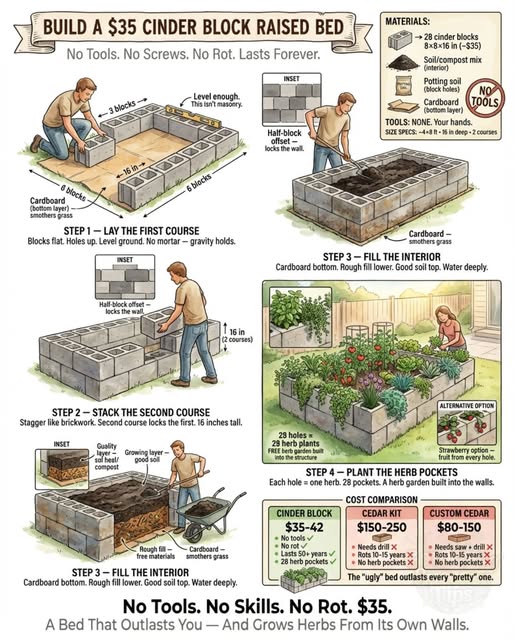
1. Lay cardboard on the grass inside your raised bed frame to smother weeds and attract earthworms as it decomposes. Add a few inches of soil over the cardboard to create a base layer

2. Dig a trench eight to ten inches deep running horizontally down the center of the bed. Keep the excavated soil nearby — you will use it to cover the core

3. Fill the trench with four to five inches of partially broken-down straw, dried leaves, or shredded grass clippings. Straw works best because hay carries grass seeds that will sprout in your bed. Do not overfill — too thick a core will not decompose by next season

4. Cover the core completely with quality topsoil or compost so no straw is exposed. The surface should look like any normal raised bed — the sponge is invisible underneath

5. Charge the core by flooding the bed with a deep, slow watering until the soil is saturated down to the straw layer. This is the step that activates the system — a dry core does nothing. After charging, plant immediately and mulch the surface.

The straw breaks down over one season, loosening soil structure and adding organic matter as it goes. Each spring, dig a new trench and lay a fresh core. The bed gets lighter, drains better, and holds more moisture every year — all from burying material most people rake to the curb.

A trench, some straw, and one deep watering — the bed holds moisture the way soil alone never could.

Reducing Transplant Trauma

Transitioning slowly from seedling tray to garden bed.

Seedling Tray To Garden Bed

Those seedlings you grew under lights look perfect on the windowsill. Put them straight into the garden and they’ll stall — pale leaves, wilting stems, weeks of recovery before they grow again.

The bridge between indoors and outdoors takes about a week. Here’s the short version.

The schedule:
– Days one and two — set the tray outside in full shade for an hour or two, then bring them back in. The wind alone starts thickening the stems. Indoor seedlings have never felt moving air, and the stems respond by building structural cells they didn’t need before

– Day three — move to dappled light under a tree canopy for a few hours. The leaves start developing a protective waxy layer they couldn’t build under grow lights, which put out almost no UV

– Day four — gentle morning sun only, a few hours. Move to shade before afternoon intensity. Morning light is significantly softer than afternoon light and gives the leaves time to adjust

– Day five — full sun for most of the day. By now the seedlings look visibly different from where they started — shorter, stockier, darker green, thicker stems

– Day six — leave the tray outside from sunrise to sunset. Bring inside at night

– Day seven — first overnight outdoors. The cool night temperature triggers a final toughening response in the cell walls

Day eight — transplant into the garden. Water deeply. Mulch around the stem.

The seedlings that went through this week hit the ground growing. The ones that skip it spend three weeks catching up. A week of patience on the porch saves a month in the bed.

That’s the whole schedule. Shade to sun. Gradual. One week

Succession Planting

Succession Planting

Your raised bed sits empty from October to April. That’s half the year producing nothing from the same soil, same space, same sun.
One bed can run three rounds in a season. Cool crops, warm crops, cool crops again — each round feeding the next.
🌱 Round one — spring:
Peas on the trellis, lettuce in rows, spinach in the gaps, radishes in every open inch. These crops want cold soil and finish by late May. When the peas come out, the nitrogen-fixing nodules stay behind in the roots — free fertilizer for what comes next.
Pull everything in late May. Add an inch of compost. Replant the same day.
Round two — summer:
Bush beans go in the pea spot and feed on the nitrogen the peas left. Cucumbers grab the same trellis. Basil fills the lettuce gaps and thrives in the heat that killed the greens.
This round finishes by late August. Same routine — pull, compost, replant within the week.
🌿 Round three — fall:
Kale goes in September and tastes better after frost converts its starches to sugar. Turnips give you a fast root crop with edible greens — two harvests from one plant. Garlic goes in October, roots before winter, and you harvest it the following June.
The bed carried food from March through November and has garlic overwintering for next year.
Three rounds. Same soil. Each crop leaves something behind for the one that follows — nitrogen, trellis infrastructure, loosened soil, residual compost. The bed gets more productive each cycle, not less.
Same square footage. Roughly triple the harvest.

Maximise Your Harvest Yield

Maximise Your Harvest Yield

Wrong exposure, halved harvest. Most gardeners plant wherever there is space — not wherever there is the right light — and then blame the compost.

Every crop has a precise light requirement. Too much sun scorches delicate leaves. Too little and fruit never ripens.

2 to 3 hours of sun is enough for lettuce, spinach, lamb’s lettuce, and parsley. The shade actually protects them from bolting in warm weather.

4 to 5 hours suits chard, brassicas, peas, and leafy herbs. These grow well with morning sun and afternoon shade — the classic pole-facing or partially shaded bed is often better for these crops than a full equator-facing position.

6 to 8 hours unlocks tomatoes, peppers, and courgettes. Without full sun, British-grown tomatoes stay green and flavourless, and peppers remain thin-walled. An equator-facing raised bed or a warm sheltered wall is essential for these crops in most of the UK.

8+ hours of direct sun is the requirement for pumpkins and squash, Mediterranean herbs such as rosemary, thyme, and sage, and sweet corn. These are the plants that genuinely need the most open, unshaded, sun-facing position available. Rosemary especially thrives in a hot dry sun-facing spot and resents shade.

Map the sun hours on your bed before deciding what to plant in it.

Trellis Types

Trellis Types

Each climbing vegetable needs a different support structure. The wrong match means broken stems, poor airflow, and fruit rotting on the ground.

Flat string trellises give tomatoes the vertical plane they need to spread heavy branches evenly.

A-frame designs let cucumbers hang freely underneath — the fruit grows straight and clean instead of curling on the soil.

Wire arches suit beans and peas perfectly. Their tendrils wrap thin wire far better than thick wood.

Heavy producers like squash or melons demand reinforced arches with fabric slings under each fruit. Without support, the weight tears the vine down mid-season.

The setup rule that saves your roots:
– Install your trellis before transplanting, not after — driving stakes near established roots damages the plant you’re trying to help
– Set the structure first, then plant about six inches from the base
– Anchor trellises on the north side of the bed so vertical crops don’t shade shorter plants to the south. (In the Northern Hemisphere. Reverse that in the Southern Hemisphere.)

One trellis per crop type. Get that right and vertical gardening stops being a gamble.