
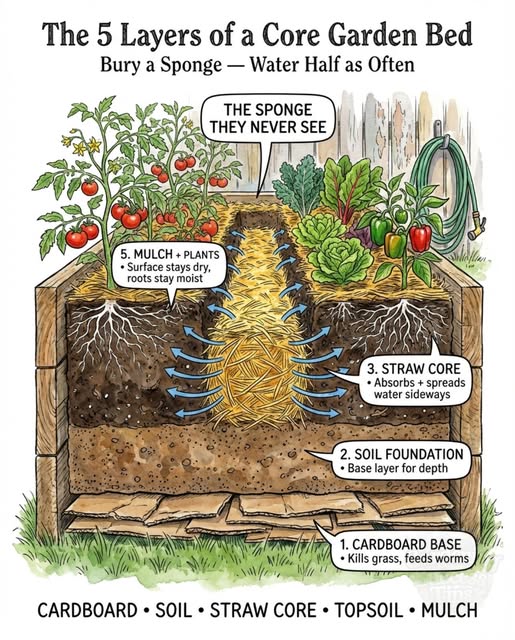
Most raised beds lose water straight down through the soil. Roots chase it, the surface dries out, and by midsummer you are watering every single day just to keep up.
A core garden buries a sponge down the center of the bed. A trench eight to ten inches deep runs the full length, filled with four to five inches of straw or dried leaves. When you soak that core, it absorbs water the way a sponge absorbs from a bowl — then releases it laterally through the soil, reaching roots up to two feet on either side. Instead of water draining straight past the root zone, it sits in the middle of the bed and feeds outward all week.
The method originated in arid regions where rainfall was scarce and every drop had to count. Gardeners dug trenches, packed them with dried grass, and covered them with soil. The buried organic layer held enough moisture to grow food through dry stretches without daily irrigation. The same principle works in any raised bed — and unlike a wicking bed, there is no liner, no plumbing, and no reservoir to build. You dig a trench, fill it, cover it, charge it with water, and plant the same day.
How to build a core garden bed:
1. Lay cardboard on the grass inside your raised bed frame to smother weeds and attract earthworms as it decomposes. Add a few inches of soil over the cardboard to create a base layer
2. Dig a trench eight to ten inches deep running horizontally down the center of the bed. Keep the excavated soil nearby — you will use it to cover the core
3. Fill the trench with four to five inches of partially broken-down straw, dried leaves, or shredded grass clippings. Straw works best because hay carries grass seeds that will sprout in your bed. Do not overfill — too thick a core will not decompose by next season
4. Cover the core completely with quality topsoil or compost so no straw is exposed. The surface should look like any normal raised bed — the sponge is invisible underneath
5. Charge the core by flooding the bed with a deep, slow watering until the soil is saturated down to the straw layer. This is the step that activates the system — a dry core does nothing. After charging, plant immediately and mulch the surface.
The straw breaks down over one season, loosening soil structure and adding organic matter as it goes. Each spring, dig a new trench and lay a fresh core. The bed gets lighter, drains better, and holds more moisture every year — all from burying material most people rake to the curb.
A trench, some straw, and one deep watering — the bed holds moisture the way soil alone never could.