
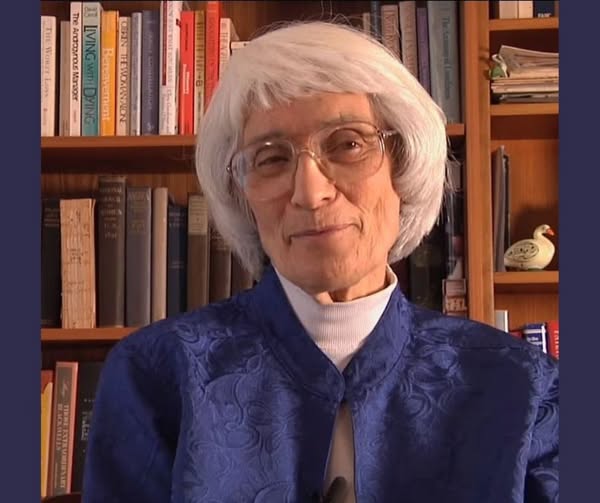
She was rejected for being “too strong for a woman”—so she walked into a library and found the footnote that would change the law for millions.
The year was 1969.
Bernice Resnick Sandler had just completed her doctorate at the University of Maryland. She had been teaching part-time in her department for years. She knew the faculty, she knew the students, and she knew the work inside and out. When seven full-time faculty positions opened up in her department, she applied.
She wasn’t considered for a single one.
She asked a faculty friend—someone she trusted who knew her work—why she hadn’t even been interviewed. He told her the truth, or at least his version of it: “Your qualifications are excellent,” he said. “But let’s face it—you come on too strong for a woman.”
She went home and cried. Then, she kept applying.
She applied to another institution, where the interviewer dismissed her as “just a housewife who went back to school.” She applied to a third, where the department chair told her they couldn’t hire her because her children might get sick and keep her at home—never mind that her daughters were already in high school.
She had a doctorate, years of teaching experience, a solid academic record, publications, and glowing references. None of it mattered. The real reason she was being turned away was simply that she was a woman. In 1969, that was enough to disqualify her and close every door.
At first, like many women of her generation, Bernice had been ambivalent about the women’s movement. She had half-believed the media’s description of its supporters as “radical” or “difficult.” But now, with three rejections and those five words echoing in her mind—“too strong for a woman”—something shifted. She was not going to accept this. She decided to find out if what they were doing was not just immoral, but illegal.
The Discovery in the Library
She started in the library, reading through law after law. She searched for any legal foundation that applied to sex discrimination in universities, but she found one closed door after another. The Civil Rights Act of 1964 covered race, but it specifically excluded educational institutions from its employment provisions. Title VII had similar exemptions.
Then, buried in a footnote at the bottom of a page, she found it.
She was reading a report from the U.S. Commission on Civil Rights regarding race-based antidiscrimination laws. The footnote referenced Executive Order 11246, signed by President Lyndon Johnson in 1965, which prohibited federal contractors from discriminating based on race, color, religion, and national origin.
But the footnote also noted that in 1967, Johnson had signed Executive Order 11375, an amendment that added “sex” to the list of protected classes. It had gone into effect in October 1968.
“Even though I was alone,” Sandler later wrote, “I shrieked aloud with my discovery.”
She realized that most colleges and universities held federal contracts for research and student aid. This made them federal contractors, meaning they were now prohibited by law from discriminating on the basis of sex. Virtually every university in America was breaking federal law.
Changing the System
Bernice Sandler didn’t just notice the connection; she acted on it. She contacted the Department of Labor and spoke with Vincent Macaluso, who had been waiting for someone to use the executive order this way.
Partnering with the Women’s Equity Action League (WEAL), Sandler filed a class-action complaint in January 1970 against every university and college in the United States. She also filed over 250 individual charges against specific institutions, collecting testimony from women across academia who had been passed over for tenure or paid less than male colleagues.
This massive effort caught the attention of Congress. Representative Edith Green held landmark hearings on sex discrimination, with Sandler providing the evidence to show that this discrimination was structural and deliberate. Alongside Representative Patsy Mink and Senator Birch Bayh, the groundwork for new legislation was laid.
The strategy was to keep the bill quiet to avoid drawing organized opposition. It worked. On June 23, 1972, President Richard Nixon signed Title IX of the Education Amendments of 1972 into law.
Thirty-Seven Words
The law consisted of just thirty-seven words:
“No person in the United States shall, on the basis of sex, be excluded from participation in, be denied the benefits of, or be subjected to discrimination under any education program or activity receiving Federal financial assistance.”
Those thirty-seven words transformed American life. Title IX opened medical schools, law schools, and engineering programs. It protected students from sexual harassment and gave girls the right to play sports and compete for athletic scholarships.
Every woman who has graduated as a doctor, engineer, or attorney since 1972 walked through doors that Bernice Sandler helped push open.
A Lasting Legacy
Bernice didn’t stop there. She directed the Project on the Status and Education of Women for twenty years and coined the phrase “the chilly campus climate“ to describe the subtle ways women were still discouraged in academia. She gave over 2,500 presentations on gender equity and was eventually inducted into the National Women’s Hall of Fame.
She passed away on January 5, 2019, at the age of ninety.
As a little girl, her nickname was “Bunny,” and she told her mother she was going to change the world. She did exactly that. She took the five words meant to dismiss her—“too strong for a woman”—and used them as the title of her essay about the creation of Title IX.
Bernice Sandler proved that when the world tells you that you are “too much,” you have a choice. You can make yourself smaller, or you can do the research, find the footnote, and change the rules for everyone.
Be “too much.” The world still needs it.