
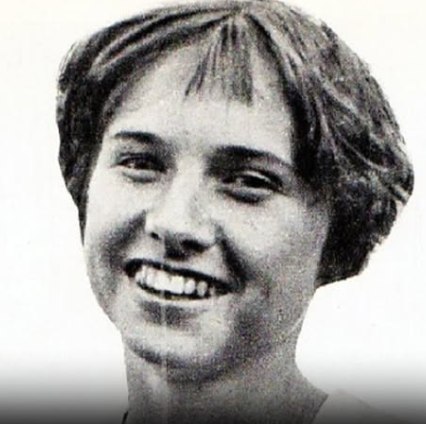
It started with a missed train.
Early 1928. A sixteen-year-old girl named Betty Robinson was sprinting across the platform at Thornton Township High School in Harvey, Illinois, trying to catch her ride home.
She didn’t think she was athletic.
She’d never competed in a race.
She just really didn’t want to miss that train.
Her science teacher, Charles Price, watched her run from the platform — and thought she was fast. Not fast enough to catch the train, but fast.
Then the doors closed, he boarded, and found Betty already sitting in the seat next to him.
She’d caught it after all.
The next day, Price timed her running in the school corridor. Then he invited her to train with the boys’ track team — because there was no girls’ team. Women’s track didn’t exist yet.
“I had no idea women even ran,“ Betty said later.
Three weeks after that, she entered her first competitive race.
She came in second — against the U.S. record holder at 100 meters.
Three months after that, she beat her.
Four months after first lacing up her spikes, Betty Robinson qualified for the 1928 U.S. Olympic Team.
She was going to Amsterdam.
Here’s what made Amsterdam remarkable: it was the first time in history that women were allowed to compete in Olympic track and field. Not because officials believed women belonged there. Because they’d finally stopped believing they could keep them out.
It was an experiment. A reluctant one.
Betty didn’t care about the politics. She just wanted to run.
When she arrived at the stadium for the 100-meter final, she realized she’d packed two left shoes.
A teammate sprinted back to get the right pair. They arrived with minutes to spare.
Betty lined up — four competitive races into her entire career — against the fastest women on the planet.
July 31, 1928. The gun fired.
She ran side by side with Canada’s Fanny Rosenfeld, the favorite. The race was impossibly tight. When Betty crossed the line, she wasn’t sure she’d won. The Canadian team was already celebrating, throwing Rosenfeld in the air.
“I thought I came in second,“ Betty said. “I was thrilled with that.“
Then her friends jumped the railing and ran to her.
That’s when she knew.
12.2 seconds. A world record. Olympic gold.
Betty Robinson — sixteen years old, four races into her career — had just become the first woman in history to win Olympic gold in track and field.
She also won silver in the relay.
Back home, twenty thousand people came out to cheer her in her hometown. They gave her a diamond ring. The newspapers called her “America’s Olympic Queen.“
Betty went back to school and started training for 1932.
Then, on June 28, 1931, her plane went down.
A small biplane piloted by her cousin. A crash that should have killed her. A man found the wreckage, found no pulse, and drove her to the local undertaker.
When the undertaker opened the car, Betty was still alive.
She was rushed to hospital with a broken leg, a crushed arm, and a concussion. She was unconscious for weeks.
When she finally woke up, doctors told her she’d never walk again.
The 1932 Los Angeles Olympics came and went. Betty watched from a wheelchair.
She spent two years relearning to walk.
But Betty Robinson was not finished.
By 1934, she was running again.
There was just one problem: the crash had left her left knee too stiff to get into a crouch. And without a crouch, the 100-meter start was impossible.
So she found another way.
The relay. Third or fourth leg, standing start. No crouch required.
She trained for two more years. She fundraised her own travel money to Berlin — because the U.S. Olympic Committee funded the men’s team, not the women’s. She made the 1936 Olympic relay squad anyway.
August 9, 1936. Berlin. The 4×100-meter relay final.
Germany was the favorite. They’d set a world record in the qualifying round. Adolf Hitler sat in the stands, certain they would win.
On the final exchange, Germany dropped the baton.
Betty ran her leg, handed off to anchor Helen Stephens, and the U.S. won by eight yards.
Betty Robinson — five years after being found without a pulse, eight years after her first gold — stood on the Olympic podium again.
She was 24 years old when she retired.
She lived another sixty-three years.
She volunteered as a track referee. She watched women’s athletics grow from a reluctant experiment into one of the greatest showcases in all of sport. In 1996, at age 84, she carried the Olympic Torch through Atlanta.
She died on May 18, 1999.
Betty Robinson never set out to prove anything.
She wasn’t trying to make history. She wasn’t trying to break barriers or change the world.
She just ran to catch a train.
But here’s the thing about people like Betty:
They don’t stop running. Not when they’re declared the underdog. Not when they’re declared the winner. And not — not even — when they’re declared dead.
She just ran.
And somehow, that was enough to change everything.