
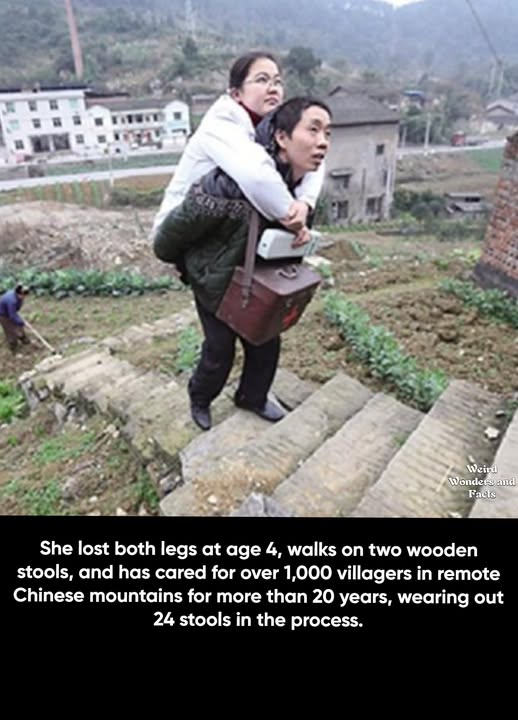
In 1983, in a small village in southwest China, a four-year-old girl named Li Juhong was hit by a truck. Her legs were so badly crushed that doctors had to amputate both of them to save her life. She survived. But her childhood would never look like other children’s.
Most people would say a story like this ends in sadness. Li’s story was just beginning.
By the age of eight, Li had taught herself something almost no one believed she could do. She picked up two small wooden stools and learned to walk on them. She placed one stool, then the other, and pushed her body forward with her arms. It hurt. It was slow. But it worked. The stools became her shoes. The world became hers again.
As she grew up, Li made a quiet decision. She had felt so much pain in her life that she wanted to spend the rest of her years easing the pain of others. So she went to a special vocational school and studied Chinese traditional medicine. In the year 2000, she earned her medical degree. She returned to her home, Wadian Village in the mountains of Chongqing, and began work as the village doctor.
The village had about 1,000 people back then. Most were elderly farmers or small children. The young people had all left for jobs in the cities. There were only two doctors at the local clinic. The other doctor was already in his seventies and close to retirement. So most of the work fell to Li.
Every day, she opened her clinic. But many of her patients were too old, too sick, or lived too far away to come to her. So Li went to them. With her medical bag hanging around her neck, she set off down narrow mountain paths on her wooden stools. Step. Stool. Step. Stool. Hours of slow, careful movement, just to reach one patient.
When the path was too steep or too rough, her husband Liu Xingyan came with her. He gave up his own job after they married so he could support her work. He cooks. He cleans. And when Li cannot make it across the mountain on her own, he carries her on his back for kilometers at a time so she can reach the patient who is waiting.
In her first 15 years of service, Li wore out 24 wooden stools. She handled more than 6,000 medical cases. She delivered medicine, checked blood pressure, gave injections, and sat beside dying elders so they would not be alone. Her monthly salary in a busy month was about 300 US dollars. She never complained. “Even if I am not honored for my work, I would still continue to do my job as a rural doctor,“ she once said.
Her son grew up watching all of this. He told his mother he wants to be a doctor too one day.
Li does not see herself as special. She does not call herself brave. She simply says, “After suffering so much pain, I want to help people relieve their pain.“ That is the whole of her philosophy. That is the whole of her life.
When her story reached the world through People’s Daily and other news outlets, millions of people cried. They cried because Li’s life is a quiet answer to all our excuses. We say we are too tired. We say the road is too hard. We say we are too small to make a difference. And then we read about a woman with no legs walking on wooden stools through mountains to save the lives of strangers.
Real strength is not in our bodies. It is in our choice to keep going. Real love is not loud. It is a husband carrying his wife up a mountain so she can heal someone else. Real purpose is not chosen by what life takes from us. It is chosen by what we decide to give back.
Li Juhong’s wooden stools may wear out every year. Her spirit never will.