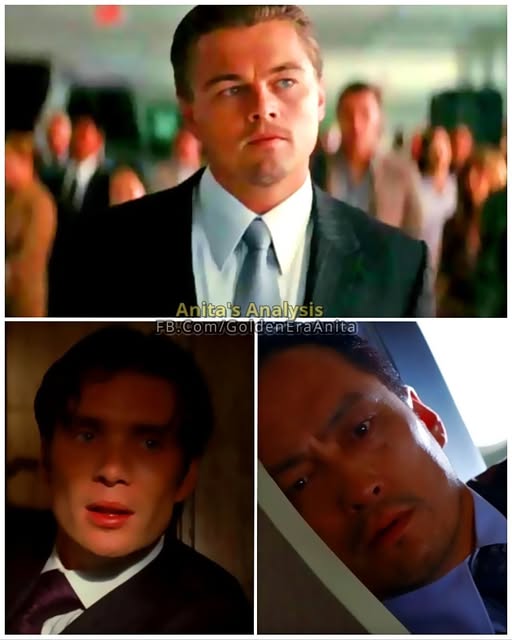
The final moments of “Inception” (2010) came together in a quiet room on the Warner Bros. lot, far removed from the collapsing dreamworld where the story unfolds. A small wooden table was placed beneath soft, even lighting, chosen carefully so nothing in the frame distracted from the spinning top at its center. There were no folding cities or crumbling architecture present during filming. The setting was deliberately plain, almost mundane, designed to feel grounded and real.
Christopher Nolan positioned the top himself, ensuring its placement felt natural rather than symbolic. Leonardo DiCaprio stood just outside the frame while the camera focused entirely on the totem. What audiences never saw was that there was no trick involved. There were no visual effects, no hidden mechanics, and no digital manipulation. It was a real object spinning on a real table, followed by a cut to black that would go on to redefine how modern film endings could function.
The ending had been debated long before the final scene was filmed. Nolan, who wrote and directed the film, envisioned ambiguity from the beginning. To him, confirming whether Cobb was dreaming would undercut the emotional journey. Studio executives initially raised concerns, worried that viewers might feel frustrated without a definitive answer. Nolan pushed back, insisting that the ending was not about logic or proof. It was about release. Cobb’s choice to stop questioning reality was meant to serve as the film’s true resolution, even if the audience continued to question it.
To achieve the shot, the production team used a custom metal top designed to spin longer and more smoothly than a standard toy. Several identical tops were prepared in case of damage or inconsistency. Cinematographer Wally Pfister worked closely with Nolan to keep the visual language restrained. The camera remained locked in place, and the lighting was kept neutral and domestic to reflect the film’s version of the real world. Crew members stood quietly as each take was filmed, watching the top spin, tilt slightly, and continue.
DiCaprio remained on set throughout the filming, even though he never appears in the final frame. In later interviews, he explained that Nolan never told him whether the top would fall. Instead, he was instructed to play the moment as one of emotional relief. Cobb sees his children and chooses not to look back. DiCaprio later said that decision mattered more than the mechanics of the dream. Michael Caine, who appears in the final sequence, once mentioned that Nolan told him scenes featuring his character were set in reality, a comment that only intensified debate rather than settling it.
The filming itself was simple but tense. The top had to be spun repeatedly, with dozens of takes recorded for the editing room. Some spins ended too quickly, while others appeared too stable. Nolan wanted a take that suggested instability without confirming it. After production wrapped, Nolan and editor Lee Smith reviewed the footage carefully, selecting the exact frame where uncertainty felt strongest. There was no musical emphasis and no visual cue. The cut to black arrived suddenly, leaving the audience alone with the question.
When the film was released, the ending became an immediate cultural flashpoint. Viewers debated endlessly over whether the top eventually fell. Critics praised Nolan’s restraint, noting that the refusal to explain elevated the film beyond a puzzle and into something more reflective. The ambiguity turned the ending into a conversation rather than a conclusion, extending the life of the film far beyond the theater.
Pfister later admitted he expected the final cut to show the top falling. He was surprised when the screen went black at the premiere. DiCaprio shared a similar reaction, saying the uncertainty gave the film its lasting power. Nolan later clarified that the emotional truth was what mattered most. Cobb’s peace was the answer, even if the question remained unresolved.
The scene is now studied in film schools for its precision and confidence. A single object, a locked camera, and a bold editorial decision combined to reshape expectations of cinematic closure. What appeared to be a simple spinning top was, in reality, a carefully crafted illusion designed to linger.
The top never stopped spinning on screen, yet in that suspended moment, Cobb found peace, and the story of “Inception” (2010) refused to settle into certainty.