First hand reports of efforts to suppress the temperature truth to support the man-made global warming lie.
View video: https://x.com/FatEmperor/status/2076037263188758847?s=20

Tom's Blog on Life and Livingness

First hand reports of efforts to suppress the temperature truth to support the man-made global warming lie.
View video: https://x.com/FatEmperor/status/2076037263188758847?s=20

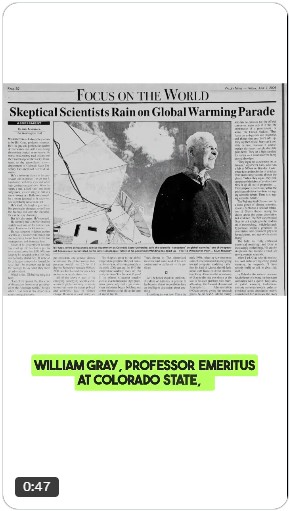
19 years ago, one of the world’s top hurricane forecasters took a stand against climate orthodoxy.
Dr. William Gray, Professor Emeritus at Colorado State, is on record saying, “I am of the opinion this is one of the greatest hoaxes ever perpetrated on the American people.”
Gray wasn’t fringe. He was respected, prolific, and data-driven. But by 2006, he was cast out. Not for bad science, but for refusing to parrot the CO2 dogma.
He accused alarmists of cherry-picking data, exaggerating models, and silencing dissent.
“They argue not as scientists, but as lawyers,” he said.
The establishment responded with smears, defunding, and exclusion. His career, erased.
The climate machine is a trillion-dollar industry powered by fear, models, and ideology. But real-world data keeps defying the script. Gray didn’t live to see its full unraveling, but he saw through its machinery. And the collapse is coming.
Click to view the video: https://x.com/Electroversenet/status/2074584238893269191?s=20

Interesting story about the omega blockade.
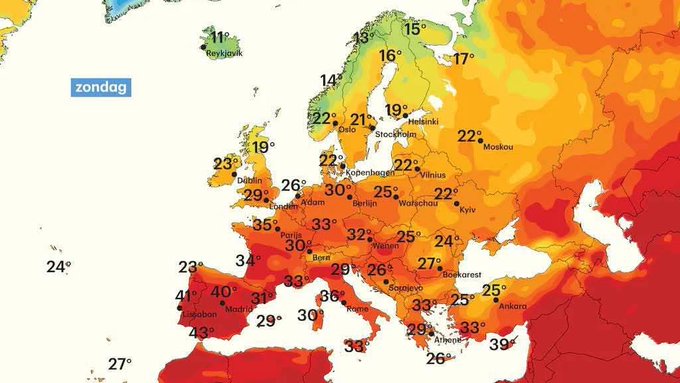
A meteorologist explains why it’s so warm this week (and no, it’s not due to climate change
The omega blockade — that’s the real meteorological explanation behind the extreme temperatures currently being measured across a large part of the European continent. While major media outlets like NOS reflexively link the heat to climate change and greenhouse gases, critical scientists point to a much more straightforward and better-supported explanation: a persistent weather pattern in the upper atmosphere that has gripped Europe many times before.
What exactly is an omega blockade?
An omega blockade is a specific pattern in the jet stream — the powerful wind current at high altitude that largely steers the weather in our latitudes. The name comes from its resemblance to the Greek capital letter omega (Ω): a large high-pressure ridge in the middle, flanked by two low-pressure areas on either side. This pattern ensures that air masses can hardly flow through and the weather pattern can remain stuck for weeks.
In the case of the current heatwave, hot Saharan air is transported northward toward Western Europe by the anticyclonic (clockwise-rotating) airflow pattern. As that air mass rises and falls under the high-pressure ridge, it is adiabatically compressed — a purely physical process that causes the temperature to rise further. No CO2 involved.
Meteorologist Chris Martz sounds the alarm.
The American meteorologist Chris Martz shared his extensive analysis of the current weather pattern via social media. His conclusion is clear: this omega blockade has nothing to do with climate change or greenhouse gas emissions. It’s a well-known, thoroughly documented weather dynamic that has always occurred and would have led to record heat even in a hypothetical pre-industrial climate.
Martz also points to a striking scientific paradox. There are, in fact, various studies suggesting that warming of the Arctic would actually lead to fewer frequent blocking weather patterns like the omega blockade, because the temperature difference between the equator and the polar regions becomes smaller. That stands in stark contrast to the claim that climate change causes or intensifies this kind of heatwave. Martz acknowledges that there is debate on this topic, but the simplistic climate message conveyed by the media is oversimplified anyway.
Europe hit more often, but why exactly?
Then there’s an increase in solar radiation reaching the Earth’s surface, due to less cloud cover from low and mid-level cloud layers. That decrease in cloudiness is partly linked to strict European air pollution regulations, which have led to fewer atmospheric aerosols. Fewer particles in the air means less cloud formation, more direct sunlight, and thus higher surface temperatures.
In other words: Europe’s own environmental regulations contribute to the increased heat. That’s an uncomfortable conclusion you’re unlikely to encounter in mainstream media.
Media choose sensation over scientific nuance
Think tank Clintel, represented by science journalist Marcel Crok, endorses Martz’s analysis. The conclusion is simple: if you want to understand the cause of the European heat, it’s better to consult a meteorologist than a newspaper editorial team chasing a clickbait story.
It’s become a fixed pattern by now: as soon as it’s warm somewhere, the link to climate change is made, almost without nuance, rarely with meteorological backing, and certainly not with reference to possible alternative explanations. That’s not journalism — that’s activism disguised as science.
If you have space and don’t want to grow veggies…
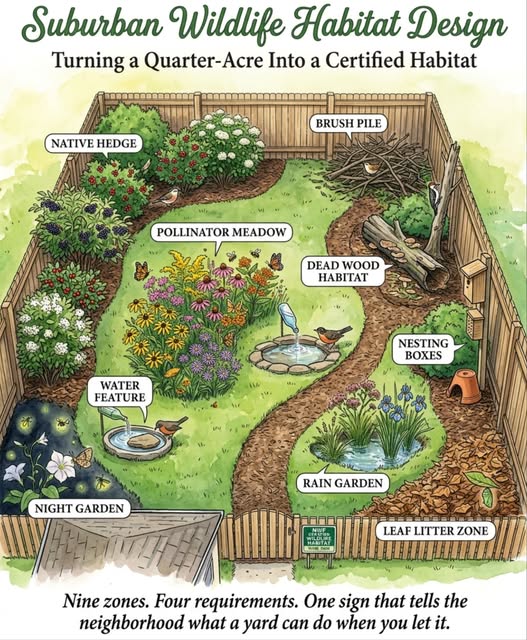
Most wildlife habitat programs list requirements that sound like they belong on a rural farm — meadows, ponds, hedgerows, dead wood. But the National Wildlife Federation’s Certified Wildlife Habitat program was designed specifically for suburban lots, and the four requirements are achievable on a standard quarter-acre property without removing a single existing feature.
The four elements are food, water, cover, and places to raise young. Most suburban yards already provide one or two of these accidentally. The gap between what exists and what qualifies for certification is usually two or three deliberate additions that cost less than a weekend dinner out.
This layout shows how nine habitat zones fit into a standard suburban backyard — each one addressing a specific ecological function that the yard is currently missing.
POLLINATOR MEADOW — a twelve-by-twelve-foot section of lawn converted to native wildflowers. Black-eyed Susan, coneflower, goldenrod, aster, and milkweed planted in a dense mix and left unmowed from spring through fall. This single conversion provides nectar and pollen for bees and butterflies from April through October and satisfies the food requirement for certification.
WATER FEATURE — a shallow birdbath or ground-level basin with a flat rock for perching and a drip bottle above for sound and movement. Does not need to be a pond. A twelve-inch saucer sunk to ground level with a rough stone ramp and fresh water changed every three days satisfies the water requirement and attracts birds, toads, and butterflies that need minerals from damp soil.
NATIVE HEDGE — a mixed border of native shrubs replacing a section of fence or property line. Elderberry, winterberry holly, viburnum, and native dogwood provide berries for birds from summer through winter, dense branching for nesting cover, and flowers for pollinators in spring. One ten-foot section of hedge provides more habitat value than an entire lawn.
BRUSH PILE — a loose stack of prunings and branches in a back corner that provides shelter for ground-feeding birds, toads, overwintering insects, and small mammals. Three feet wide and two feet tall. Takes five minutes to build from material the yard already produces and satisfies the cover requirement.
DEAD WOOD HABITAT — one standing dead branch section or a log left on the ground in a shaded area. Dead wood supports over a thousand species of insects, fungi, and lichens. Solitary bees nest in the tunnels. Woodpeckers feed on the larvae. A single log left to decay in a garden bed adds a dimension of biodiversity that no living plant can replicate.
NESTING BOXES — a bird box with a 1.5-inch entrance hole for chickadees, wrens, and titmice mounted on a post or tree. A mason bee nesting block on a south-facing wall. A toad house made from a broken terracotta pot half-buried in mulch. Three boxes for three different species satisfies the places-to-raise-young requirement.
NIGHT GARDEN — a section of the yard left unlit after dark for fireflies, moths, and bats. One corner where the landscape lighting does not reach. Moths pollinate plants that bees cannot because the flowers open only at night. Fireflies breed only in darkness. A single dark zone restores an entire shift of ecological activity.
RAIN GARDEN — a shallow planted depression that collects runoff from the roof downspout and allows it to soak slowly into the ground instead of draining to the storm sewer. Native sedges, Joe Pye weed, and blue flag iris thrive in the alternating wet and dry cycle. A rain garden filters pollutants, recharges groundwater, and provides drinking water for birds and insects at ground level.
LEAF LITTER ZONE — one bed where fallen leaves are left in place from autumn through late spring instead of being raked and bagged. Butterfly and moth pupae overwinter in leaf litter. Ground beetles, millipedes, and earthworms process the leaves into soil. Leaving the leaves is the simplest habitat action in any garden and the one most people resist because it looks untidy.
The NWF certification process is an online application. You document the four elements — food, water, cover, and places to raise young — with photos and descriptions of what you have planted or installed. The fee is twenty dollars and the yard sign that arrives marks your property as an officially certified habitat.
Nine zones. Four requirements. One sign that tells the neighborhood what a yard can do when you let it

Matthew Sheahan writes:
Dear Tom,
For over a decade, the activists and elites have been telling us the planet is hurtling toward catastrophe – uninhabitable heat, collapsing ecosystems, entire cities underwater by 2100.
It has been relentless.
It was custom-made to terrify people into changing our entire economy around Net Zero.
But here’s what they’re not telling you: It’s not true.
That entire nightmare was built on one extreme scenario, known at the United Nations as RCP8.5 – the absolute worst case, the outer edge of what was even theoretically possible.
Now the scientists who actually design these scenarios have quietly dropped it.1
In their own words, it has “become implausible”.
It was never going to happen.
You’d think a correction this big would turn Canberra on its head.
You’d think there’d be a press conference where the Prime Minister apologised to the Australian people for the cost and harm caused by Net Zero.
Instead? Silence.
So here’s the question Albo doesn’t want you asking:
“If the climate catastrophe even the so-called experts now call implausible isn’t going to happen – when are you going to dump Net Zero?”
Maybe that’s why your ADVANCE movement is having such a massive impact.
Have a look at this satirical image the team made of Chris Bowen receiving his frequent flyer upgrade from ‘Chairman’s Lounge’ to the prestigious ‘Climate Elite Platinum Club’.
It has been seen a massive 352,822 times by Aussies.
Overall, ADVANCE social posts were seen an unbelievable 17.6 million times on Facebook and Instagram in May.
FACT: 1100 immigrants come to Australia every day under Albo
Bob Hawke would be called an extremist by today’s Labor Party.
New analysis of ABS data shows Hawke and Keating added just 238 migrants a day to Australia’s population.2
Anthony Albanese has opened the floodgates to 1100 a day.
That’s more than four times higher.
Back then, most population growth came from Aussies having kids. Today, immigration accounts for almost 80 per cent of population growth.
So next time Labor tells you mass immigration is normal, remember this:
Even Labor’s most celebrated Prime Minister ran an immigration program a fraction of the size of Albanese’s.
Yours sincerely,
Matthew Sheahan
Executive Director, ADVANCE
P.S. It’s not too late to sign the petition telling Albo to DUMP NET ZERO by clicking here. If you’ve already signed it, send it to a friend.
https://www.advanceaustralia.org.au/dump-netzero
1 The Australian, ‘Climate doomsday scenarios just got a major rewrite’, May 16, 2026.
2 The Australian, ‘Migration surge under Albanese adds nearly 1100 people to Australia each day’, June 9, 2026.

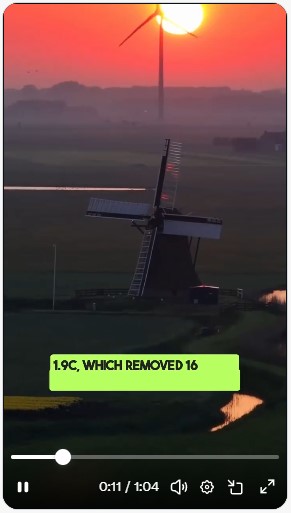
In 2016, the Netherlands Meteorological Institute adjusted temperatures at De Bilt, the country’s main climate station. Daily maximums from 1901 to 1950 were lowered by up to 1.9C, which removed 16 of 23 heatwaves from the record.
The altered data were then used to claim modern heatwaves were unprecedented.
Four researchers challenged the changes, but the institute dismissed the criticism, so the analysis went to peer review. In 2021, it was published, conclusively demonstrating the method systematically erased historical heat extremes.
Today, the Meteorological Institute has quietly changed its approach, and as a result, seven erased heatwaves have been restored, including the extreme summer of 1947.
Here again, we have a government agency caught rewriting climate history. The Netherlands Meteorological Institute erased heatwaves of the past, ignored critics, and reinstated the truth only when the evidence became impossible to ignore.
Policies were built on that manipulated record.
Dutch farmers lost livelihoods.
Industry and the wider economy paid the price.
But accountability is coming.
https://x.com/Electroversenet/status/2060375612045541411?s=20


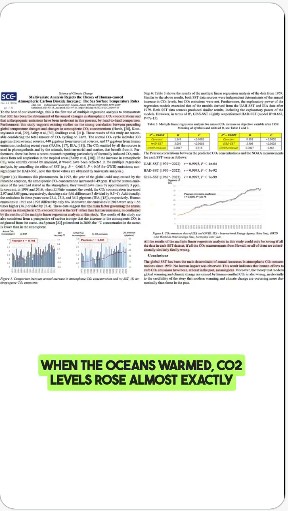
The Strongest Warming Was BEFORE CO2 Rose
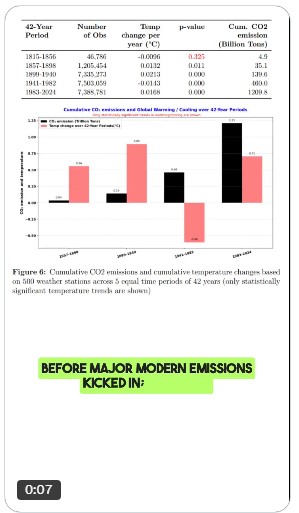
A new study analyzed daily temperatures from 992 long-running weather stations across 29 countries covering the years 1899 to 2024.
Then it compared those temperatures to cumulative human CO2 emissions.
They don’t match.
From 1899 to 1940, the planet warmed at a rate of 0.022 C per year, even though emissions were low.
Then from 1941 to 1982, temperatures cooled, despite CO2 emissions more than tripling.
From 1983 to 2024, warming returned, but slower than before, at a rate of 0.017 C per year, even as emissions rose 8.6 times higher than during the earlier warming phase.
As the author concludes, “These findings challenge the conventional assumption that human-induced CO2 is the primary driver of global warming.”
Click to view the video: https://x.com/Electroversenet/status/2055800464617382287?s=20

Activist: “Your cows are putting carbon into the atmosphere.”
Farmer: “Where did they get it?”
Activist: “What?”
Farmer: “The carbon. Where did the cow get it before it put it anywhere.”
Activist: “From… eating?”
Farmer: “From eating grass. And where did the grass get it.”
Activist: “The soil?”
Farmer: “The air. The grass pulled it out of the air last spring. The cow ate the grass. The cow breathed some of it back out. It went back into the air it came from.”
Activist: “But it’s still going into the atmosphere.”
Farmer: “It’s going back. There’s a difference between a thing going somewhere and a thing going back. You’ve described a circle and you’re frightened of it.”
Activist: “Then just don’t have the cow.”
Farmer: “The grass still dies in autumn. It rots where it falls. The carbon goes back into the air either way, just without anyone getting fed in the middle.”
Activist: “It’s not that simple.”
Farmer: “It’s grass, cow, breath, grass. Or it’s grass, rot, air, grass. Same circle, fewer dinners. If that’s complicated for you I’d stay away from the water cycle. That one’s got clouds in it.”

Scientist Gregg Braden warns that efforts to dramatically reduce atmospheric CO₂ could take us dangerously close to the extinction threshold, endangering all life on Earth. “If we were to meet the [the UN’s climate] goals… we would see a CO₂ level right around 220 or so parts per million.” “Extinction level CO₂ on this planet—when the CO₂ drops below a certain level, forests die and life does no longer thrive—that is 180 parts per million.” “It’s not good for us. Those proposals are not good for humans.”
https://x.com/wideawake_media/status/2046174797294403770?s=20