
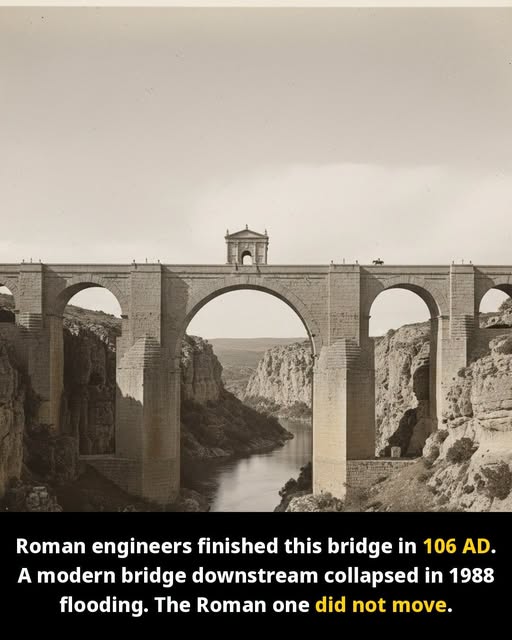
In 104 AD, Roman engineers broke ground on a bridge over the Tagus River in what is now Alcántara, Spain.
No concrete. No steel rebar. No modern adhesive. Just granite blocks, cut and fitted with a precision that still puzzles civil engineers today.
The bridge took roughly two years to complete. When it was finished, Emperor Trajan commissioned an inscription for a small temple at its center. The inscription read, in part: a bridge that will last forever.
He was not wrong.
The Puente Romano de Alcántara stands today, nearly 1,920 years after the last stone was placed. Trucks cross it. Tourists walk its six arches. The Tagus still runs beneath it.
The arches rise 48 meters above the river. The longest single span stretches 28 meters. Engineers who have studied the structure note that the granite was quarried locally and transported without the benefit of mechanized equipment, yet the tolerances between blocks are measured in fractions of a millimeter.
The Romans used a technique called opus incertum for the core fill and dressed the exterior faces in ashlar granite. The arches rely on the geometry of the voussoir, wedge-shaped stones that transfer load outward through compression rather than fighting it with tensile strength. Roman engineers understood that stone is strong in compression and weak in tension. Modern concrete is the opposite problem managed differently.
The bridge has not had an easy 1,920 years. It was partially destroyed in the 8th century during the Muslim conquest of Iberia. Rebuilt. Damaged again in the Peninsular War in 1812 when a span was blown up to slow Napoleon's forces. Rebuilt again.
Each time, the original Roman stonework remained. Each repair grafted itself onto the Roman core.
In 1988, heavy flooding struck the Tagus valley. A modern concrete bridge downstream, built decades earlier, collapsed. The Roman bridge did not move.
There is a phrase in Spanish engineering circles, not quite a joke: si quieres que dure, que lo hagan los romanos. If you want it to last, have the Romans build it.
The Puente de Alcántara is a UNESCO World Heritage Site. It is classified as one of the finest examples of Roman bridge construction in the world.
Almost two thousand years old.
Still open to traffic.