
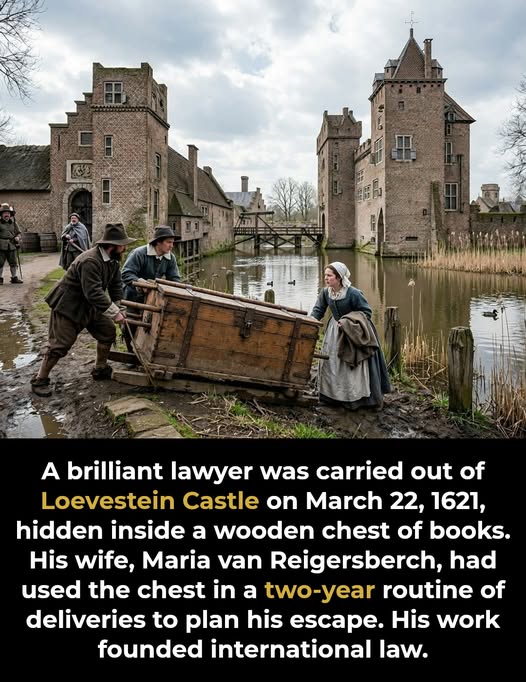
Loevestein Castle. March 22, 1621. A wooden chest came down out of the fortress, and it appeared to contain nothing more than scholarly books and laundry.
Hugo Grotius was inside it.
He had sided with the Remonstrants against the orthodox Calvinists. The state answered with the fortress of Loevestein and a sentence with no end in it.
For two years his wife Maria van Reigersberch had been bringing him books and taking away his laundry in a large chest. Books in, laundry out. Week after week. The guards, grown accustomed to the routine, rarely inspected it thoroughly.
But Maria had counted on exactly that. On March 22 the chest came out as it always did, and this time it did not hold what it appeared to hold.
Grotius lay hidden inside, barely able to breathe. He fled immediately to Paris.
In exile he wrote. In 1625 he published ‘De Jure Belli ac Pacis’. On the Law of War and Peace. He drew on Roman law, Christian theology, and natural philosophy.
His argument was that certain laws transcended national boundaries and religious differences. That nations were bound by universal principles of justice, even in warfare.
That the seas belonged to no single nation.
That prisoners of war deserved humane treatment. That even enemies retained certain inviolable rights.
He built the concept of natural law into the intellectual foundation for what would eventually become international law. His ideas would influence the Peace of Westphalia in 1648, the Geneva Conventions, and ultimately the establishment of international courts. From the Hague to the United Nations, his fingerprints remain on every major international legal institution.
The guards checked the laundry. They never checked the lawyer.
A chest of books left the castle. A body of law came out of it.
Sources: Encyclopaedia Britannica / Peace Palace Library, The Hague