Patience & Compassion

The irreducible essence of it is that the person who is the most patient is the one who understands the most.

So the simple, if hard, path to improving your patience is to improve your understanding.

Most people are not prepared to do this. So they suffer through their impatience.

If you are still with me, well done. Stop and think about it. Frustration comes about as a result of not recognising the existence of factors that apply to the scenario and trying to accomplish a result that does not take all factors into account.

Example 1: You want to change a washer in a tap but when you go the box with your plumbing supplies in it there is no washer there. You forgot you used the last one on the previous tap repair. You become frustrated.

You think about the extra time this is going to take and how that will make you late for something else. Your frustration mounts.

Example 2: True confessions time. This one is real and it was mine.

Many years ago I had an argument with my late wife. I was exceedingly frustrated with her. So much so that I went upstairs to take a time out.

While sitting there I happened to look at a green door. It was to me, an ugly green, a blue-green sort of a green that did not at all appeal to me.

After a few seconds the similarity hit me between the eyes with a force of a Mack truck. Me being upset at Julie for being Julie was as stupid as me being upset at the door for being green.

My upset at Julie stemmed from the fact that I expected something different from her than where Julie was at.

Who was wrong? Julie for being Julie or me for expecting something different from what she was?

Quite obviously I was in the wrong. Humbling realisation.

At that point one of the bigger jigsaw puzzle pieces of life settled neatly and firmly into place.

Any time I was frustrated was because I had an expectation that did not match reality.

It did not cure me of wishing things were different or having a desire to improve things but it did make me a lot more aware that my frustration stemmed from my lack of communication with the various factors in a given scenario.

OK, so how can we immediately improve our patience while on the long road to infinite understanding?

Body Basics
One aspect of existence to which many (most?) people pay too little attention is the effect on our attitude that being underslept or improperly nourished has.

I went through male menopause in my 50s. Nowhere near as bad as many ladies suffer but some nights I racked up little more than 4 hours sleep.

Come mid-afternoon I would sometimes be thinking dark thoughts. After a while I learned when that happened to stop and observe the obvious, that I was suffering from a poor attitude, then ask, “OK, how much sleep did I have last night?”

When the recollection returned something like ‘4 hours’, recognising that trying to compute optimal solutions with a bad attitude was an exercise in futility. So I would say to myself, “OK. Don’t think, just do.” and get busy and productive doing something manual.

I mention this as being hungry or underslept significantly lowers the frustration trigger point to where patience vanishes like early morning dew on a hot morning.

So I have a basic requirement of myself to get adequate sleep and arrange my eating and exercise routine and quality of dietary intake to be as physically optimum as possible.

Contingency Planning – Utilising Waiting Time
One technique you can apply is to sit down and make a list of situations you find challenging and activities that will make the time more productive.

If you have something you can do while waiting it means you are still being productive and therefore less likely to be frustrated with the time waiting.

My time with Woolworths as a supermarket trainee then manager taught me the value of having a pad and pen on me at all times so I could make notes of things to later add to my daily ‘to do list’. You can do that or make notes on your phone.

Expectation Colliding With Reality
The first thing we do when we want to create something, be it a physical or digital product or a relationship is we imagine it in our mind. When you do that it is created in your universe. Each of us has our own universe where we create. Then there is the physical universe. That universe is the universe of agreement.

When you want to create something in the physical universe and somebody else wants to create something else in the same space the two of you do not have agreement, you have disagreement over completely different realities.

This happens from time to time. A lot actually.

So to harbour the expectation that just because you imagine something in your own universe that you will be able to create it uncontested in the physical universe without first obtaining agreement from others is at least wildly optimistic if not downright unreal.

So to get frustrated at someone else’s desire to create something different is allowing a collision between your expectations and reality to upset your equilibrium. Something to be avoided.

The truth is that it often takes far more communication than we predict to attain consensus.

Life Is Short. Enjoy The Trip And Be Kind!

Compassion
I read that there are two sorts of people, the constructive (about 75%) and the destructive (about 25%).

For the constructive majority, the ability to put yourself in the other person’s shoes will often rapidly dissolve frustration.

Be Kind

You may have seen the quote commonly attributed to Brad Meltzer, “Everyone you meet is fighting a battle you know nothing about. Be kind. Always.”

On the post where I saw that one comment rang true with my experience. Rex Perry’s following caveat is at least as important as the prior post:

“It’s a very kind comment. One also has to be aware that a small minority of people are fighting a battle they don’t even consciously know they are fighting and that everyone around them is a part of that battle and must be taken down at all cost. It’s very important to be able to spot those and to know the difference. It’s still a very kind comment, but the caveat is vital to understand if one is going to survive in this world.”

The destructive 25% delight in conflict and chaos, so for you to buy into that conflict with frustration at their insanity only quickly or slowly erases your patience.

Having compassion does not mean you have to tolerate everything. When you are invited to lose your patience by a destructive person who delights in conflict, it pays to remind yourself of the old saying, “What’s the sense of wrestling with a pig? You both get all over muddy and the pig likes it.”

More often than not the best response to criticism or stupid action is to simply recall that quote, turn and leave the scene, patience intact.

Read Their Emotional State
One thing you can do is to start paying closer attention to the actors in the play of your life. Look for the indicators that tell you whether they are angry, worried, bored, etc.

Accurately gauging how they are feeling gives you some foresight on what will be real to them and how they will communicate with you.

A better understanding of people gives you a leg up on delivering responses appropriate to where they are at in present time.

Test The Waters
My late wife told me of a very accomplished board chairperson who would solicit the opinions of each member individually and canvas support for her position on a subject well prior to a vote being called for it in committee.

This meant two things happened. She very rarely, if ever, backed a losing proposition. And her stature as an opinion leader in her circle was greatly enhanced.

How does this apply to patience? Outright opposition or lack of support for your plans can be frustrating. Prior to making a direct sales pitch for your plan you could ask some questions designed to feel out the other person’s perspective on the topic. Then you are in a position to frame your pitch appropriate to their viewpoint.

Expectation Mapping
What understanding does is it enables us to better predict the future so we don’t get disappointed and frustrated.

Events that are predicted have far less power to shatter your equilibrium. One tactic is to train your imagination to countenance different potential realities and have possible solutions you can implement.

The ability to predict is a skill that can be improved by improving our communication with the factors of the situation. How do we do that? Like we improve anything – with practice.

Here are some questions you can start with.
“What events are due to occur today?”
“What expectations do I have about these events?”
“What factors could I anticipate to impact on those events?”
For each unexpected influence, “If that happens, what is the best response?”

Mental Agility And Flexibility
And then there are all the things that happen differently from what you planned or expected. Of course you cannot predict every possible variation that might occur.

Wise individuals have recognised this and written of it:
“Life is what happens to you while you’re busy making other plans”, a phrase attributed to a 1957 article by Allen Saunders and quoted in the John Lennon song ‘Beautiful Boy’.

Another very useful skill is the ability to stay calm and respond quickly and appropriately to anything unforeseen.

So a willingness to face what is actually there as it happens and not be surprised at unexpected events and ability to handle them helps enormously in maintaining a calm and patient attitude towards life.

So work on improving that willingness and ability.

Breathe and Consider the Relative Weight
In the heat of the moment, when emotions are running hot, it is easy to lose perspective of the relative importance of things.

You normally only hear the term ‘temporary insanity’ as a defence against a murder charge, when someone’s response has been fatal to another. Let’s take a broader view of when that label might accurately apply.

If you look over times in the past when the urge to respond to something that upset or frustrated you resulted in you delivering a response in a tone of antagonism, anger or hate, it was rarely constructive.

When a situation causes you stress several changes occur in your body:
-The autonomic nervous system determines that you are in a fight or flight mode
-Short, shallow breaths replace calm, regular breathing
-Stress boosts your cortisol levels
-Blood flow shifts from the organs and flows to the extremities
-Digestion slows down
-The adrenal glands start working overtime.

Two actions you can take to defuse a situation and prevent a descent into ‘temporary insanity’ are as follows.

1. To counter a rising stress level, stop and compose yourself – take several slow, deep breaths to get some oxygen into your lungs.

2. While you are doing this deep breathing, remind yourself that this is a snapshot in the movie of your life. While snapshots capture scenes or points in time they are nowhere near the whole movie!

One question to ask yourself that adds perspective in present time is, “Will this matter in a month or year?”

While some small things – most especially those relating to character, ethics, integrity and responsibility – are worth drawing a line in the sand over, a great many can be instantly demoted on the scale of things you ‘lose patience over’ by recognising their relative weight in the overall picture.

This demotion can be very therapeutic in reducing your angst level.

‘Selling Yourself’
When you feel your patience dropping, one tactic is to list off reasons why losing your patience is a bad idea and the benefits of staying patient.

Another time this technique is useful is when you start to feel frustrated about a long or boring or tedious job. Easy to do if you focus on the doing, not so easy to fall victim to if you switch focus to the product. For instance I personally do not find the idea of going for a jog or doing dips and pushups with 33 kilos on my back to be uplifting but if I change focus to the product – maintaining my health, strength and mobility for another 20 years – then the reservations fall away.

Gratitude Gear Change
What we choose to think about governs our disposition. When something happens over which you would previously lose patience, one thing you can do is make a list of things for which you feel grateful.

So step one of this is to make a list. Could be your parents, siblings, spouse, kids, grandkids, friends, pets, work, hobbies, abilities, goals, accomplishments, experiences, compliments you have received.

Step two is to have that list on hand at all times.

Step three is to remember, when appropriate, to pull out the list and spend say 30 seconds feeling grateful for one of the items on your list. And another, until you are stably ‘up’.

In Closing
I have listed quite a few techniques here. Don’t try to implement them all at once. Pick the two you feel best fit your personal scenarios and spend two weeks applying them and improving your application of them.

Then come back to this article and reread it. Pick out two more suggestions and, without dropping your first two, implement and master those.

Repeat that process. By the time you have implemented the suggestions that you feel apply in your life you should feel a lot calmer and more at peace with life.

Be Kind

To your success!

Tom Grimshaw
tom@tomgrimshaw.com

Additional Reading:

How To Work Out Your Basic Purpose In Life:  https://www.tomgrimshaw.com/tomsblog/?p=37862

Boosting Your Confidence:
https://www.tomgrimshaw.com/tomsblog/?p=67246

On Bringing Order:
https://www.bringorder.info/English.html

Addressing Procrastination: https://www.tomgrimshaw.com/tomsblog/?p=67238

How To Boost Self-Discipline:  https://www.tomgrimshaw.com/tomsblog/?p=67086

Effective Time Management:
https://www.tomgrimshaw.com/tomsblog/?p=67285

Effective Time Management

Time management is a bit of misnomer as you don’t actually manage time, after all, there are 60 seconds to a minute, 60 minutes to an hour and 24 hours in a day for all of us, no matter our management skills.

And once you spend those 24 hours in a given day they are irrecoverable. You cannot get them back or reassign their use.

We can’t actually manage time as such.

So why do some people get more done than others in the same time?

Apparently the single most powerful time-managemnt habit is treating time as non-negotiable and what you do with it as the variable.

The key being how you manage yourself, your use of time or the tasks on which you put your effort and attention.

This redefinition of what we are trying to accomplish when we wish for ‘better time management skills’ opens the door to more successful management.

We need to focus on what we do with our time to get more things done, more important things done or a better work/life balance.

The Difference Between Effective And Efficient
Effectiveness is about getting the right result.

Efficiency is about getting that result with a minimal waste of resources.

The dictionary defines efficiency as acting or producing effectively with a minimum of waste, expense, or unnecessary effort.

And it defines effectiveness as having the intended or expected effect. Getting the result you wanted.

So to be effective or efficient requires you know what the result is you are aiming to produce. Let’s call this result a ‘product’, be that physical item like making a meal or a service deliverable like a mobile phone service or medical diagnosis.

Therefore efficiency is getting the desired product expending as few resources as possible.

You can fail to attain your goal, despite being very efficient, by not getting products that forward your progress towards your overall goal.

You can fail by being effective without being efficient over too long a time frame to be successful.

Ideally each product you obtain should forward your progress towards some overall goal.

If it does not, you can be the most efficient person in the world and still fail to reach your goal.

So every task you undertake in an area should be aligned to forward your progress towards your goal for that area.

And even better, arrange your tasks in the priority of doing first those things that will most rapidly advance your forward progress.

To simplify it:
Effectiveness = doing the right things.
Efficiency = doing things right.

Effectiveness without efficiency means you reach the desired result, but waste resources getting there.

Efficiency without effectiveness means you perform the wrong task extremely well.

The goal of this article is to give you the tools and techniques to transform your life to closer to the one you will really enjoy!

How To Be More Efficient
Here are some tips I have found useful.

As much as possible, when you start something, finish it. Half-done jobs hold attention units better devoted to new tasks or projects.

When storing things, always label containers with their contents. For perishables, date them.

Always put containers on shelves with their labels facing outwards.

Have enough space to store things. Inadequate storage space is a principle source of clutter.

Conversely, if your space is limited, keep less. Become more disciplined on what you throw out.

It was a sobering experience cleaning out my wife’s possessions after she died. So much that she possessed was of zero value to anyone else after she passsed. Even down to one of a woman’s most important posessions, her handbag!

Always keep your tools in a standard location. Even when working. This is an enormous time saver.

Keep all tools in good working order.

Keep your working area clean and tidy. Clean up as you go.

For objects, paperwork or digital files on your computer, have a filing system. Was talking to a guy at the exercise station in the park and I recalled a realisation I had about filing systems. For me, they were rarely planned, they grew organically based on the accumulation of particles with the same or similar subject matter.

For instance, when I first started work they were tax declaration forms, wage slips etc. Then medical forms, licenses, registration and so on. An expanding file was useful to start with which grew to four drawer filing cabinets over time. Always group and store particles by type and arranging alphabetically.

The role of a facilities manager in a large organisation is to:
-have an inventory of all equipment and its location, condition, age, warranty and replacement date
-do regular inspections of the building, its equipment, lighting, plumbing, grounds and other facilities, and log anything that is not as it should be
-have a maintenance schedule for all equipment and ensure that maintenance is done to schedule
-have a cleaning schedule that maintains the premises and spaces to the desired standard
manage repairs and corrective maintenance when faults are reported or found
-ensure statutory inspections, testing and certifications are carried out when required
-manage building and workplace safety, including identifying hazards and ensuring corrective action
-maintain records of inspections, maintenance, repairs, incidents, contractors and compliance
-manage contractors and service providers, including obtaining quotes, monitoring their work and checking that contracted standards are met
-liaise with Treasury/Finance to prepare requests for service contracts, maintenance, repairs and capital expenditure
-prepare an annual facilities budget and monitor expenditure against it
-plan for replacement and renewal of ageing equipment and building infrastructure
-manage access, keys, security systems and physical security where these fall under facilities management
-manage utilities such as electricity, water, gas, waste removal and, where applicable, energy efficiency
-manage emergency preparedness, including emergency equipment, evacuation arrangements and ensuring facilities are usable during emergencies
-establish standards for the condition and presentation of the premises and regularly assess whether those standards are being maintained
-respond to complaints and requests from staff and building users concerning facilities
-maintain a forward works plan so that major maintenance, refurbishment and replacement can be planned rather than dealt with only when something fails
– identify facilities requirements and prepare business cases, specifications and budget requests for maintenance, service contracts, repairs, replacement and capital works, in conjunction with Finance/Procurement.

An asset manager’s role is to ensure facilities remain safe, functional, compliant and fit for purpose.

Take from that list what is appropriate for your living/working space for which you are responsible and incorporate those functions into your routine.

This will ensure you suffer minimal disruption from equipment emergencies and disordered space.

Order
Untidy and disordered spaces are inefficient. I have a few tips on bringing order over at https://www.bringorder.info/English.html

Efficiency Can Make Ineffectiveness Worse
If only your time is involved it makes no difference whether you inefficiently do one ineffective thing an hour or efficiently do ten ineffective things in the same hour.

But if resources other than your time are used, being more efficient at doing ineffective things is actually more wasteful than doing them inefficiently! The increased efficiency compounds the loss of the non-time resources.

Efficiency Is Not A ‘Set And Forget’ Activity
I am always looking for ways to accomplish a high standard product as efficiently as possible. Sometimes I even shame myself when I come up with a better technique after doing something many, many times.

As a for instance, for nearly two decades I have measured ingredients into multiple mixing bowls for different batches of my health products.

When I started, I would measure the amount required into a smaller bowl on a set of scales them tip that into each large mixing bowl.

After a while I bought multiple sets of scales, set each mixing bowl on its own set of scales then measured the quantity of each ingredient directly into each mixing bowl.

Saved the time of emptying the small quantity into each bowl. Sometimes the amount I emptied from a spoon would be more than the exact required so I would have to, if possible, fetch it out.

Then one day I set several mixing bowls out on the table with one set of scales in front and put the first ingredient packet or tub on the scales, tared the scales them spooned the amount I wanted to put in the first mix measured as a minus from zero on the scales.

This operating basis has the advantages of:
– Only having to set up one set of scales – saves time and the capital cost of scales.
– Only ever spooning out the exact ingredient amount. If I extract out too much onto the spoon it is easier to just jiggle the spoon to return some to the bag.
– No taking a large spoonful, sprinkling into the mixing bowl until the exact amount is reached then returning the unused portion to the bag or tub.
– No overage making it into the mixing bowl and no time wasted retrieving it.
– Saves time cleaning only one set of scales at the end of the day.

So don’t be mistaken that just because you or somebody else has been doing something for years or decades that a faster way cannot be found that does not diminish the quality of the product and in some cases even improve it.

Doing Work Once
One of the simplest and easiest rules to say and which the vast majority of people violate most heinously in the digital realm is, “Only do a job once.”

The most egregious violation of this is reading emails. How many times have you opened an email, read it, decided to come back to it later and reread it? Instantly your workload just doubled. You just did the same work – read an email – twice. For zero increased productivity.

This is an example of why efficiency is never a set-and-forget activity – the best systems always look for smarter ways to do the same job once, perfectly, every time.

Discipline yourself to set a specific time to go through your emails and rigorously apply the data in the section below called The Four ‘D’s.

I would love it if you could, before you start this practice, run a stop watch on your email time for a week to document the amount of time you spend on emails.

Then, while rigorously applying what you have learned from this article, run the same stop watch on your email time for the next week.

If you do this I’d love you to drop me a line with your productivity gain.

Trade-offs
We don’t live in a perfect world and often a tradeoff must be made between quality and efficiency.

Hand-made goods are an extreme example. Some people are prepared to pay far more for custom-built furniture, original artwork, unique dresses etc. By all means perform that work efficiently but originality and quality are far more important.

Then there is having to get 5 tasks done in the time it would normally take you to do 4.

You may have heard the maxim that applies to software development.
1. You can choose to have the finished product contain all the features you want.
2. You can choose the have the software finished on time.
3. You can choose to have the product come in under budget.

But you can only have two of the three.

If you want the software to contain all the features and be delivered on due date, forget about budget.

If cost and features are chosen, forget about target dates.

If cost and budget are the priorities you need to tightly prioritise your features as you will not get all of them.

Opportunity Cost
The cost of undertaking a task is not only the resources it consumes. The cost is also the lost opportunity to use those resources for something more valuable.

But if that same hour were expended in something that yielded $500 of gain towards the organisational goal then the opportunity cost is $500, far more than the $50 of wasted time.

The opportunity cost, in this example, $500, of inefficiency is usually higher than the cost, again, in this example, $50, of the wasted resource.

So that allocation of your time to the low-value task could have been used for something that would have made you $500 richer – in money, health, family time or career progress.

Standards Matter
Some people can misunderstand efficiency as “do everything as quickly as possible”.

Efficiency does not mean doing something as cheaply, quickly or easily as possible regardless of quality.

It means achieving the product to the required standard with no deferment of work to a later time. It is NEVER more efficient to scrimp on effort to get the stated quality. If only due to double handling, having to pick up the article or open the file again.

I have a sign over my desk that say, “There is never enough time to do it right but there is always time to do it again.”

Shortcuts that not only save time but also reduce the quality of the product often result in that work needing to be redone. This does not just result in the time to redo the work to the proper standard but also the opportunity cost of that time and potentially financial or reputational lossses or damage from the sub-standard product.

When Efficiency Becomes the Bottleneck
Efficiency is awesome… …until it isn’t.

There comes a point when pushing to make something more efficient actually hurts the result.

When you’re already doing a task 95% perfectly, any extra efficiency push (extra shortcuts, extra speed) can create rework or quality loss, introduce errors, fatigue or create new bottlenecks elsewhere.

The rule of thumb: If you’re already hitting the required standard with no double-handling, stop. Efficiency only pays off up to the point where the product still meets the standard with minimal wasted effort. Beyond that, effectiveness (getting the right result) takes over again.

Real-world examples from recent sources include:

Building projects (2026 analysis): “Faster building demands better planning” – efficiency gains without corresponding quality checks create long-term failures.

Business operations (McKinsey, HBR): Overly aggressive efficiency pushes can turn into “bottleneck bosses” or operational drag.

Personal productivity: If you’re already batching emails perfectly, adding another layer of rules just increases mental load.

Quality Control Step
In my experience, delivering a product to a specified standard requires an inspection step frequently enough to warrant incorporating routine inspection as a standard practice.

This was brought home to me in software development. If I was conceited enough to think that code should work just ‘cos I wrote it and it looked good, I was severely humbled on testing it.

Same reality adjustment when painting a balustrade over a staircase. I could think I had painted the far side of the balustrade verticals reasonably completely until I stood up and looked over the top to see all the places I had missed.

Effectiveness therefore requires periodically asking:
“Did the product actually produce the result I expected?”

Testing and Piloting New Ideas
Sometimes you will want to try a new idea. Could be a new form of advertising, a new way of doing something, a new sales pitch, whatever.

Once of the best ideas I picked up from a very successful marketer was the idea of failure as being a necessary stepping stone to success.

The key was to manage testing and pilot projects, in fact you could apply this to anything new, tightly and rigorously with the intention to ‘fail small and fail fast’ so as to waste as little as possible learning if that idea worked or not.

Much better to learn the idea is a flop in a day with $100 spent than $1,000 in 10 days.

This is an excellent reason to keep score on the existing so it can be compared to the new.

How many hours does it take to produce 100 widgets under the old system versus the new?

How many leads and sales from $100 spent in the old medium compared to the new one?

Attention Management
Studies on cognitive load confirm people are far more efficient when they stay in the same mental “state” instead of jumping between topics.

When you switch contexts, on average you lose 23 minutes of productive time. That is substantial, especially when you add it up over multiple times a day.

I first heard this in the mid 1990s from a software developer who told me he banned mobile phones from the programming room as it took a programmer 30 minutes to get back in the groove after a call.

At the time I shook my head and wondered why it took others so long to get back in the groove. Obviously it is one of the things at which I am good. Or just don’t notice the drop. I like to think the former. LOL.

You can factor this knowledge into your operating basis a couple of different ways.

One is batching the same tasks or similar tasks requiring the same mindset, covered in detail below.

Another is learning to manage your attention, as you are not always in control of what interrupts your day.

Think of it as being similar to driving a manual gear shift car. When you first start an activity you need to ramp up the mental framework you adopt and apply for that task. So, like going through the gears, you orient yourself and ramp up to the point you are operating at high speed.

While driving, when you then encounter a hill you know you need to shift down a gear in order to take the hill.

When at your desk, if an interruption necessitates a mindshift, take a hot second to recognise that, put a placeholder in your mental framework and deliberately shift mental gears.

Making a deliberate practice of mentally shifting gears puts you more at cause over your mental framework instead of being the effect of another person’s interruption.

If you want to get really good at this you can drill doing this verbally with a collegue, coach or spouse.

Batching
Batching (grouping similar products or tasks)is one of the highest-ROI productivity tools because it dramatically cuts attention residue (the mental “tax” of switching contexts) and context-switching costs so you only pay the setup cost once.

Schedule fixed blocks for emails, meetings or other tasks of similar nature instead of reacting to every ping.

Customer support teams who batch inbound calls/emails into 30–60 minute blocks report 20–30% fewer interruptions and higher resolution rates.

Knowledge workers (designers, writers, analysts): Batch research into morning “deep work” blocks, then content creation in afternoon blocks. The 2026 Daybook guide gives a simple 5-step habit to build it:
(1) pick 2–3 similar tasks,
(2) schedule a dedicated block,
(3) silence notifications,
(4) start with the most complex first,
(5) end with a 5-minute reset.

TASK SELECTION BASED ON PRIORITIES

Establish your Basic Purpose in Life
In my mind, establishing your basic purpose in life is the best starting point for any effort to improve yourself or your life, purely because being on your basic purpose is more motivating, more likely to be productive and fulfilling than almost anything else. Here is a link to some techniques I have learned and documented on how to find yours:

How To Work Out Your Basic Purpose In Life:
https://www.tomgrimshaw.com/tomsblog/?p=37862

Set Some Goals
Next in importance is having clearly defined, written goals.
It is hard to overestimate the value of this one.

It’s about 50 years ago I first heard “of any 100 people aged 25 now, by the time they get to age 65, 1 will be rich, 4 will be independently wealthy 5 will be working still, 27 will be dead, 63 will be broke.” (source: ABS 1992 Census).
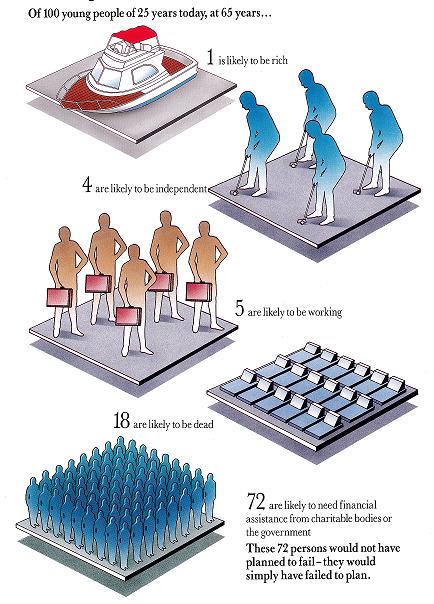
100 25 Year Olds

I once heard a lecture on the question, “Is the future cause and the present effect or is the present cause and the future effect?”

Do we think about eating tomorrow (cause) so we work today (effect) to bring that about or do we eat tomorrow (effect) as a result of having worked today (cause)?

Which one is cause?

Well as a hypothesis, let’s take the view that the future is cause. We list every result we want to bring about in the future. Then we work out what action we need to perform in the present to bring about that future result.

Now let’s come out of the philosophical and bring it back to directly helping you get what you want out of life. What future do you want to create?

Some questions to help in this task are:
“Where do I want to be a year from now?”
“Where do I want to be in five years time?”
“Where do I want to be in ten years time?”
“Where do I want to be at retirement?”

Ask these about different areas of your life relevant to you:
Awareness and attitude
Body fitness
Health level
Family – Relationship with your significant other, children, parents and siblings, wider family
Financial
Career
Colleagues
Professional Associations
Social/sports groups
Community
Pets
Possessions – House, furniture, car
Environment
Spiritual

Doing that as a first step ensures you are in a position to evaluate any action against the criteria of whether or not it moves you forward to your goal.

It enables you to operate on the solid principal of ‘Effective First. Efficient Second.’

A note of caution:
Don’t get too hung up on needing to have everything perfect or thinking if you write it here it holds good for all eternity. Just get something on paper to start with and be prepared to refine, modify or completely replace it later.

While there is some old advice to, “Set your goals in concrete and your plans in sand.” it is also true that the first time you do anything it is very rarely going to be your best attempt.

Setting the goal is a first step in creating a detailed system of managing your activity, a system that has the following in alignment:
– A plan
– Programs
– Projects
– Targets
– Statistics
– A valuable final product for the overall activity

If you would like to learn how to create such a system to speed your progress, drop me a line and I will refer you to a free course that teaches it.

Planned Tasks, Normal Traffic and Abnormal Traffic
In any job there are three categories of task that require your attention.

The first category is those tagets laid down in advance which forward the strategic plan dring toward the overall goal for the activity.

The second is the normal traffic (people and particles) for the post. If you are in sales that is in person sales calls, telephone calls out, client and prospect calls in regading orders and delivery queries, dialy/weekly reports to management, commission payment submissions etc.

If you are a shop assistant that is the preopening routine, loading the float into the cash register, setting up displays, loading stock, cleaning the shop, serving customers, handling refund requests, closing up, counting the till etc.

Every job has its normal traffic.

Then there are the abnormal traffic items. The ones that are not on your list of targets in your Programs or Projects on which you are working. How do you work out whether or not to do them and where they fit into your day? What follows are some tools and techniques to help you better answer that question.

The Signal vs Noise Concept
A concept used by some highly productive individuls comes from audio electronics. The signal is what you want to send or receive along a wire or wireless electronic medium. Could be a telephone call, a wireless radio or mobile phone. Noise is anything other than the signal you want on the line. Feedback from a sound system that interferes and can override the guitar signal is one example.

Signal-to-noise ratio (SNR) measures how strong a desired signal is compared with background noise, and it’s usually expressed in decibels (dB). A higher SNR means the signal stands out more from the noise. A ratio higher than 1:1 (greater than 0 dB) indicates more signal than noise.

In leadership, it’s about amplifying clarity and cutting through distractions—whether in decision-making, communication, or strategic focus.

In his recent interview on The Diary Of A CEO podcast, investor Mohnish Pabrai shares:

“The key to success is to focus on the signal and ignore the noise. Most people get distracted by the noise—news, opinions, trends—but the signal is where the truth lies.” — Mohnish Pabrai

He emphasizes that great leaders and investors operate with a high SNR, filtering out distractions and zeroing in on what truly drives results.

These examples were used by Mohnish Pabrai, highlighting how successful leaders maintain a high Signal to Noise Ratio by focusing on what truly matters.
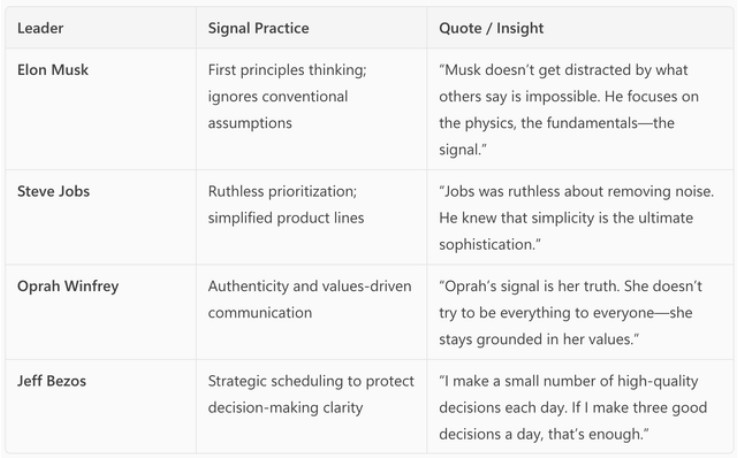
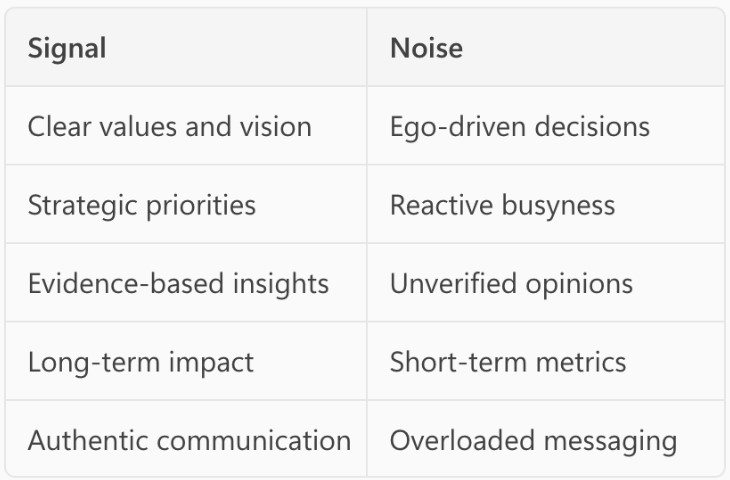
Signal vs Noise Users

Signal vs Noise Grid

One executive coach helps leaders tune into their signal by asking questions like:

What are the 3–5 most important things you need to accomplish this week?
What distractions are pulling you away from your core mission?
How do you differentiate urgent from important?
What data or feedback truly informs your decisions—and what just adds noise?
How do you maintain clarity in moments of pressure or overload?

The Most Productive Viewpoint, Skill and Strategy
One of the first rules I learned in economics was that there are always more things on which to spend money than there is money to spend.

The same is true for time. There are always more things to do than there is time to do them.

It is unrealistic to think at the beginning of the day, “I will be as efficient as possible and do everything that comes my way.”

I find as I learn more and increase my awareness, the more I see that needs to be done. As a result, every year I am less and less abble to do ‘everything that hits my plate in a day’.

The better you get, the lower the return you will obtain in trying to do more in the available time. Not that you should ever stop trying to be more efficient, to a point.

There is a law known as ‘The Law of Diminishing Returns’, a fundamental principle in economics, (also known as the law of diminishing marginal productivity) states that in a productive process, if a factor of production continues to increase (we’ll take speed), while holding all other production factors constant, at some point a further incremental unit of input will return a lower amount of output. Think of making mistakes as you do things at a speed greater than feels comfortable.

So a key element in determining your success in a given area is your selection of which things are important and take priority over all others.

That is the real skill – selecting the best task to do first. Once you master this skill you will have more time than you thought possible to do the highest value tasks.

The most effective strategy is to:
– select the most important task in terms of how well it closes the gap between where you are and where you want to be,
– complete that task as efficiently as possible,
– rinse and repeat.

Triage
Triage is a French word meaning to pick or sort, used in medicine to describe how front line or ER staff prioritise patients to be seen. It is usually relied upon when there are more injured individuals than available care providers or when there are more injuries than supplies to treat them.

Most often, patients are grouped into three categories:
A) Those almost certain to die, regardless of how much effort is expended.
B) Those who will most likely only survive given timely treatment.
C) Those most likely to survive, treated or not.

One treatment regime is to do as little as possible that will relieve the pain for group A. For those in group C to stop bleeding, prevent infection etc. and to devote most of the available medical personnel and supplies to maximise the survival potential for those in group B, those for whom it will make the most difference.

OK, that’s picking and sorting in the medical field. How can we apply that to the workaday world, or even at home?

There are various tools you can use to increase your chances of success in this regard. I will detail several so you can choose the one with which you are most comfortable to commence.

Feel free to come back to this article after a month then quarterly to revist the others to see if you can take your effectiveness and efficiency to a new high level.

Task Evaluation
When a task hits your plate that is not part of your programs or projects, there are really five questions to ask yourself:
Should this be done?
Is this the right thing to do?
What result must it produce?
Is it delegatable or do I need to do it?
How can we obtain the product as efficiently as possible?

I have seen a couple of tools to help with this.
One of them was a grid into which you assign each task:

Difficult & Dislike Difficult & Like
Delegate first (easy tasks you hate) Do it yourself – enjoy the challenge!
Easy & Dislike Easy & Like
Delegate first Delegate or do it – whatever you prefer

The premise being that if a task was easy and you dislike it then that falls into the group you should delegate first. Cleaning the bathroom comes instantly to mind!

You can then delegate the easy tasks that you like.

By then you have hopefully found someone competent enough to do the difficult tasks that your dislike.

This leaves you doing the complex, difficult tasks that you enjoy. And as a result you are a lot happier at your job!

Productive Work Versus Completed Work
The product of a task is not necessarily the goal. It is only useful if obtaining that product contributes to achieving the goal.

Not every task moves the marker towards your goal the same distance.

The optimum result is obtained by identifying the most important task(s) calculated to most rapidly forward your progress towards your goal and by getting that task done to the required standard with as little wasted motion and as few resources as possible.

To consistently attain this optimum result from your efforts necessitates that you:
– have goals
– know what products it will take to attain the goal
– have those products prioritised so you know their relative importance in moving you forward
– set your weekly and daily production targets with emphasis on the high priority products aligned to your goals for that activity

This is a major departure from the way many of us operate most of the time. I have, from time to time, observed in myself and gotten agreement from others on, an operating basis that when you stop and take a look back at it feels like ‘running on automatic’.

So if you find merit in the above, the first action to take is to decide to ‘come off automatic’ and allocate some time to identify your goals for different areas of your life.

Pareto Principle Applied to Target Selection
A fairly commonly known concept known as the Pareto Principle asserts that 80 per cent of results come from 20 per cent of the causes – 80% of sales come from 20% of clients.

According to this principle, one of your evaluation points when planning the sequence of your tasks should be to identify from a given set of targets which are the 20% that will yield 80% of the progress towards your goal.

The Four ‘D’s
One person told me they classify every task into what they called one of the four ‘D’s.

Do
Drop
Defer
Delegate

This is a brilliant tool for handling emails as most of us read and reread our emails which instantly doubles our workload.

Do: You may have heard of the ‘2 minute rule’. If a tast takes less than two minutes and it does not fall into those that can and should be dropped, it is most efficient to do it now.

It is alawys more efficient to ‘do it now’ as you spend zero time rereading it, no time reorienting yourself to it, no time delegating or diarising it but to have ‘do it now’ as your only tool puts you at the effect of every cycle that hits your plate and no point of cause over your priorites or schedule.

Drop: One question to ask is, “What would happen if I just dropped this completely?” If the answer is, “Nothing negative.” you’ve just made your call.

If the answer is a negative but it is less on the minus side of the ledger than your other tasks are on the positive side, you may still be better off dropping it due to the opportunity cost.

Saying no and dropping trivial value tasks is the fastest way to do more of the right things. Research shows people who say no to 20–30% of requests reclaim 5+ hours a week and focus better on the Pareto 20% that actually move the goal.

Another study of knowledge workers found that those who said no to 30% of incoming requests had 25% more focused work time and 40% higher satisfaction. That’s a huge payoff for learning to say no and drop more tasks.

Defer: If the tasks is yours, important enough to do but can safely be deferred to another time, log it however you log future tasks and move on. The necessity to do some tasks evaporates in time so it can pay dividends to not do some things instantly.

Of course there is a danger that you build up too many tasks in your deferred pipeline that it creates an overload down the track so be mindful of this and check your deferred tasks at a frequency appropriate to your activity to ensure this does not happen.

Delegate: If the task properly belongs to another person, hand the request back to whomever gave it to you with the name, position title and contact details of to whom it should be forwarded.

If it belongs to one of your subordinates, inform them of it with all necessary data and a deadline appropriate to their workload and priorites.

The Eisnhower Method
Another tool was a similar grid suggesting you classify tasks according to Urgency and Importance that came from a saying attributed to the American General then President Dwight D Eisenhower: “I have two kinds of problems, the urgent and the important. The urgent are not important, and the important are never urgent.”

Urgent but Not Important Urgent & Important
Delegate-Put out fires and move on Do-Tackle these right now
Not Urgent & Not Important Not Urgent but Important
Drop-Delete or delegate Defer-Log it and do later

The observation can be made that a lot of time can be consumed on doing things that are urgent but not important to the detriment of the important things that are not urgent.

This leaves you ‘putting out fires’ but not making significant progresss towards your goal. Frustrating and discouraging.

In assigning each task to one of these four categories you might decide that many tasks in the Not Urgent and Not Important category can be dropped or delegated, leaving you more time for the higher priority tasks.

PICK Chart
While researching for this article I came across a tool apparently used by Lockheed Martin for evaluating process improvement possibilities. It looks like this:

Low Payoff High Payoff
Easy to Do Possible – Explore further Implement – Start now
Hard to Do Kill – Drop the idea Challenge – Test thoroughly

According to Wikipedia:
PICK charts are a method to prioritize a number of action items or problem solving ideas. A pick chart allows visual comparison of action items relative to their impact to the problem being addressed vs. the ease/cost of implementation. In very rudimentary terms, PICK charts are a Return on Investment (ROI) method.

When faced with multiple improvement ideas a PICK chart may be used to determine the most useful. There are four categories on a 2*2 matrix; horizontal is scale of payoff (or benefits), vertical is ease of implementation. By deciding where an idea falls on the pick chart four proposed project actions are provided; Possible, Implement, Challenge and Kill (thus the name PICK).

Normally the result of using this would be the creation of a Program or Project containing multiple targets to implement the idea.

MANAGEMENT TOOLS

Learn To Say No!
I had a management consultant say to me many years ago that it was very important for a small business owner to learn to say No.

He said opportunity was the enemy of small business owners or entrepreneurs as they could see opportunity everywhere but did not have the resources of a large enterprise to take advantage of them – these ‘opportunities’ became a distraction.

I can recall examples of very large businesses perceiving an opportunity in acquiring a smaller business only to have some very large investments totally evaporate value wise in less than 5 years. So I think the problem is not restricted to small businesses.

So that is saying no on a large scale. It also applies to minor tasks.

A Low Impact ‘No’
If a person comes to see you at a time that does not suit or they are a time waster or the subject matter is not key to your post, one technique can use is to stand and greet the person but not invite them to sit. You could say, “Let’s grab a coffee together. What did you want to discuss?” and steer them towards the elevator.

This puts you at cause over the duration of the conversation far more politely than standing and saying, “Time for you to go.” when you have determined it is done.

Block Timetable To Cement High Priority Tasks
Way back in the early 1970s when I was training to be a supermarket manager, Woolworths introduced me to a block timetable for the workplace.

Of course school is the first place most of us are exposed to the concept. But I don’t see a great many people applying it past there. Except for being at work bewtween x and y and travel time to and from. But not for tasks.

It can be a very useful tool to prevent the minor priorities taking up more of your schedule that they should. You may have heard the saying, “The job expands to fill the available time.” Well here is one way to limit the available time taken up by low priority jobs – schedule blocks of time for your high priority tasks.

In fact it is much more than merely a useful tool, this is the single habit that most separates people who ‘have time’ from those who don’t.

If your high priority task is a creative one, make sure you schedule the space in your block timetable during a time of day when you are most on the ball.

To give you one idea of how to do one, here is one of mine filled in for my diet and exercise scheduled items arranged around my course study time.
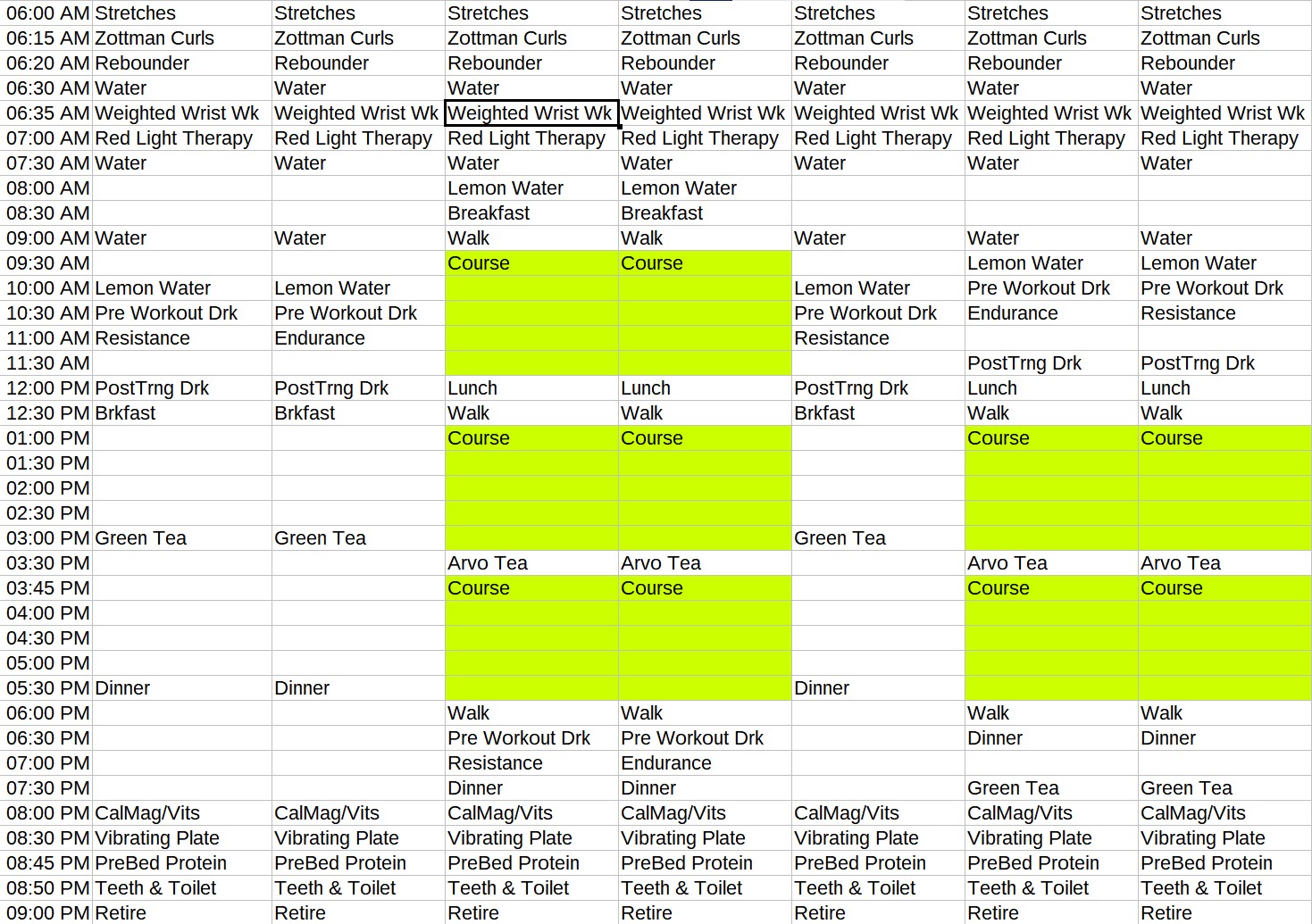
Here is one of mine filled in for my diet and exercise scheduled items arranged around my course study time.

Diet and Exercise Block Timetable

Playing the Piano
A CEO who dives into one division and spends an inordinate amount of time there is thereby neglecting other divisions to their detriment.

An individual who focuses too heavily on one area of life and ignores others is setting themselves up for failure in those other areas. Such a failure may completely undo the gains in the one area on which attention was focused.

The Dalai Lama, when asked what surprised him most about humanity answered, “Man. Because he sacrifices his health in order to make money. Then he sacrifices money to recuperate his health. And then he is so anxious about the future that he does not enjoy the present; the result being that he does not live in the present or the future; he lives as if he is never going to die, and then he dies having never truly lived.”

I heard an expression that covers this well. Whether a CEO or a worker on the factory floor, we all need to develop the skill of ‘playing the piano’ – moving from one division in the organisation, if a CEO, or one area of life to another, regularly and with dexterity, such that we keep all the juggling balls in the air and none drop to the floor.

If you instantly rebut this with some version of, “But if I do that then…” I would encourage you to sit down and revisit your goals and priorities for different areas of your life.

Statistics
Management guru Peter Drucker said many years ago: “What gets measured gets managed.” so your management is improved considerably be keeping daily and weekly statistics on the production of your products.

Statistics should measure the quantity of that being produced but only those that are produced to the required standard. This discourages the number being artificially inflated by low quality products.

The degree to which the product contributes to the viability of the activity also determines whether or not it should be staticised.

Ideally a weekly graphed statistic should be on a long-term up-trend. Tools exist to help in managing an activity based on the trend of the line on a statistic graph. If better management interests you, get in touch with me. I can recommend a course I did many years ago that helped me enourmously.

Overall Framework

1. Set Goal – Decide what you want to achieve.

2. Plan – Decide the overall Plan, the Programs, Projects and Targets will move you towards the goal. Prioritise target sequence. Set your Block Timetable.

3. Manage – Eliminate tasks that don’t contribute or contribute minorly. Categorise and handle that which hits you plate each day. Batch similar tasks.

4. Produce – Produce the required products of your post effectively and efficiently to the required standard.

5. Inspect – Inspect the completed products to ensure they meet the required standard.

6. Review – Check the quantity, quality and viability of products produced per statitics and whether the products produced actually moved you towards the goal.

7. Adjust and repeat.

If you want to get deeper into this I can recommend a free course that teaches you about planning production and setting targets in a lot more detail. Drop me a line. I will be happy to share it with you.

Once you have fleshed out your framework a really valuable question to ask yourself is, “What are the top 3 things that, if I got perfect at in the next 12 months, would make everything else easier or more valuable?”

And of course then allocating some time to acquiring those skills.

And before you go down in the mouth contemplating the time it would take, remember that most people over estimate what they can get done in a day and under estimate what they can accomplish in five years.

I did not post 18,000+ blog posts and write two 2,000+ page books in two weeks, I can assure you!

In Conclusion
Being busy is not evidence of being effective or efficient.
Having an operating basis of being efficient at low priority items sabotages your progress towards your goal.
Working inefficiently on high priority targets yields slower progress towards your goal.

~~~~~~~~~~

To your ever growing effective efficiency.

Tom Grimshaw
tom@tomgrimshaw.com

Additional Reading:
How To Work Out Your Basic Purpose In Life: https://www.tomgrimshaw.com/tomsblog/?p=37862

Boosting Your Confidence:

Boosting Your Confidence

On Bringing Order
https://www.bringorder.info/English.html

Addressing Procrastination:
https://www.tomgrimshaw.com/tomsblog/?p=67238

How To Boost Self-Discipline:
https://www.tomgrimshaw.com/tomsblog/?p=67086

Boosting Your Confidence

Competence
People who have certainty on their ability to produce a product are confident in their competence.

Confront
The ability to face what is actually there rather than what you expect to be there, rather than what you want to be there, rather than what you wish was there requires a high level of courage.

Most people do not confront the people and circumstances of their environment.

Those who are prepared to look at what is there, who do not flinch away from things they do not like are not afraid, they are confident.

Those who can better observe understand more. They are more capable and competent at doing what it takes to work efficiently and getting products.

Goals
Those who feel prepared to face life, who know want they want and where they are headed are certain and confident.

Ethical
When you are honest and ethical, have an established framework of core values you create internal alignment and eliminate internal friction and conflict. You are not looking over your shoulder, wondering and worrying if you have been or will be found out. You are set up to be confident.

Unsuppressed
People who have someone in their circle who invalidates or belittles them or their work, undermines or contradicts their decisions, dismisses them or their opinions or in any way makes them feel smaller will find it more difficult to retain confidence.

Toughness
Very rarely is life a steady stream of wins. There are often setbacks – personal, business, financial, relationship, physical – for which toughness – a strong personal resiliance – is an invaluable buffer.

When you have this characteristic it enables you to show up and be counted whereas a person with less confront and resilience would fail to show. The willingness to be there and be seen, even when it is uncomfortable, elevates you to a much higher level.

Self-Talk
Imagine how you might feel if every time you sat down to plan out your day or week you did a mental review of every failure you had ever suffered. I doubt it would be a good feeling.

This could be considered a consistent stream of self-invalidation, something you would not permit from another person.

Imagine instead, if you completely ignored every loss you had ever suffered and recalled every win you had ever enjoyed.

Can you appreciate how much more confident you would feel if at every opportunity you validated your wins and rightness?

High-Trust Associates
Having a close circle of family/friends add comfort, longevity, and a safety net that no amount of willpower can replace. And is a major factor in longevity!

These observations lead to the conclusion that genuine, bone-deep confidence is built on purpose, courage, prediction, competence, personal ethics, freedom from suppression, establishing a strongly supportive circle of associates and careful management of your self-talk.

Notice I differentiate genuine confidence from putting on a brave face, exhibiting bravado or being brash.

Genuine confidence is often calm, quiet, not flashy or showy. It is often associated with reliability, stability and certainty. It does not have to prove itself to anyone or receive acknowledgement or validation. It just knows.

There is nothing wrong with the advice to ‘fake it till you make it’ but make it genuine as soon as you can by developing those skills and characteristics underlying genuine confidence.

If you already have a goal or know your basic purpose in life, tick that box. If not, head over to my article on ‘How To Work Out Your Basic Purpose In Life’:
https://www.tomgrimshaw.com/tomsblog/?p=37862

If a person who wanted to be more confident were to focus their attention on increasing
their awareness,
their ability to confront,
their ethic level and
performing their tasks as competently as possible to as high a standard as possible and
handling anyone in their environment who manifested counter intention to their survival or happiness then
their confidence would rise as a direct result.

Specific Tips
————-
Write out where you would like to be in 5 years time. Work out what the intermediate steps would be to get there. No fancy planner needed, pen and paper is fine.

Start aligning your weekly and daily To Do lists to align with and forward your progress to attain those objectives.

Document your core values.

Resolve to consistently live up to your values, even when inconvenient.

Make it a habit to look more, see what is there and recognise it for what it is.

If someone does something that frustrates you, ask yourself, “What am I seeing here?” with brutal frankness. Follow that with, “What do I want to do in response to that?”

The better you know people, the fewer surprises you’ll receive and the less you’ll be disappointed by their actions

Be the sort of person you are proud to be by only doing those things you would be prepared to have everyone know.

Develop an ethic framework of what you will allow in your actions and in those of your associates. Set clear boundaries for yourself and others and be prepared to communicate those boundaries when appropriate.

Be prepared to call out unethical action on the part of others.

Be honest in reviewing situations where you feel you did not live up to your own ideal ethic level and change your framework to ensure no repeats of that situation.

Curate the people you allow to enter and remain in your circle. Ask if that person adds value to your life? If you add value to their life without them constantly draining you.

Own your decisions.

Keep your word to yourself and others. Honour your promises and commitments to yourself and others. This builds self-respect and respect for yourself among others.

Celebrate small wins privately.

I often suggest to a person that they maintain an exercise book labeled ‘Wins and successful actions.” I recommend they add to the book every time they have a win, noting those actions that contributed to the win. This will ensure no loss of awareness of what contributed to each success.

Once a month review your increase in skills and wins. You will find it highly encouraging, even confidence building! It’s documentary proof that every small step is stacking up.

Then make a list of those specific skills you wish to focus on for the coming month.

To your ever growing competence and confidence.

Tom Grimshaw
tom@tomgrimshaw.com

Additional Reading:
How To Work Out Your Basic Purpose In Life:
https://www.tomgrimshaw.com/tomsblog/?p=37862

Addressing Procrastination:
https://www.tomgrimshaw.com/tomsblog/?p=67238

How To Boost Self-Discipline:
https://www.tomgrimshaw.com/tomsblog/?p=67086

On Bringing Order:
https://www.bringorder.info/English.html

Effective Time Managment:
https://www.tomgrimshaw.com/tomsblog/?p=67285


Addressing Procrastination

Procrastination

What is procrastination?
Procrastination is the unwillingness to do a task now.

While reminding yourself of Nike’s slogan “Just do it!” works some of the time, when it doesn’t, the following will help you identify your reason(s) for procrastinating on this particular task so you can handle them and move forward.

I once heard that a problem well stated is a problem half solved. So if we nail the paricular reason(s) for this procrastination we are half way to solving it.

Why do we procrastinate?

Procrastination could be the result of one or a combination of factors.

One way to identify procrastination is to ask, “Which ‘I don’t’ applies?”

Dislike
I don’t want to — dislike, discomfort, resentment.

Doubt/Uncertainty
I don’t know — uncertainty, lack of information, lack of skills or unclear starting point.

Fear
I don’t believe I can — fear of failure, perfectionism, uncertainty about capability.

Habit
I don’t initiate promptly. Repeatedly postponing similar tasks can become the default response, requiring little conscious decision-making.

Inadequate Incentive
I don’t want to pay the price now — time, money, energy, resources, competing desires, opportunity cost or consequences.

Mental or Physical Inadequacy
I don’t have the energy. You may consider the task worthwhile but currently lack sufficient mental or physical resources – lack of food or rest, exhaustion from previous efforts – to tackle it effectively.

Expanding on these…

Dislike
A dislike for the action(s) involved in doing the task.
Immediate discomfort. Starting the task requires tolerating boredom, frustration, embarrassment, uncertainty, effort or some other unpleasant experience.
The task has become associated with unpleasant experiences. Previous difficulty, criticism, failure or frustration can make you reluctant to begin again.
Resentment. You may deliberately or unconsciously resist doing something because you dislike being required or expected to do it.

Doubt/Uncertainty
Insufficient information. You need information, skills, materials or a decision from someone else before you can proceed.
The task is too large or complex. You cannot see a clear first step, so the task feels overwhelming.
Lack of a clear starting point. You know what needs to be achieved but do not know exactly what to do first.
Unclear purpose. You do not understand why the task matters, so there is insufficient reason to invest effort in it.

Fear
Avoidance of a decision. Sometimes procrastinating the task is actually a way of postponing a difficult decision that the task would force you to make.
Uncertainty that the decided option is the best one.
Uncertainty that you can accomplish the desired product as a result of doing the task.
Feat of harm. Knowledge that, despite being the best option you can think of, some degree of harm will come from executing that option.
Fear of failure. You may delay because completing the task creates the possibility of discovering that you cannot do it successfully.
Fear of success. Completing the task may create new responsibilities, expectations or consequences that you would rather avoid.
Perfectionism. Fear of not doing it to a high enough standard. The task seems too important to do imperfectly, so you postpone starting until you can do it properly.

Inadequate Incentive
An unwillingness to commit resources to doing the task now. (Resources could be time, energy, space, money, materials, other people’s labour or time.)
Competing priorities. Another task appears to have greater urgency, greater immediate benefit or more serious consequences if neglected.
Low immediate reward. The benefits of completing the task are distant, uncertain or relatively small compared with the immediate pleasure of doing something else.
Loss of motivation. You originally decided the task was worthwhile but your perceived value of completing it has subsequently declined.
Poor estimation of consequences. The cost of delaying feels small now, while the future cost is difficult to appreciate.

Other Factors
While the above are the main reasons there are other factors that can contribute to procrastination:

Lack of external accountability. There is no immediate consequence for delaying, making postponement easy.

Distraction. Other activities provide an easier, more immediate source of stimulation or satisfaction.

Some Handlings
As with any task that required thinking, do this when you feel at your best-well slept and fed.

0. Don’t Play ‘the Blame Game’
Decide not to play ‘the Blame Game’. Berating or invalidating yourself does not work. Neither does blaming somebody else if they have assigned you the task.

1. Own The Task
Get into communication with the task.
Does it need to be done?
Can it be delegated?
If you decide it needs to be done and cannot be delegated, take ownership and responsibility for completing the task. Fully own it. Tell yourself,
“This is my task to complete!”
“I am the one responsible for doing this!”
“If it is to be, it is up to me!”

2. Evaluate Your “I Don’t’
Once you have your basic reason(s), sit down and get into communication with it/them.
For each, write it down or type it up.
List every reason you cna think of why it is valid to hold that view.
List reasons why it might not be optimum to hold that view.

3. Evaluate the Task
Write up the diffferent steps that need to occur to complete the tast or at least a first draft of what actions need to be done to complete it. Does not have to be complete, it is a first draft and may change as you get into the task and learn more.

4. What is the Accomplishment Prize?
Write down the advantages of getting it done
– time saved, morale boost, pride, satisfaction – and the disadvantages of putting it off – demotivation, accumulating losses, stress, guilt, lack of quality time enjoying other activities – including how you will feel as a result of each alternative.

If the prize seems inadequate think of how you can ‘sweeten the pot’ and give yourself a bigger completion bonus for finishing the task.

5. Focus On The Product
Once you have identified your reasons for this particular procrastination, recognise the philosophical truth that resisting a negative ends up in failure. A far more productive way to approach any problem is to decide on the positive outcome then work towards it.

You could ask,
“What is the optimum outcome here?”
then,
“What it will take to achieve that result?”

and let your answers to those questions decide your actions.

One thing I find useful is to stop thinking about the effort and focus on the product.

So putting my focus on the end result I am wanting to create boosts my drive to get out and put in the effort to get there.

6. Don’t Overcommit, Just Commit To Starting
Another thing that can overcome initial inertia and boost drive when you are starting something you dislike is to start small and build gradually. Commit to putting in 5 minutes. That’s all. You could tolerate nearly anything for five minutes. Except a deadhang. I max out at two minutes on a deadhang.

This starting small does several things. It all but eliminates resistance – the contemplation of five minutes does not generate anywhere near as much internal resistance as the thought of starting with three hours of it! – and it builds a winning attitude – you set a target and attained it!

And if you started with five minutes it is super easy to double it the next day!

Thereafter, set SMART targets:
Specific (excat action)
Measurable (x minutes)
Achievable (tiny)
Relevant (progress the marker toward a task done)
Time-bound (deadline)

7. Manage Your Attitude Towards Yourself And The Task
Making a decision to do a large or complex task then carrying it forward to completion is often not a ‘set and forget’ exercise. It can require picking yourself up after a loss or failure and many other self management skills.

I wrote a comprehensive article on Self-Discipline you can find at https://www.tomgrimshaw.com/tomsblog/?p=67086

It covers a range of topics you might find useful:

boosting your drive level (motivation)
overcoming distractions
the buddy system
accountability
‘selling’ yourself on winning
handling negative thoughts
handling minor failures
toughness
inertia and momentum

Hope this helps you.
If you have any other techniques you know of that work for you, drop me a line so I can include them.

To your success!

Tom Grimshaw
tom@tomgrimshaw.com

How to Boost Self-Discipline

Nike’s “Just do it” works until it doesn’t. When it doesn’t, hopefully this will help you.

This article is built on the assumption that you know your Basic Purpose or at least have a goal in life that is one you consider worthwhile.

If neither of those is true then it may not seem to matter what you waste your time doing as not much else is more important.

In that case, before addressing self-discipline – the how – let’s establish your best why. Head over to my article on ‘How To Work Out Your Basic Purpose In Life’: https://www.tomgrimshaw.com/tomsblog/?p=37862

Anything you do in life has various actions working on it:
– your Purpose that initiates it
– your personal Drive level that carries it forward
– Friction that slows progress
– Resistance that opposes progress
– Distractions that take your time and attention away from higher priority activities on your Purpose

For progress to occur, the sum of Purpose and Drive need to be greater than the sum of the effects of Friction, Resistance and Distractions.

Organisation and systems reduce Friction, Resistance and Distractions.

Why This Article?
—————–
I have a friend who runs a Life Improvement Centre. I told her I would do some surveys for her to find out what people are interested in improving. So I’ve been out and about asking people what they would most like to change or improve about themself.

A common answer is self-discipline. So I created this article to share what I have learned on the subject.

So let’s start by defining the ability we are improving.

Definition: “Self-discipline is the ability to make yourself do what you should do, when you should do it, whether you feel like it or not.” – Elbert Hubbard

The two principle failures in self-discipline are:
1. doing what you know should not be done and
2. failing to do what you know should be done.

Carrying on doing something past when you should you no longer be doing it (doom scrolling past bed time) falls under 1.

Not starting to do something when it should be started (homework, work project) falls under 2.

Doing something with or to someone for whom it is inappropriate (being romantic with someone not your partner) falls under category 1.

So, now we have defined self-discipline, let’s look at what disciplined action is and what can derail it.

Making it Personal
——————
One person flipped the table on me after giving their answer and asked me what I would most like to change or improve about me.

I thought about it for a second. Even though two people have called me the most disciplined person they have ever met, I said I wouldn’t mind improving my self-discipline further.

After all, I was getting to bed mostly between 10:30 and 11 pm rather than the 9 pm that would better align with circadian rhythms.

And I have a vibrating plate and mini-trampoline I bought for my late wife and never got into the habit of using after she passed 9 months earlier.

Systems and Routines
——————–
I looked at the B category priority actions I recognised should be in my daily routine but were not yet and realised I needed to get organised and provide an increased level of importance to them.

I recalled a point system on a course I did that measured student production. 10 points per page read, 5 points per minute of tape listened to, 5 points per demo etc.

I wondered, “Why don’t I apply this to the different things that I want to incorporate into my routine?”

So I created a spreadsheet and listed 38 tasks with the objective of increasing the number of them I completed each day. I assigned a point value to each to place more emphasis on the high value or time intensive tasks.

For instance:

Pts Task
100 Resistance workout
80 Endurance workout
10 10 minutes on vibrating plate
5 50 bounces on rebounder
3 10 Zottman curls w/8 kg load
10 20 minutes red light therapy

Previously I did not have a list so was relying on randomly remembering to do each item as I went through the day. Bad strategy. No organisation. No system. Low task completion rate.

I remember a saying I heard many years ago, “The bluntest pencil is better than the sharpest memory.” The older I get, the more truth I find in that saying. A written system for tracking things hands down beats randomly remembering tasks!

Having a list I look at regularly through the day to check things off, it reminds me of the things yet to do.

Since creating this list I have been completing far more of those things I had previously let slip day after day.

The key point here is that what good intentions on their own struggle with, a system makes it far easier to accomplish. In fact there is probably a natural law something like, “The worst system, applied, is more certain of success than most people’s willpower.”

So a workable change in your operating basis is whenever you think the thought, “I need more self-disciple to do ___.” immediately then ask, “What system could I devise that would make it easier to do ___?”

Rewards and Penalties
———————
To follow on from the point system I used to incorporate the B category items in my daily routine, one thing you might find useful is to set up a Rewards and Penalties structure. If you do X by Y date or a certain number of times reward yourself with Z.

And, if you fail to do X in Y days, put Z amount in a donation box.

Habit-Stacking
————–
One very successful action is to take a new activity you want to incorporate into your routine and schedule to do it immediately after an activity already cemented into your routine. This is called Habit-Stacking.

My most successful long-term application of this is my stretching routine. Because most of the stretches are horizontal I do those in bed as soon as I decide resting is over and am ready to get up.

I recently added three more activities to this stack. One is deep breathing exercises. I started doing them as I do my stretches. Zero resistance as I am already in exercise mode and zero reluctance as it costs me no extra time. Dead easy to add to my routine.

The other is the Zottman curls. As soon as my feet hit the floor I bend over and pick up the dumbbells. Again, no friction as the dumbbells are within reach.

The third is the 50 bounces on the rebounder. I aim to make them after the dumbbells on the way to the bathroom.

Friction
——–
Friction is generated by things that do not permit as fast a rate of progress as would be possible without it. The form of friction that comes most readily to mind is that caused when you push a box or other heavy object along the floor.

There are various ways to address this form of friction, such as putting the object on a cart or trolly, putting plastic slider underneath it and dragging the plastic, putting rollers under the object etc.

There are other types of friction that slow your progress.

Foundational Friction items are Sleep, Food, Stress, Loneliness and Loss.

Staying up late or otherwise not being fully rested generates the friction of being tired and not being as productive the next day.

Lack of adequate nutriton and hydration has a counterproductive effect on thinking, energy and discipline levels. Ever notice how the hungrier you feel when you go shopping, the more junk goes in the trolley?

Stress leads to illness and accidents. Look at the source of stress and decide what you can do to be more at cause in the situation. If you cannot resolve it, drop me a line and I will direct you to a course I did that helped me.

Loneliness and Loss are demotivating. If you are lonely, look for someone to help.

If you have had a loss, go for a walk and look at things until you feel better. Do this daily,

Friction can also be time-consuming preparation activities or inconvenience in getting things together, not having the objects you need to do a job to hand when you need to start the task.

Like having to make your pre-exercise shake and gather your exercise gear and runners and water bottle etc. from multiple place prior to heading out the door.

Or having to make your pre-exercise shake then make your post-exercise drink when you return then your pre-bed drink later with the same ingredients. Easier to make them all at once so the two later drinks are ready when needed. Far less chance of forgetting them when they are sitting there looking at you!

Getting things prepared and ready and streamlining what needs to be done to get a product reduces friction.

It pays to identify where friction occurs in your life and organise to eliminate it.

As you go about your routine for the next week, be conscious of friction where it occurs and redesign your environment and routine to minimise friction.

Resistance
———-
You may encounter resistance, internal or external. It pays to take a moment to try and predict what resistance will occur and what actions you can take to bypass, reduce or eliminate that resistance.

External resistance can be an objection to the action, invalidation of your ability to do it, criticism of the timing of doing it etc.

Asking the person to not put up resistance can be helpful. If not, removing yourself from their resistance can be workable.

Internal resistance is considerably more complex and insidious. I will cover that in more detail later in Intention and Counter-Intention.

Destructive Distractions
————————
As well as Friction and Resistance, other activities, not core to your Basic Purpose, can serve as distractions, pulling you away from investing the time to achieve your goals.

Time-wasting habits like mindlessly watching TV, scrolling social media, TikTok or YouTube reels.

Spending a lot of time at the pub drinking, gossiping with friends etc.

Each of these pastimes takes up time that, if devoted elsewhere, would improve a skill or help you make faster progress towards your goal(s).

Distractions also include a mobile phone that pings every time you receive an SMS, a post to your social media account, an email etc.

You can minimise this type of distraction by switching off notifications and setting a specific time in your schedule to read those notices.

So, here’s an exercise. Take five minutes and jot down the activities in your life that you would reduce or scratch completely if you were really dedicated towards achieving your goal.

Boosting Your Drive Level
————————-
When the thought of heading off with 30 kilo of weights on my back on a blustering, cold morning or worse, after dark at 7:30 pm in winter, leaves me lacking enthusiasm, one thing I find useful is to stop thinking about the effort and focus on the product.

Why am I doing this?

For me it is to stay healthy and fit as I age so I can enjoy playing tennis and street cricket with my family on get togethers and not be suffering for three days afterwards.

I cannot maintain that level of activity being a couch potato, sitting in front of the TV/computer all day.

So putting my focus on the end result I am wanting to create boosts my drive to get out and put in the effort to get there.

A valuable exercise is to pay attention to what motivates you and enter it into a book I encourage people to keep called “My Successful Actions and Wins”.

Any time you have a good win, identify what you did that caused it and write it up in your book. That prevents it from fading into the dim mist of forgotten memories.

Then, each month, pull the book out and reread it. You might be surprised at what you had let fall out of your routine.

Another thing that boosts drive when you are starting something like an exercise regime is to start small and build gradually.

This starting small does several things. It all but eliminates resistance – the contemplation of one pushup does not generate anywhere near as much internal resistance as the thought of starting with ten or twenty! – and it builds a winning attitude – you set a target and attained it!

And if you started with one it is super easy to double it the next day!

Adding more on a gentle gradient helps the same way. I built up to doing 2,100 dips and pushups one night by starting small – 5 dips and 5 pushups on each of 21 park benches – and adding more in small increments till I built to 100 dips and 100 pushups on every bench.

Remember the old saying, “Rome wan’t built in a day.” Despite what we see presented on media, huge gains, massive improvements and remarkable results rarely, if ever, happen quickly. They are usually built on constant attention to doing the basic fundamentals consistently well over a period of time.

That ‘overnight success’ was often 20 years in the making.

Buddy Up
——–
In my personal development I have – perhaps overly so – relied on improving myself to be as competent and independent as possible. While this suits my personality it may or may not suit yours.

If you are a person who does this best with company, look in your circle – or further afield if necessary – for someone with similar aspirations.

Jogging is the activity that comes most readily to mind. I often see people jogging together. Now that I think about it, nowhere near as many as I see jogging solo. Interesting.

Accountability
————–
As well as providing guidance, a good mentor also introduces an element of external accountability to provide increased incentive to follow through and accomplish set targets.

Someone who has already accomplished what you strive to achieve knows the road you will travel and helps you plan for and counter the obstacles that resist forward progress.

I read that a high proportion of Olympic athletes have a close family relative who was also an Olympian.

Intention and Counter-Intention
——————————-
The following is from: https://www.healthline.com/health/how-many-thoughts-per-day

Thoughts weave their way across your mind constantly. From your first moment of consciousness after waking until you close your eyes to sleep (and sometimes, long after that), you’re generally thinking about something.

These thoughts might include garden-variety, everyday musings:

“What a gorgeous day. I should really get out and get some sun.”
“I need to clean out this car today.”
“Gotta add oatmeal to the grocery list.”

Or more complex, deeper cogitations:

“I wonder what dogs dream about.”
“Would trying to date again improve my life?”
“What are my long-term goals in this job?”

The results of a 2020 study (https://www.nature.com/articles/s41467-020-17255-9) suggested people typically have more than 6,000 thoughts per day.

~~~~~~~~~~ End of quote. ~~~~~~~~~~

To get the most out of your life you should understand yourself, what motivates or inspires you, what demotivates you, even understanding and learning how to manage your thoughts. Yes, you can manage them.

A way to understand something is to divide instances of it into classifications. And so it is with thought.

One way thoughts can be broadly divided is into two categories, constructive and destructive. Even constructively inclined people (the vast majority of us) can have destructive thoughts. The difference between constructive and destructive people is that the constructive people rarely act on their destructive thoughts.

In addition, because the stream of conscious thought that occupies our attention is rarely without debate, for most of us, whenever we think of doing something there will often be a reason come to mind why we should not do it, a counter thought in opposition to the first thought.

So another way to divide thoughts is into thoughts and counter-thoughts, thoughts opposing the prior thought.

For instance a constructive person has the thought to go do the weekly shopping. Next may come a reason to not do the shopping. This is a counter thought.

In this example we could simplistically class the counter-thought as not good as it provides resistance to the attainment of a valid objective.

However the truth is far more complex. You might have experienced an occasion when you had quite a solo contemplation about the different factors involved in such a course of action:
Should I do it alone or wait until my wife is available so we can do it together as she has different tastes?
Will she be too tired later and I will have to do it alone anyway?
It is close to 3:30 pm when the mums will pick their kids up and traffic past the school will delay me.
The fridge is still pretty full but we need more of xxxxx.
I have/have not made a shopping list.
The car needs fuel too but filling the car and the shopping time will mean I will not be back in time for xxxxx.

And that is for something as menial as going shopping let alone contemplating something significant like a career change!

Or a destructive person has the thought to go do someone some harm. Their counter thought might be to not do the harmful act because it would harm a person other than the intended victim. In this example we could class the counter-thought as good, it is a reservation about doing harm.

So not all counter-thoughts are counter-productive.

It is important to recognise which of the two classes of resistance that this intention counter to the first thought falls into.

If the first thought is non-survival, as an extreme instance, doing something criminal, then the counter-thought is probably your conscience objecting.

When you think of doing something constructive and a negative thought enters your head, one solution is to recognise the counter-intention that pushes back as resistance and just do.

I recall a couple of decades ago going through male menopause. Yes, it is a real thing, not as bad as the girls suffer but enough to disrupt my sleep down to four hours a night.

I’d get to the afternoon and be thinking dark thoughts. Realising no good could come from this calibre of thinking I’d pull myself up at this point and ask myself, “How much sleep did I get last night?”

When the answer, “Four hours.” or something similarly rediculous came back I would then think, “OK, don’t think, just do.” and go find some physical action that needed doing.

Worked a treat.

The Battle Between Our Ears
—————————
When considering a task you may recall having some negative thoughts about it or you enter your head.

One of the barriers to starting and completing anything is thoughts that invalidate us or our efforts.

Most of us have made the mistake that thinking every thought that comes into our head is ours – we originated it.

That is false. Dangerously so.

What we are not taught in school is that there is a part of the mind that is responsible for the negative and counter-productive thoughts that enter your head.

Differentiating between your own thoughts and those not yours is one of the hardest things to do.

The part of the mind that generates these thoughts is not you. It is a collection of memories. Memories composed of everything bad that has ever happened to you. Every loss. Every failure.

This is where self-doubt, self-invalidation, fear, over-thinking, anger, hate, impatience, intolerance, destructive impulses and out-ethics impulses comes from.

Successful people recognise these thoughts as having zero merit and great destructive power and work out strategies to conquer them.

I have read that it is vital to do so in elite athletes as negative thought have a measurable counter-productive effect on athletic performance for several hours.

There are various distinct methods to address the negative thoughts coming from this collection of losses.

1. The permanent, long-term solution is direct address. To eradicate the source of these negative thoughts using techniques specifically engineered to completely erase that source.

2. Is indirect address. Using techniques designed to reduce the horsepower and effect of the negative thoughts without direct address. Remember this one for the next time you feel down or have a loss. Go for a walk and look at things, one after the other, until you feel better. A most effective indirect address. Certain tribes in Africa use walking to resolve post-partum depression. Yes, it is that powerful!

3. Administrative tools or organisational techniques to put you more in control of your thoughts.

This article addresses the last of these three. For more about techniques to do 1 and 2, drop me a line.

Learn To Constructively Distract Yourself
—————————————–
When they occur, recognise negative thoughts as having zero merit and great destructive power and learn how to not entertain those thoughts and instantly you recognise them, refocus and start thinking about something else.

Personally I find starting to think about the actions I need to take on my current main project to be both therapeutic and constructive.

Learn To Be The Best Sales Person To Yourself
———————————————
One major difference between successful people and unsuccessful people is their self-talk – that conversation that goes on between your ears.

For instance, fear of failure prevents many people from taking action.

One side or the other is going to win that sales conversation. Either the fear of failure will ‘sell’ you on taking no action or you will sell yourself on taking action despite your fears.

Courage is not the absence of fear but the taking of action despite it.

I read of one very successful marketing master who embraced failure as a vital part of the learning process. He promoted the idea of failing often and failing fast with the objective of trying enough alternatives to find what worked. Really worked.

And here’s a quote from a video I watched on YouTube: “Losing is not the enemy of winning, it is the education for it.”

There are many caveats that apply to this statement but if you
maintain the intention to win,
continue to learn from your failures,
keep improving,
fail often,
fail fast
so you arrive soonest at what works,
that covers a lot of them.

An Analysis Of What It Takes To Get A Product
———————————————
Thinking about self-discipline I realised there are times I have looked at something that needs to be done yet not done it, then later, noticed it again, sometimes multiple times.

Analysing the mental process involved in my thinking in these scenarios I observed there are the following distinct actions involved in getting a product.

Each of them are vital to ensuring a task is completed fully to an appropriate standard. The absence of any one of them derails the completion to standard.

Tasks
—–
For a great many small tasks, this is the sequence:

1. Observing
Observing something that needs doing. This can be as simple as observing the pot plants need watering.

2. Owning
That tasks is mine, I am responsible for doing it.

3. Assessing
What will it take to complete this action?

4. Deciding
I will do it.

5. Planning
Should I do it now or at a better time?

6. Targeting
I will schedule to start it on this date and time and complete it on this date and at this time.

7. Beginning
Beginning the task.

Before beginning a task it is more motivating to focus mostly on the purpose or product.

Once you have started, an effective strategy is to change focus to concentrate on doing the process efficiently and to the best of your ability.

8. Continuing
Keeping at it till it is done.

9. Completing
Doing a final look over to ensure nothing is undone then cleaning up any mess, putting away any tools etc.

10. Verifying
This is purely making sure that the product is complete (all plants watered) and to the standard you consider acceptable.

Larger Jobs
———–
For larger jobs that might more properly called a program or project, a more complete list would be:

1. Observing
Deciding or concluding something that needs doing. This may result from an analysis rather than direct observation of a physical situation.

2. Owning
That tasks is mine, I am responsible for doing it.

3. Assessing
What resources – personnel, finance, materials – will it take to complete this action? For large projects this step can be huge and can contain many individual targets.

4. Deciding
I will or will not do it based on the assessment.

5. Planning
This is the process of laying out all the steps required to complete the product.

If you would like a template for this action flick me an email and I will send you a link to a free course that teaches it.

6. Targeting
I will schedule to start it on this date and time and complete it on this date and at this time.

7. Beginning
Beginning the task.

When you are backed off from a task because it feels complex or overwhelmingly large, it could be one large, time-consuming task or because it contains many tasks that you have not isolated into individual actions.

The first thing to do is identify into which camp it falls.

If it is one lage task, one effective technique is to just make a start on some portion of the task you can confront. It can be rather surprising how much more confrontable the task can become once begun. When I used to face that scenario I often found that procrastination had made the task seem larger than it turned out to be.

If it breaks down into smaller tasks, pick one, maybe a prerequisite for other tasks, and knock that one off.

8. Continuing
On larger tasks this can involve maintaining disciplined focus, ignoring distractions, overcoming obstacles, staying motivated and continuing it until completed.

9. Completing
Doing a final look over to ensure nothing is undone then cleaning up any mess, putting away any tools etc.

10. Verifying
This is purely making sure that the product is complete and to the standard you consider acceptable. Best done by a person who did not do the job.

11. Certifying
Signing off on the completion as complete and to standard.

For larger or more complex jobs a more expanded process is called for. There is a free on-line course available to give you data on how to plan and organise larger programs. Drop me a line for details.

Handling Falling Off The Wagon
——————————
Sometimes something (or more than one something) happens to derail your best intentions and you do not do what you set yourself up to do.

Many people respond to failure with excuses (denying responsibility) or self-criticism (I am weak, lack discipline, not good at this, poor at routines etc.)

This does not help build a better you, the excuses just make the thing you blame more powerful than you and the self-criticism just makes you smaller. Neither are good options.

I recommend you correctly categorise excuses as Friction and self-invalidation as Resistance (to recognising your true self-worth).

I read once that humility was an important quality in a reviewer. Hubris and pride are destructive as they prevent correct observation and evaluation.

Personal integrity includes accurate observation and full and complete communication of that correct observation.

A more constructive approach is to acknowledge the failure, look at the circumstances to see if you can learn something from it then never think of it again. Once you have learned what you can, thereafter ignoring losses is a great practice.

If the failure does come to mind again, instantly practice Constructive Distraction and think of something else on which to focus.

Dwelling on failures serve no constructive purpose.

Toughness
———
Finally, a word on the single quality that most reliably translates to increased success- toughness. What is toughness?

Resiliance in the presence of pressure
Preparedness to forgo short-term gratification for long-term gain
Showing up despite adversity
Not giving in to the urge to quit
Being prepared to work harder, to put in more
Being confident
Accepting challenges
Being prepared to commit
Being in control

Inertia and Momentum
——————–
Inertia is resistance or disinclination to motion, action, or change.

Momentum is the force or energy exhibited by a moving body, the natural inclination to continue in motion.

If you feel backed off from starting something, recognise it as inertia. The hard part is starting, you have to overcome inertia.

Once you have started something, momentum is on your side. As you build momentum it becomes easier to continue than to stop. And interestingly enough, the start does not have to be big. It can be quite a small one to overcome the mental inertia.

In Closing
———-
In this article I have covered a lot of ground and I predict for some readers it may seem daunting to contemplate the difference between where you perceive you are now and where you would like to see yourself.

I would like to remind you that my most important word on the subject of exercise – gradient – applies equally to mental development. You don’t win by trying to do the impossible instantly.

Start by picking one thing from the above and decide to implement that tomorrow.

Each time you incorporate one aspect of the above into your life, give yourself a pat on the back and choose another.

Make a note to come back and read this in a month and keep picking something to work on.

If you improve by one percent a week that’s 100% in two years.

Not many investments give you that sort of return!

“Discipline isn’t punishment — it’s self-respect. It’s choosing your future over your feelings, over and over again.” – Elena Cardone

To your success.

Tom Grimshaw
tom@tomgrimshaw.com

Additional Reading:
How To Work Out Your Basic Purpose In Life: https://www.tomgrimshaw.com/tomsblog/?p=37862

Addressing Procrastination:
https://www.tomgrimshaw.com/tomsblog/?p=67238

Confidence:

How To Work Out Your Basic Purpose In Life

“Follow your bliss and the universe will open doors where there were only walls.”
Joseph Campbell – Author (1904 – 1987)

Create A Life You Love

Why?

Greatness Follows Embraced Passion

The Right Path

“Choose a job you love, and you will never have to work a day in your life.”
Confucius – Philosopher (551 – 479 BC)

“An aim in life is the only fortune worth finding.” – Jacqueline Kennedy Onassis

How?

If You Want To Know Where Your Heart Is
I attended a talk by Bernard Percy, a person who for a living (Foundations for Brilliance) helps people identify their basic purpose, and he spoke of talent, personality and basic purpose being a package. He drew three intersecting circles on the whiteboard and labelled one Talent, one Personality and the last one Basic Purpose.

He said that some people are doing something that suits their personality but it is not exactly on their basic purpose and not something at which they are never going to be the best in the world.

Others are doing something that is on their purpose but does not suit their talents or personality.

And others are in a career that they are really good at but does not totally fit their personality or basic purpose.

He then pointed to where the three circles intersected and specified THAT as the target: What we are after is this sweet spot in the middle, it’s on your basic purpose, you’re REALLY good at it and it fits your personality to a T.

I have found several ways to help people determine their basic purpose.

~~~~~~~~~~

One is to look over products they have gotten in the past to identify those of which they were really proud. Ones up there at the level of masterpiece. That evoke an emotional response.

Then I ask them if there was a purpose they had when they were doing that. It was always some specialization or narrowing of the purpose to help. To help people by/to _____________.

~~~~~~~~~~

Another is I get them to take a piece of paper, draw a line down the center and label the left column Personality and the right column Talent.

Then I get them to fill in their personality characteristics in the left column and everything they are good at in the right column bearing in mind talent relates not just to arts and sports but anything you find easy that others find difficult. The thing about which you often receive compliments: “Oh you’re so good at that!”

When I tried this first on my elder daughter, after she had completed the two columns I then asked, “Looking over the two columns, if Talent, Personality and Basic Purpose are a package, is there a purpose that weaves its way through those two lists?” She said, “Yes. To change kid’s lives. I want to make a difference in kid’s lives!”

So we packed her off to the Mohave Desert school for a year where she learned how to handle high dynamic kids with Joke Reader.

~~~~~~~~~~

A third technique is predicated on what I understand Confucius had to say on the subject, “Do something you love to do and you will never work a day in your life.”

I employed this technique on a young Chinese computer programmer who came to work for me as an intern straight after finishing his uni degree. I gave him a task to perform I would have expected a programmer to do in 15 minutes. Took him 2 days. I said, “Mate, you don’t appear to be cut out for this. How did you come to study computer programming?” Turns out it was  not his choice at all, it was something his parents wanted him to do.

I figured we needed to get him on a track more aligned to his purpose.

I explained the concept of Be-Do-Have to him. To get a product (Have) you have to perform (Do) certain tasks which require you to assume a certain Beingness (Be). Each profession has a person assume a different Beingness, perform different Doingnesses to produce different products (Have).

I got him to duplicate that a Baker (Be) Bakes (Do or Does) and winds up with the product Bread (Have).

Most people ask kids, “What do you want to be when you grow up?” The better question is, “What do you want to do when you grow up?” The best question is, “What product would you most like to produce when you grow up?”

So I then told him to make a list of 50 jobs from an employment job seeking site and told him to work out what the product was of each job. I said after you do that, look at how much enjoyment you would get from producing each product. If you have no stomach for blood, cross out vet, nurse, doctor, surgeon etc. If you have a fear of heights, cross out abseiler, window cleaner, sky diver, airplane pilot, cell phone tower maintenance technician etc.

After you have crossed out those you would not enjoy you are left with a much shorter list. If, like me, you are 71 and don’t want to go back to school for 12 years to become an astrophysics professor, you could cross that off too. So you narrow the list down using any deselection factor you can till you are left with one or a few that you go, “YES! I would feel like I was being paid to have fun if I were doing that!”

He got the idea.

Two days later he was gone, found a job doing something FAR more suited to him than computer programming.

~~~~~~~~~~

This is such an import aspect of existence that one would be well advised to make is a high priority to spend whatever time it took to discover one’s basic purpose. Many wise men have felt the same. This one from Japan:

Ikigai

After I wrote this up it occurred to me that there was an omission in my write-up: the value of doing the exercise with another person who knows what to look for, can spot indicators and can apply decent two-way communication.

The other thing to do is then work out your product that best aligns with your purpose. For instance my primary purpose is to understand, my secondary purpose is to raise others to a higher level of awareness. My product is a more aware, more capable, more competent being, better abe to survive and help, able to help salvage this civilization or help build a new one out of the rubble of this one.

And I well remember some advice I received many years ago, “As you become more successful in business it becomes more important to say no. Opportunity is the enemy of small business. You do not have the resources to take advantage of all the opportunities that present themselves.”

IMHO this applies equally to a person as much as a business. As you gain more awareness and competence in life you see more that needs to be done and your interest comes up. So you can get very dispersed trying to do everything and make little headway with anything.

Imagine giving $1 each week to 50 different charities. More than a dollar’s worth of time would be wasted, your end and theirs, recording and receipting it. Better to give $200 once a month to one charity.

This can apply to projects too. Most tasks have a setup and cleanup time. so it may be more efficient to do 7 hours once a fortnight than 3.5 hours once a week let alone 30 minutes a day.

On the other hand it may not be possible to assign a block of 7 hours to one specific task, as any mother will tell you. It may be that spending 15 minutes a day, first thing after you rise, is the best way to ensure you make progress on the most important tasks in your life.

For I have read that often times the important things are not urgent and the urgent things are not important so one should make time to do the important things that make a difference as they are rarely the urgent ones!

My suggestion would be to schedule some time each week in the creative arts, even if it is as little as 2 hours and have a list of projects that you plan on doing but do one at a time. That way you can focus on completing a cycle of action, getting a product and you have a future mapped out. (Very good for survival having future goals.)

Find Your Own Path

And once you know your path…

“Just don’t give up trying to do what you really want to do. Where there is love and inspiration, I don’t think you can go wrong.” – Ella Fitzgerald, Singer (1917 – 1996)

~~~~~~~~~~

Gillian Lynne – An Example

This is an absolutely brilliant example of an extraordinary talent on her own purpose line!

Watch video: https://www.facebook.com/share/p/189tjmNZRL/

~~~~~~~~~~

In closing, most people grossly overestimate what they can can get done in a day and grossly underestimate what they can do in a decade.

Hope this helps. If you get almost there and you need a hand to make it over the final jump, holler! I love to help. In fact, I am a serial helper.