Rosemary hides its problems well — it still smells good even when half the base is dead. Annual pruning prevents the point of no return from arriving unannounced.
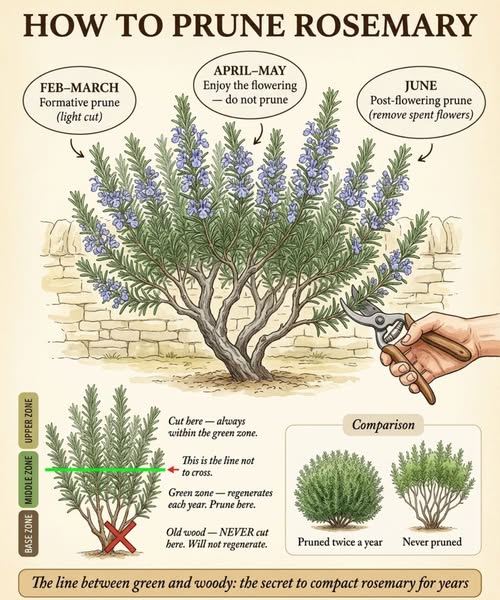
The rule that governs rosemary is the same as for lavender: below the green zone lies grey wood that does not regenerate. Without annual pruning, the shrub lignifies from the base upward, and within three years you have a bare trunk topped by a green tuft at the tips. At that point there is no recovery — old rosemary wood does not carry dormant buds capable of breaking back into growth.
How to manage it through the year in the Northern Hemisphere:
— Late February to early March: formative prune. Cut back the green stems by roughly a third, keeping carefully above the visible junction between the soft young growth and the rigid old wood beneath. That junction is the line that must not be crossed.
— April and May: leave the plant completely alone and enjoy the flowering. This is the main pollinator window — early bumblebees and honeybees depend on rosemary as one of the first substantial nectar sources of the year.
— June: a second light trim to remove spent flowerheads and encourage new lateral growth.
Two rules that never change:
— The dry grey bark at the base is a no-cut zone. Cutting into it leaves permanent stubs that will produce nothing.
— Remove stems that cross through the centre of the shrub. Without airflow, the interior stays damp and fungal problems develop.
After six to eight years, even the best-managed rosemary thins at the base. Replacing it with a rooted cutting taken in summer is a better option than trying to force recovery from an old plant.
The line between green and woody is the only secret to a compact rosemary for years.
For the Southern Hemisphere (e.g., Australia)
Seasons are reversed, so shift the timing by about 6 months to match the equivalent part of the seasonal cycle:
- Main formative prune: Late August to early September (your late winter/early spring).
- Leave alone for flowering: Roughly October–November (your spring flowering window for pollinators).
- Light trim after flowering: December (your early summer).