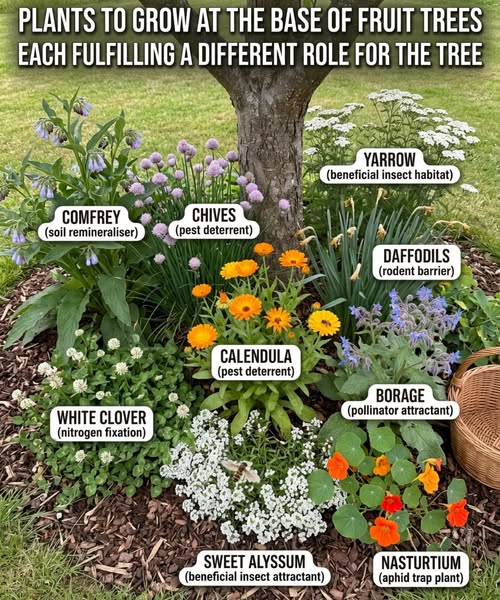
Each plant at the base of your fruit trees has a specific role: feeding the soil, deterring pests, attracting pollinators, or covering bare ground. Together they form a self-sustaining ecosystem that works for the tree throughout the year and progressively reduces the maintenance it demands.
Comfrey — deep roots that draw up calcium, potassium, and phosphorus from subsoil layers. Cut the leaves five or six times per year and leave them as a free mineral mulch directly under the tree.
Chives — sulphur-rich foliage that deters aphids and limits fungal disease around the trunk. Self-maintaining once established.
White clover — a living mulch that fixes atmospheric nitrogen in the root zone and provides continuous nectar for pollinators from spring to autumn.
Yarrow (Achillea millefolium) — flat flower clusters that attract hoverflies and parasitic wasps, both significant predators of aphids and caterpillars.
Daffodils — toxic bulbs planted in a ring near the trunk to deter voles and other burrowing rodents that target fruit tree roots.
Calendula — root exudates that reduce harmful soil nematode populations, and a strong scent that disorients flying pests.
Sweet alyssum — a dense mat of tiny flowers that draws hoverflies, lacewings, and parasitic wasps in large numbers throughout the season.
Borage — one of the best bee plants in the British garden, improving fruit tree pollination significantly. Self-seeds reliably from year two onwards.
Nasturtium — the most effective aphid trap plant available. Aphids gather on nasturtiums in preference to almost everything else nearby, drawing them away from the tree.
The more this system matures, the less you need to intervene.