
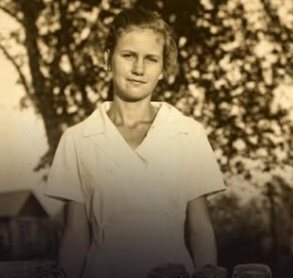
She was sitting at the back of the room.
December 1909. A teachers’ conference in Columbia, South Carolina. A government official at the front was describing a new federal program — young farm boys across the South were being given seed, land, and instruction in modern agriculture. They were producing harvests two and three times larger than their own fathers. It was, by any measure, a success.
The woman at the back was twenty-seven years old. Her name was Marie Cromer. She taught at a one-room schoolhouse in Aiken County — the only teacher, the only principal.
She raised her hand.
But what are we doing for the farm girls?
That question is recorded in the meeting notes. And it may be the most consequential sentence ever spoken at a teachers’ conference in American history.
Marie had watched her female students — girls aged nine to twenty — drop out of school every spring because their families needed their labor in the fields. They had no shoes in summer. They were expected to marry by sixteen, bear children every two years, and own nothing the law allowed a husband to own instead. Their brothers would one day inherit what little land the family had. They would not.
She came home and built something.
On her own initiative, she organized the Aiken County Girls’ Tomato Club — the first organization of its kind in the United States. Each girl who joined received a packet of tomato seeds, a one-tenth-acre plot on her family’s farm, and something more radical than either: instruction in keeping a financial ledger, and the right to keep every single cent she earned.
In the spring of 1910, forty-seven girls enrolled.
They planted. They watered. They weeded. They harvested. They canned. They sold.
And they kept the money.
The prize that first season was a scholarship to Winthrop College. Marie didn’t have the $140 to fund it herself, so she wrote to a wealthy polo enthusiast from New York who wintered in Aiken County. He funded it.
By late summer, a girl named Katie Gunter had canned 512 jars of tomatoes from her tenth of an acre and cleared a $40 profit. The scholarship was hers.
Within a few years, the best-performing girls were clearing $70 and $80 from that same tenth of an acre — more than many of their fathers earned sharecropping cotton for an entire year.
The clubs spread. Virginia. Alabama. Georgia. Mississippi. Tennessee. By 1913, over twenty thousand girls were enrolled across fifteen Southern states.
The U.S. Department of Agriculture appointed Marie one of the first women ever assigned to agricultural field work in the federal civil service.
A girl wrote about the experience in 1915:
“The work was long and sometimes tiresome. But I now have a bank account of sixty dollars.”
In 1915. In rural South Carolina. A teenage girl. A bank account. In her own name.
The Nineteenth Amendment — giving women the right to vote — would not arrive for another five years.
In 1914, the federal Smith-Lever Act folded the tomato clubs, the corn clubs, and related programs into a single national cooperative extension service. That combined program was given a name in 1924.
You know it as 4-H.
Marie Cromer went on to establish the first home economics curriculum in Aiken County. In 1953, President Dwight D. Eisenhower formally recognized her at the National 4-H Camp in Washington, D.C., as one of the founders of the organization.
She died on June 14, 1964, at home in Eureka, South Carolina. She was eighty-one years old.
There is a small historical marker on Highway 191.
Today, approximately six million American children are enrolled in 4-H. It is the largest youth-development organization in the United States.
Marie Cromer never gave a speech.
She raised her hand at the back of a conference room.
She asked one question.
And the country spent the next hundred and fifteen years answering it.