
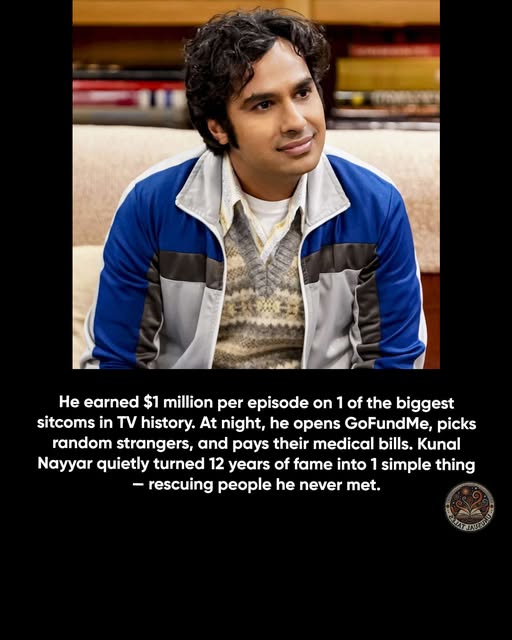
In 2007, a 26-year-old actor from New Delhi walked onto a Hollywood set with almost no experience. His name was Kunal Nayyar. He had been born in London to Indian parents, raised in India from the age of 3, and had come to America for higher education. He had only 2 acting credits to his name. Nobody could have guessed what was about to happen.
The show was called The Big Bang Theory. He was cast as Rajesh Koothrappali, a shy astrophysicist who could not even speak to women without help. His salary in season 1 was $45,000 per episode.
12 seasons and 279 episodes later, the show became one of the most successful sitcoms in television history. By the final seasons, Kunal and his 4 original co-stars were each earning a reported $1 million per episode. Forbes ranked him as the 3rd highest-paid TV actor in the entire world in 2015 and again in 2018, with annual earnings of $20 million and $23.5 million.
Money on a scale most of us cannot really picture.
He could have done what so many do at that level. Bought a fleet of cars. Built a mansion. Lived loudly. Disappeared into the kind of life that magazines love to photograph.
He did not.
Years after the show ended, in a quiet interview with The i Paper in late 2025, Kunal Nayyar revealed what he had really been doing with his money. Sitting calmly, almost as if he were talking about a small hobby, he explained it.
“Money has given me greater freedom,” he said. “And the greatest gift is the ability to give back, to change people’s lives.”
Then he described his nighttime ritual.
After dinner, after the world quiets down, he opens GoFundMe — the crowdfunding platform where families post their final pleas for help with medical bills, surgeries, and treatments they cannot afford. He scrolls. He reads stories of strangers — parents, children, sick people simply asking the internet for help. He picks a few. And then, without ever revealing his name, he pays.
He pays for a child’s chemotherapy. He pays for a surgery. He pays off a cancer bill a family would have spent the rest of their lives trying to clear. They never know it was him.
“That’s my masked vigilante thing,” he said, almost embarrassed by the words.
He does not stop there.
Alongside his wife, the former Miss India and fashion designer Neha Kapur, he quietly funds university scholarships for young people from disadvantaged backgrounds — kids whose families could never afford to send them to college. They also support animal charities, because, in his own words, “we love dogs.”
He does not make a show of any of it. There are no foundations with his face on the wall. No fundraising galas. No press tours. Just a man at home, late at night, choosing a stranger to save.
When asked why, he said something that has stayed with people who heard it.
“Right now people are not happy because we are all expecting someone else to be kind. We are expecting a president or a politician, some leader, to come and bring us world peace. But there is no world peace if your neighbour comes to your door wanting some sugar for their tea and you lock it against them and say, get away.”
In other words — be the neighbour. Open the door. Hand over the sugar.
For Kunal Nayyar, money is not a trophy. It is a tool. It is the rare kind of wealth that does not weigh on him. “It feels like a grace from the universe,” he said.
He still works. He has his own production company, Good Karma Productions. He stars in films — most recently Christmas Karma (2025), a musical reimagining of A Christmas Carol where he plays a modern-day Indian Scrooge whose obsession with wealth is rooted in trauma. The role almost feels like a wink at his own life.
Except in real life, Kunal Nayyar never needed a ghost to teach him the lesson.
He learned it on his own — that the truest measure of what we have is not what we hold on to, but what we quietly give away.
Somewhere tonight, a family is opening an email, looking at a GoFundMe page, and finding that someone they will never meet has paid for their child’s surgery. They will cry. They will not know who. They will whisper a small thank you into an empty room.
And somewhere across the world, the man who paid will already be asleep, ready for the next day.
He does not need to know what happens next.
For him, that is the whole point.