
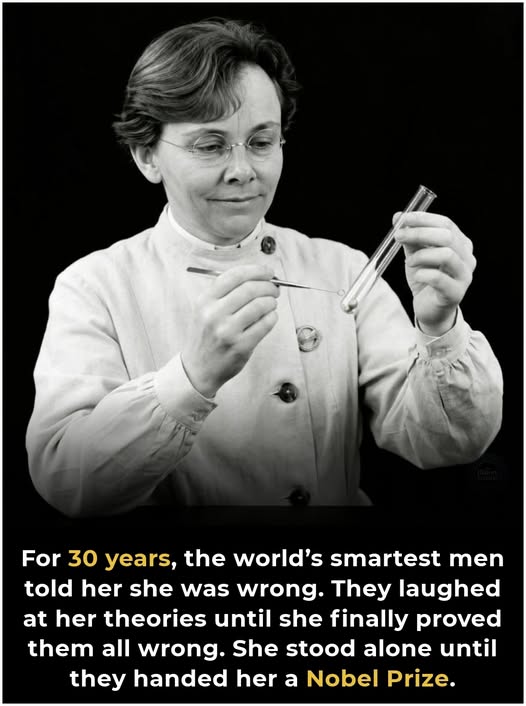
In 1951, she stood before a crowd of the most brilliant minds in genetics to present her life’s work. By the time she finished, the room was silent. Then, the whispers started. They didn’t just disagree with her; they mocked her.
Barbara McClintock was a woman working in a man’s world at Cornell and later Cold Spring Harbor. In an era when genes were thought to be fixed in place like pearls on a string, she discovered something impossible. She found that genes could actually move.
She called them transposable elements, or jumping genes. The scientific establishment was outraged. They told her she didn’t understand her own data. They said her colonial-colored corn kernels were just a biological fluke.
But Barbara knew what she had seen under her microscope. She had spent years alone in the fields, meticulously tracking the patterns of heritage in every leaf and cob. She saw the truth when no one else would look.
For the next two decades, the mockery turned into something worse: silence. Barbara stopped publishing her findings in major journals. She didn’t seek fame or argue with her critics. She simply went back to her laboratory and continued her work in total isolation.
She saw their skepticism. She saw their arrogance. She saw their mistake.
But the truth does not change just because it is ignored. By the 1970s, new technology finally allowed scientists to look deeper into the DNA of other organisms. One by one, they began to find exactly what Barbara had described decades earlier.
Geneticists realized that her jumping genes were not a fluke. They were the key to understanding evolution, cancer, and the very complexity of life itself. The woman they had pushed into the shadows had been right all along.
In 1983, at the age of 81, she was finally called to the stage in Stockholm. She became the first woman to win an unshared Nobel Prize in Physiology or Medicine. It took thirty years for the world to catch up to her.
Today, every biology textbook carries her legacy. She proved that courage is the ability to stand by what you know is true, even when the rest of the world is turned against you.
She didn’t need their validation to change history.
Sources: Nobel Prize Press Office / Genetics Society of America