
Congestive heart failure (CHF) is a major global health problem and one of the leading causes of morbidity and mortality worldwide. Coenzyme Q10 (CoQ10), also known as ubiquinone, is a lipid-soluble antioxidant that plays an important role in mitochondrial energy production by participating in the electron transport chain for ATP synthesis. Because the heart requires a large amount of energy, it contains high concentrations of CoQ10, and reduced levels of this compound have been associated with increased severity of CHF. This relationship has led researchers to investigate whether supplementation with CoQ10 could improve cardiac function and clinical outcomes in patients with heart failure.
A meta-analysis published in The American Journal of Clinical Nutrition evaluated randomized controlled trials examining the effects of CoQ10 supplementation on patients with CHF.
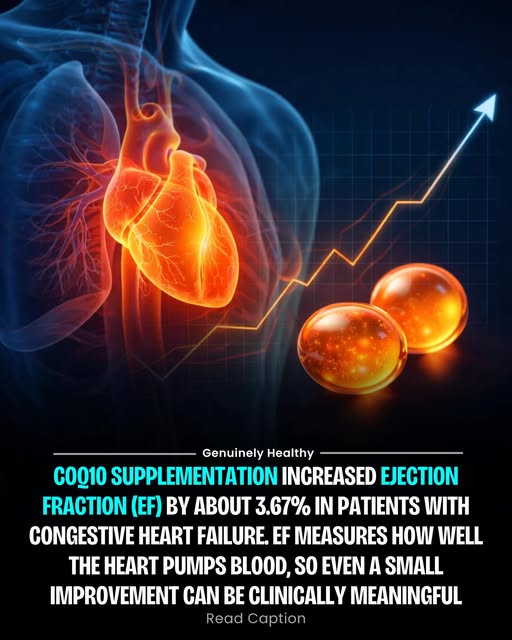
The analysis included 13 studies involving 395 participants and assessed outcomes such as ejection fraction (EF) and the New York Heart Association (NYHA) functional classification. Results showed that CoQ10 supplementation led to a pooled mean increase of approximately 3.67% in ejection fraction, indicating improved heart pumping ability. Although a slight improvement in NYHA functional class was observed, the change was not statistically significant. Overall, the findings suggest that CoQ10 supplementation may provide benefits for patients with heart failure, particularly in improving cardiac function, although further large and well-designed studies are needed to confirm these effects.