
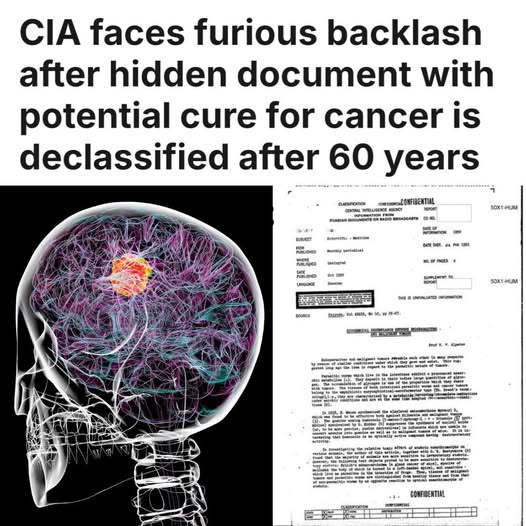
Declassified 1951 CIA Report Shows Strong Similarities Between Parasites and Cancer—This Points Directly to Treatments Like Ivermectin
A declassified CIA document from February 1951 was marked CONFIDENTIAL and remained classified until 2014. It summarizes a 1950 Soviet scientific paper and outlines clear biological similarities between malignant tumors and certain parasites, including intestinal worms.
Both thrive in low-oxygen conditions.
Both store large reserves of glycogen.
Both produce energy efficiently with very little or no oxygen present.
The report highlights several key points:
• Tumors and parasites function as “aerofermentors.” They generate energy effectively in oxygen-poor settings and survive in nearly oxygen-free environments. This matches the low-oxygen cores commonly seen in solid tumors and the oxygen-limited conditions inside the gut where many parasites live.
• Early experiments tested compounds designed to target parasites and discovered they also impacted tumors. Examples include:
– Myracyl D, which treated parasitic infections such as bilharzia and demonstrated activity against malignant tumors.
– Guanozolo, which blocked nucleic acid production essential for DNA and RNA, slowing growth in both microbes and mouse tumors.
– Different mirror-image forms of Atebrin affected tumor tissues and parasites differently than healthy cells, indicating altered receptors in diseased states.
• Additional shared characteristics include unusual purine metabolism, modified proteins, and possible unique antigens that may contribute to cancer development.
These observations show that treatments effective against parasites can cross over to cancer because of the shared biology.
This directly aligns with the known actions of ivermectin, a powerful antiparasitic drug.
Laboratory studies and animal models demonstrate that ivermectin:
• Stops cancer cells from growing and spreading.
• Triggers programmed cell death in cancer cells.
• Blocks new blood vessel formation that tumors need to grow.
• Interferes with critical cancer signaling pathways.
• Enhances the effectiveness of chemotherapy in resistant cancer cells.
These effects appear across models of breast cancer, colorectal cancer, lung cancer, pancreatic cancer, ovarian cancer, and many others.
Current developments strengthen the case:
• In early 2026, the National Cancer Institute confirmed they are conducting preclinical laboratory studies on ivermectin’s ability to kill cancer cells, driven by accumulating evidence and strong public interest. Results are expected soon.
• Early human trials have begun combining ivermectin with immunotherapy agents for metastatic triple-negative breast cancer, evaluating safety and initial signs of effectiveness.
• Peer-reviewed scientific reviews present ivermectin as a low-cost compound with a well-established safety profile at approved doses, making it a strong candidate for further cancer research.
This 1951 document, kept secret for over 70 years, combined with the growing body of modern research on ivermectin, shows that the metabolic weaknesses shared by parasites and cancer cells have been recognized for decades.
Affordable antiparasitic approaches that exploit these exact vulnerabilities are now under serious scientific scrutiny.
The implications are clear and urgent.
Simple, accessible strategies that target these shared biological features deserve immediate large-scale investigation.