Garden Bed Heights

Garden Bed Heights

The most common raised bed mistake happens before a single seed goes in. You pick the height that’s cheapest, not the height that matches the body using it every day for the next ten years.

A 30 cm bed — the default kit at every hardware store — requires a full forward bend to reach the soil. That’s the posture that ends most gardening sessions after twenty minutes.

An 45 cm bed cuts the bending in half. Most gardeners can work for an hour comfortably. Enough depth for carrots, peppers, and most root crops.

A 60 cm bed lets you sit on a stool beside it and work at table height. No crop is limited by depth.

A 90 cm bed changes everything:

– Zero bending. Standing-height planting, weeding, and harvesting.

– A person in a wheelchair can reach the soil from seated position.

– This is the height that turns gardening from something that hurts into something that doesn’t — the reason people who quit can start again.

A 120 cm x 480 cm bed at 30 cm needs about 172 litres of mix. If you fill the whole bed with soil, 60 cm requires double that and 90 cm, the same footprint needs three times that.

The soil budget does not need to scale with the height — plan before you cut wood.  Most annual vegetable crops develop the majority of their active root system in the top 15-25 cm (6 to 10 inches) of growing medium. The fine feeder roots that absorb water and nutrients concentrate in the upper portion of the bed where organic matter, biological activity, and oxygen levels are highest. The deeper roots provide anchorage and access water reserves during dry periods but do not contribute significantly to nutrient uptake in the same way the upper feeder roots do.

The bottom layer of a raised bed can be filled with any combination of organic materials that will decompose over time and contribute to the growing medium above. This is the hugelkultur principle applied in a simplified form.

Cardboard: plain cardboard without glossy printing or staples. Breaks down within one season. Suppresses any grass or weeds below the bed. Contributes carbon to the developing soil biology.

Small logs and branches: woody material that decomposes slowly, holding moisture and releasing nutrients over years. Fill loosely to allow settling.

Leaves: autumn leaves either fresh or partially composted. High carbon material that decomposes within one to two seasons. Free from any garden with deciduous trees.

Straw: clean straw, not hay which contains seeds, provides bulk fill that decomposes within one season contributing organic matter to the growing medium above.

Grass clippings: mixed with cardboard or leaves to prevent compacting into a dense mat. High nitrogen material that decomposes rapidly and contributes fertility.

The combination of cardboard at the very base, logs or branches above it, and leaves or straw filling the gaps produces the most biologically active bottom layer with the widest range of decomposition rates and the most significant long-term contribution to the growing medium above.

Match the bed height to the body that uses it. Not the kit that’s on sale.

Raised Garden Bed Soil Mix

Raised Garden Bed Soil Mix

The most common raised bed mistake is filling the entire depth with expensive purchased topsoil or compost. A standard 30 cm (12-inch) deep raised bed filled entirely with quality growing medium costs significantly more than it needs to and provides no growing advantage over a bed filled with a cost-effective layered approach that uses the bottom half for bulk fill and reserves the upper half for the quality growing medium where plant roots actually spend most of their time.

Understanding what plant roots need, and where in the bed profile they actually develop, changes how you approach filling a raised bed and significantly reduces the cost of establishing one without any reduction in growing performance.

Here is the complete raised bed filling framework ??

What roots actually need and where they grow:

Most annual vegetable crops develop the majority of their active root system in the top 15-25 cm (6 to 10 inches) of growing medium. The fine feeder roots that absorb water and nutrients concentrate in the upper portion of the bed where organic matter, biological activity, and oxygen levels are highest. The deeper roots provide anchorage and access water reserves during dry periods but do not contribute significantly to nutrient uptake in the same way the upper feeder roots do.

This root distribution means the quality and composition of the upper half of the bed matters enormously. The lower portion of a deep bed matters much less and can be filled with significantly less expensive bulk material that contributes primarily as a moisture reservoir and as organic matter that decomposes upward over subsequent seasons.

The layered filling approach — the cost-effective method:

Bottom layer — the bulk fill, 15 cm (6 inches).

The bottom layer of a raised bed can be filled with any combination of organic materials that will decompose over time and contribute to the growing medium above. This is the hugelkultur principle applied in a simplified form.

Small logs and branches: woody material that decomposes slowly, holding moisture and releasing nutrients over years. Fill loosely to allow settling.

Cardboard: plain cardboard without glossy printing or staples. Breaks down within one season. Suppresses any grass or weeds below the bed. Contributes carbon to the developing soil biology.

Leaves: autumn leaves either fresh or partially composted. High carbon material that decomposes within one to two seasons. Free from any garden with deciduous trees.

Straw: clean straw, not hay which contains seeds, provides bulk fill that decomposes within one season contributing organic matter to the growing medium above.

Grass clippings: mixed with cardboard or leaves to prevent compacting into a dense mat. High nitrogen material that decomposes rapidly and contributes fertility.

The combination of cardboard at the very base, logs or branches above it, and leaves or straw filling the gaps produces the most biologically active bottom layer with the widest range of decomposition rates and the most significant long-term contribution to the growing medium above.

Middle layer — the transition zone, 5 cm (2 inches).

A transition layer of finished compost between the bulk fill and the quality growing medium above introduces the biological community that begins processing the bulk material below. It also provides an anchor layer for the growing medium above and prevents settling of the surface layer directly into the bulk material below.

Top layer — the quality growing medium, 15-20 cm (6 to 8 inches).

The top layer is where the investment is made. This is the growing medium that plant roots primarily occupy and where the growing performance of the bed is determined. Two approaches both produce excellent results.

Mel’s Mix — the original square foot gardening formula:

Mel Bartholomew developed this growing medium formula for his Square Foot Gardening system in the 1970s and it remains one of the most widely used and most reliable growing medium recipes available. The formula is simple and the results are consistently excellent.

One third blended compost. One third peat moss or coco coir. One third coarse perlite.

The blended compost component

Mel’s original formula specifies blended compost from multiple sources rather than a single compost type. The reasoning is that different compost sources have different nutrient profiles and microbial communities. A blend of three to five different composts, mushroom compost, worm castings, garden compost, manure-based compost, and leaf compost, provides a more complete and diverse foundation than any single compost source.

Most gardeners cannot source five different composts economically. A blend of two or three is an adequate practical compromise. At minimum combine a mushroom or manure-based compost with a leaf or green waste compost for meaningful diversity.

The peat moss or coco coir component

Peat moss provides the moisture retention and slightly acidic pH that suits most vegetable crops. It also improves the physical structure of the growing medium, preventing compaction and maintaining the loose open texture that plant roots and soil organisms require. The environmental concern around peat extraction from peat bogs makes coco coir the preferred alternative in most current applications. Coco coir provides similar moisture retention and physical structure benefits without the ecological cost of peat extraction.

Coco coir is available in compressed bricks that expand when hydrated. One compressed brick typically produces 2 to 3 gallons of expanded coir. Hydrate fully before incorporating into the mix.

The coarse perlite component

Perlite prevents the compaction that would otherwise occur in a growing medium dominated by compost and coir. Over time compost-heavy growing medium compacts under the weight of watering and plant root development. Perlite particles maintain the pore structure that allows air and water to move through the medium and that prevents the anaerobic conditions that damage root systems.

Use coarse perlite rather than fine perlite. Fine perlite particles wash to the surface with repeated watering and provide less durable pore structure than coarse particles.

The Volume Calculation

To avoid over or under purchasing, calculate the volume of your bed in liters or cubic feet. Length multiplied by width multiplied by depth. For a 120 cm (4 foot) by 240 cm (8 foot) bed filled to 30 cm (12 inches) depth: .86 of a cubic meter (860 liters) (4 x 8 x 1 feet equals 32 cubic feet) total. The bottom half bulk fill layer represents half that volume. The top half quality growing medium represents the remaining half.

For Mel’s Mix in the top layer, half the total volume is 430 liters (16 cubic feet) divided by 3 equals approximately 143 liters (5.3 cubic feet) of each component. Purchase 150 liters (6 x 25 liter bags) (6 cubic feet) of each to allow for settling.

Settling Allowance

All raised bed growing medium settles significantly in the first season as organic materials begin to decompose and compact slightly. Fill the bed 2-5 cm (1 to 2 inches) above the top of the frame to compensate for first-season settling. Add a 2 cm (1 inch) compost top dressing each spring to maintain the growing medium level and replace the organic matter lost to decomposition.

The Economics — What This Actually Costs

As of 10 April 2026 from Bunnings in Sydney,
Compost $6-10 25l
Peat Moss $50 25l
Coco Coir $27.50 90l
Perlite $15.56 25l
Vermiculite $50 25l
Cow manure $5 25l
Chook manure $5 25l
Sheep Manure $7 25l
Potting Mix $4-11 25l

2 blocks coco coir $55
6 bags compost $48
6 bags perlite $94
Total outlay $197

So filling our garden bed with a 6-inch bulk fill layer and 6-inch Mel’s Mix top layer costs less than $200 in materials depending on local compost prices and whether bulk fill materials are sourced free from the garden. The same bed filled entirely with purchased topsoil or bagged growing medium costs $400 or more.

The layered approach costs half as much, produces better long-term growing performance as the bulk fill decomposes and enriches the bed from below, and uses materials that would otherwise go to a green waste collection.

To create a cubic meter of soil from scratch

(assuming access to compost that contains no manure)
(Prices from Bunnings.com.au, Sydney 10 April 20226)

525 litres compost (21 x 25 litre bags) $328
250 litres perlite (10 x 25 litre bags) $156
1 block coco coir (1 x 90 litre block) $28
75 litres cow manure (3 x 25 litre bags) $16
25 litres chook manure (1 x 25 litre bags) $5
25 litres mushroom compost (1 x 25 litre bags) $6
10 litres seaweed (1 x 10 litre bags) $99
Total: $638

Making your own compost halves the cost of creating soil.

Topping up established beds — the annual maintenance:

Every season the growing medium level in a raised bed drops 1 to 2 inches as organic matter decomposes. Maintaining the growing medium level by adding a 2 cm (1 to 2 inch) compost top dressing each spring maintains the quality of the upper growing zone and replaces the biological activity lost as organic matter is processed.

Do not add more perlite or coir annually. These components do not decompose and accumulate in the growing medium over multiple seasons. Add compost only for annual top ups. If you top-dress annually, complete refreshment is needed only every 3 to 5 seasons when the growing medium has significantly degraded.

A complete refresh is roughly:
35 % old soil (minerals + microbial continuity)
35 % compost (fertility + biology)
20 % perlite (drainage & air — crucial for veggies in pots)
5–6 % peat moss or coco coir (moisture without sogginess)
4 % cow manure
1 % chook manure (gentle nutrient boost)

Fill it right once. Top dress annually. The bed improves every season.

Save this. Use this formula for your next raised bed installation or potting mix.

Pruning Berry Bushes

Pruning Berry Bushes

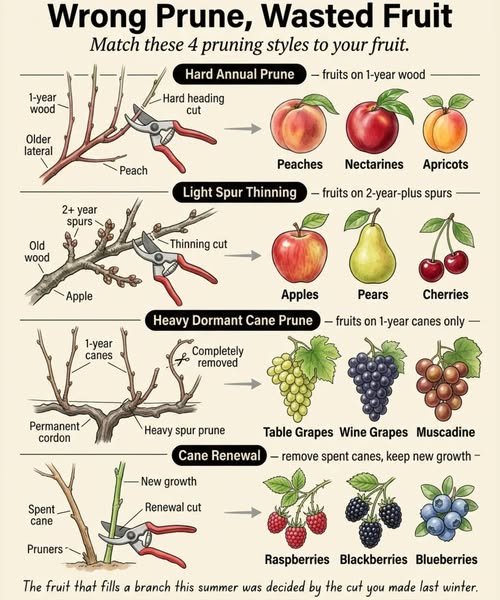
Every berry bush in your yard follows a different pruning logic. Treat them the same way and you cut off this year’s harvest or leave dead wood choking out the productive stems.

One question settles each one: which canes carry this year’s fruit.

Blueberry
Best fruit comes from canes that are a few years old. After about six years a cane turns thick and gray-barked with sparse small berries. Remove one or two of the oldest trunks at the base each spring and let fresh shoots replace them. A mature bush wants six to eight main canes of mixed ages

Raspberry
The cane type changes the whole approach:

– Summer-bearing types fruit on last year’s canes. Those spent canes are gray and brittle by spring — cut them all at ground level. Then thin the new green canes to the four or five strongest per foot of row

– Ever-bearing types fruit on the current season’s growth. The simplest method is to mow everything to the ground in early spring and let the row regenerate for one heavy fall crop

Blackberry
Same principle as summer raspberry. Canes that fruited last year are done — gray and papery while this year’s canes are green or reddish. Remove the spent ones at the base. On upright varieties, shorten the side branches on new canes to concentrate berry size

Currant and Gooseberry
Both fruit best on two- and three-year-old wood. Remove canes older than three years each spring. Keep three or four canes of each age class so the bush stays permanently productive without losing a full crop year

The canes that fruited are finished. The canes that grew last year are loaded. The canes emerging now are next year’s investment. Three ages, three roles — pruning is just deciding who stays.

Pest Predator

Pest Predator

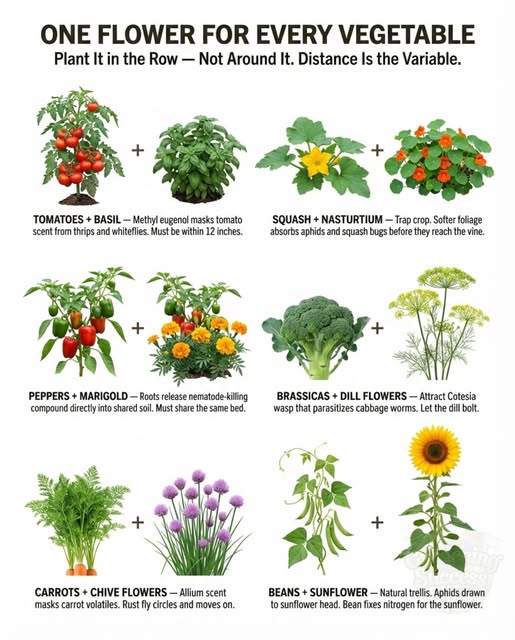
The pest doesn’t need spraying. It needs a predator. The predator doesn’t need buying. It needs a flower.

Plant the right flower and the predator shows up on its own, finds the pest, and does the work for free. The chain assembles itself.

Five chains that work:

– Aphids → ladybug larvae → plant yarrow. The larvae do the killing — hundreds of aphids each. The yarrow keeps the adults around to lay eggs near the colony.

– Tomato hornworms → braconid wasps → let your dill bolt. The wasp lays eggs inside the hornworm. The flowers are the weapon, not the dill leaves.

– Slugs → ground beetles → let cilantro flower. The beetles hunt at night while you sleep. The flowers give them daytime shelter.

– Cabbage worms → paper wasps → plant fennel. The wasps catch caterpillars, chew them into paste, and feed them to their own larvae. One nest near your brassicas catches dozens a day.

– Whiteflies → lacewing larvae → plant cosmos. The larvae have sickle-shaped jaws that drain whiteflies in seconds. The cosmos keeps adult lacewings fed and laying eggs nearby.

One flower per pest. The predator does the rest.

Match The Compost To The Purpose

Match The Compost To The Purpose

You add the same bag of compost to every bed and assume the soil got what it needed.

It didn’t. Compost isn’t one product. What it started from, how it broke down, and how long it aged all determine what it delivers — and what it can’t.

Four types. Four different jobs. Most gardens need more than one.

Hot compost — the all-purpose base. The sustained heat kills weed seeds and breaks material into stable, balanced soil amendment. Safe for direct contact with any planting. But the heat also burns off much of the nitrogen, so hot compost builds structure and biology more than it feeds. Heavy producers like tomatoes can stall mid-season if this is the only input.

Worm castings — concentrated and fast-acting. More available nutrients packed into a fraction of the volume. Ideal for transplant holes, seed-starting trays, and container refreshes where space limits how much you can add. Broadcasting it across full beds wastes its strength on soil that doesn’t need that intensity.

Leaf mold — almost no fertility, but holds several times its weight in moisture. Decomposed by fungi, not bacteria. It builds the crumbly aerated texture that perennials, berries, and garlic thrive in. Spreading it where heavy feeders need nitrogen is giving them a sponge when they’re asking for fuel.

Aged manure compost — the nitrogen source the others can’t match. Composted chicken, horse, or cow manure delivers the sustained feeding that squash, corn, and large tomatoes demand through a long season. The key word is aged — raw manure needs months of composting before it goes near food crops.

Six Soil Tests

Six Soil Tests

Before you buy a single bag of anything, grab a handful of soil from your garden and squeeze it.

If it crumbles apart immediately, you’ve got sand. If it holds its shape with a shiny surface, you’ve got clay. If it holds shape but breaks apart when you poke it, that’s loam — and loam is what you’re building toward.

That took five seconds. Here are three more tests that cost nothing.

The ribbon test:
Press a moist ball of soil between your thumb and finger into a flat ribbon. If it breaks before an inch — sandy. If it stretches past two inches without breaking — heavy clay. The longer the ribbon, the more clay you’re working with.

The worm count:
Flip one full shovelful of soil and count the earthworms. Ten or more means the biology is working. Under five means the soil needs organic matter — compost, leaf mulch, or cover crops. Worms tell you what a lab test can’t: whether anything is alive down there.

The jar test:
Fill a jar one-third with soil, add water, shake hard, and set it down. Sand drops to the bottom in a minute. Silt settles in a few hours. Clay stays cloudy for a full day. After 24 hours you can see the layers and roughly gauge your soil’s composition without sending anything to a lab.

Every one of these tests points the same direction: add compost. Sand needs it for moisture retention. Clay needs it for drainage. Low worm counts need it for biology. Compost is the answer to almost everything these tests reveal.

Four tests. No kit. Your hands and a jar.

Mulch vs No Mulch

Mulch vs No Mulch

Same soil. Same plants. Same seeds, same day. One bed got three inches of straw mulch in April. The other got nothing.

By July, they don’t look like the same garden.

The bare bed dried out in two days after every watering. Weeds filled the gaps between plants. The soil surface cracked in the heat. The lettuce bolted. The peppers stalled.

The mulched bed held moisture for four or five days between waterings. Pull back the straw in July and you’ll find earthworms at the surface — in the middle of summer. That tells you what’s happening underneath. The soil stays cooler, the roots stay comfortable, and the plants keep producing.

One input. Four shifts:
– Moisture — the mulched bed needs watering roughly half as often
– Weeds — straw blocks light from reaching weed seeds. Almost nothing germinates
– Temperature — soil under mulch runs noticeably cooler than bare ground next to it
– Yield — the plants in mulch outproduce the bare bed by a wide margin from the same starts

Which mulch to use:
– Straw — cheap, available, decomposes slowly. The standard for vegetable beds
– Wood chips — longer lasting, better for paths and perennial beds. Keep out of annual rows
– Shredded leaves — free every fall. Break down fast and feed the soil. Layer with straw for best results

Three inches, pulled back an inch from stems. Add more as it settles through the season.

One afternoon. The garden waters itself less and weeds itself less for the rest of summer.

Core Raised Garden Beds

Core Raised Garden Beds

Most raised beds lose water straight down through the soil. Roots chase it, the surface dries out, and by midsummer you are watering every single day just to keep up.

A core garden buries a sponge down the center of the bed. A trench eight to ten inches deep runs the full length, filled with four to five inches of straw or dried leaves. When you soak that core, it absorbs water the way a sponge absorbs from a bowl — then releases it laterally through the soil, reaching roots up to two feet on either side. Instead of water draining straight past the root zone, it sits in the middle of the bed and feeds outward all week.

The method originated in arid regions where rainfall was scarce and every drop had to count. Gardeners dug trenches, packed them with dried grass, and covered them with soil. The buried organic layer held enough moisture to grow food through dry stretches without daily irrigation. The same principle works in any raised bed — and unlike a wicking bed, there is no liner, no plumbing, and no reservoir to build. You dig a trench, fill it, cover it, charge it with water, and plant the same day.

How to build a core garden bed:
1. Lay cardboard on the grass inside your raised bed frame to smother weeds and attract earthworms as it decomposes. Add a few inches of soil over the cardboard to create a base layer

2. Dig a trench eight to ten inches deep running horizontally down the center of the bed. Keep the excavated soil nearby — you will use it to cover the core

3. Fill the trench with four to five inches of partially broken-down straw, dried leaves, or shredded grass clippings. Straw works best because hay carries grass seeds that will sprout in your bed. Do not overfill — too thick a core will not decompose by next season

4. Cover the core completely with quality topsoil or compost so no straw is exposed. The surface should look like any normal raised bed — the sponge is invisible underneath

5. Charge the core by flooding the bed with a deep, slow watering until the soil is saturated down to the straw layer. This is the step that activates the system — a dry core does nothing. After charging, plant immediately and mulch the surface.

The straw breaks down over one season, loosening soil structure and adding organic matter as it goes. Each spring, dig a new trench and lay a fresh core. The bed gets lighter, drains better, and holds more moisture every year — all from burying material most people rake to the curb.

A trench, some straw, and one deep watering — the bed holds moisture the way soil alone never could.

Make Your Own Plant Food

Make Your Own Plant Food

Six fertilizers made from scraps — and each one targets a different plant need.
The trick isn’t which one you make. It’s matching the right brew to what your plants are actually asking for.

Compost tea delivers living soil microbes straight to the root zone of tomatoes, peppers, roses, and fruit trees. Steep finished compost in a burlap sack for two days, stir daily, dilute to weak-tea color, and pour at the base.

Bone meal slurry gets phosphorus to roots faster than dry powder sitting on the surface. Two tablespoons per gallon, soak overnight, water directly into planting holes.

Fermented banana peel soak is a potassium feed that strengthens flower production. Chop peels, submerge in water, ferment five days, strain, and dilute one part liquid to four parts water. Use on dahlias, zinnias, and sunflowers during bud development.

Fish emulsion is high nitrogen for heavy feeders. Blend fish scraps with water, add sawdust to absorb odor, ferment two weeks with occasional stirring, strain, and dilute one-to-ten. Corn, squash, and brassicas take it up fast.

Eggshell and vinegar extract converts calcium into a form roots can absorb immediately. Dissolve crushed shells in apple cider vinegar until fizzing stops — about two days. One tablespoon per gallon, applied to tomatoes, peppers, and melons at flowering stage.

Seaweed concentrate delivers trace minerals most garden soils are missing. Soak fresh or dried seaweed three weeks, dilute one-to-five, and use as a foliar spray on seedlings, transplants, and stressed perennials.

Every recipe starts with something that would have gone in the trash.

Safe vs Unsafe Pots

Safe vs Unsafe Pots

What you grow your veggies in is just as important as the soil you use. Summer garden conditions—like heat, UV rays, and slightly acidic soil—can actually cause certain planters to leach unwanted compounds right into your food’s root zone!

Here’s a quick guide to keeping your container garden safe and healthy. Containers to Skip for Food Crops:

• Old Tires: They might seem like a clever upcycling hack, but rubber can leach heavy metals like zinc and cadmium, along with petroleum-based compounds, especially when baking in the summer sun.

• Pre-2004 Treated Lumber: Older treated wood was often preserved with CCA (chromated copper arsenate). While modern post-2004 treated lumber uses safer chemistry, untreated naturally rot-resistant wood remains the ultimate worry-free choice.

• Mystery Glazed Pottery: Older pieces or uncertified imported ceramics can sometimes hide lead in their beautiful glazes. Keep these for your ornamental houseplants and flowers!

• Galvanized Steel: These rustic buckets look great, but they can leach excess zinc into highly acidic soils. While plants need a little zinc, too much can stunt your veggies.

• Styrofoam & PVC: Constant sunlight and high temperatures cause these materials to degrade and become brittle over time, shedding microplastics and other chemical compounds into your soil.

Safe Bets for a Healthy Harvest:

• Food-Grade Plastics: Flip that container over and look for recycling codes #2 (HDPE) or #5 (PP). These stable plastics are exactly what’s used for food storage and are completely safe for growing edibles!

• Untreated Cedar: The gold standard for wooden raised beds. It’s naturally rot-resistant, beautifully rustic, and 100% chemical-free.

• Unglazed Terracotta: Classic for a reason! It’s simply baked earth—free of additives, highly breathable, and perfectly safe for your food crops.

• Fabric Grow Bags: A veggie gardener’s best friend! They’re food-safe, drain beautifully, and naturally “air-prune” your plants’ roots to keep them from circling. They are hands-down one of the best choices for growing robust tomatoes and peppers!