The most common raised bed mistake happens before a single seed goes in. You pick the height that’s cheapest, not the height that matches the body using it every day for the next ten years.
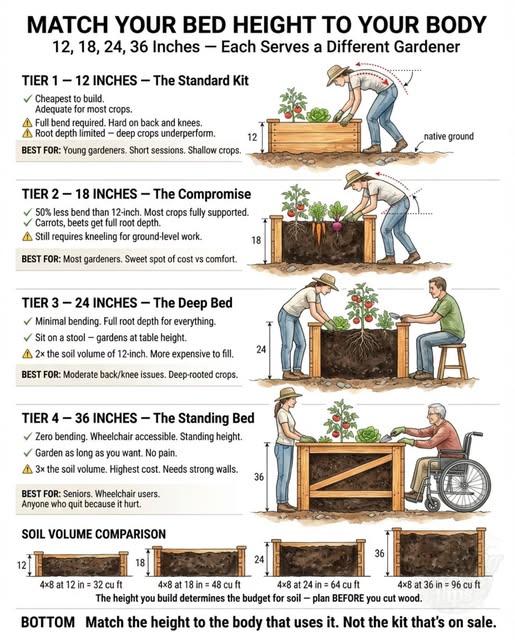
A 30 cm bed — the default kit at every hardware store — requires a full forward bend to reach the soil. That’s the posture that ends most gardening sessions after twenty minutes.
An 45 cm bed cuts the bending in half. Most gardeners can work for an hour comfortably. Enough depth for carrots, peppers, and most root crops.
A 60 cm bed lets you sit on a stool beside it and work at table height. No crop is limited by depth.
A 90 cm bed changes everything:
– Zero bending. Standing-height planting, weeding, and harvesting.
– A person in a wheelchair can reach the soil from seated position.
– This is the height that turns gardening from something that hurts into something that doesn’t — the reason people who quit can start again.
A 120 cm x 480 cm bed at 30 cm needs about 172 litres of mix. If you fill the whole bed with soil, 60 cm requires double that and 90 cm, the same footprint needs three times that.
The soil budget does not need to scale with the height — plan before you cut wood. Most annual vegetable crops develop the majority of their active root system in the top 15-25 cm (6 to 10 inches) of growing medium. The fine feeder roots that absorb water and nutrients concentrate in the upper portion of the bed where organic matter, biological activity, and oxygen levels are highest. The deeper roots provide anchorage and access water reserves during dry periods but do not contribute significantly to nutrient uptake in the same way the upper feeder roots do.
The bottom layer of a raised bed can be filled with any combination of organic materials that will decompose over time and contribute to the growing medium above. This is the hugelkultur principle applied in a simplified form.
Cardboard: plain cardboard without glossy printing or staples. Breaks down within one season. Suppresses any grass or weeds below the bed. Contributes carbon to the developing soil biology.
Small logs and branches: woody material that decomposes slowly, holding moisture and releasing nutrients over years. Fill loosely to allow settling.
Leaves: autumn leaves either fresh or partially composted. High carbon material that decomposes within one to two seasons. Free from any garden with deciduous trees.
Straw: clean straw, not hay which contains seeds, provides bulk fill that decomposes within one season contributing organic matter to the growing medium above.
Grass clippings: mixed with cardboard or leaves to prevent compacting into a dense mat. High nitrogen material that decomposes rapidly and contributes fertility.
The combination of cardboard at the very base, logs or branches above it, and leaves or straw filling the gaps produces the most biologically active bottom layer with the widest range of decomposition rates and the most significant long-term contribution to the growing medium above.
Match the bed height to the body that uses it. Not the kit that’s on sale.