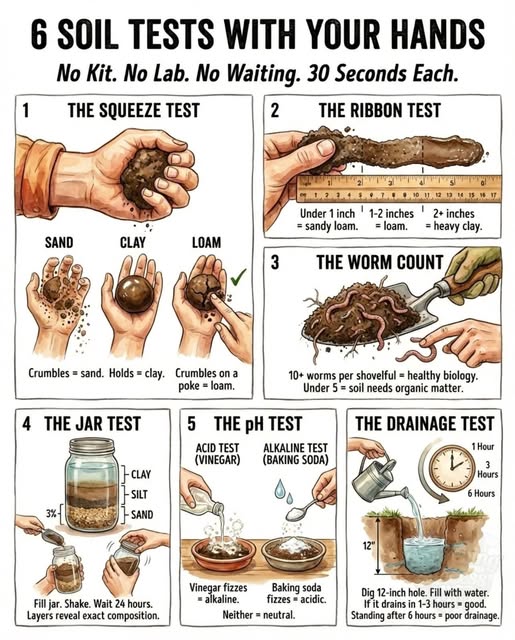
Before you buy a single bag of anything, grab a handful of soil from your garden and squeeze it.
If it crumbles apart immediately, you’ve got sand. If it holds its shape with a shiny surface, you’ve got clay. If it holds shape but breaks apart when you poke it, that’s loam — and loam is what you’re building toward.
That took five seconds. Here are three more tests that cost nothing.
The ribbon test:
Press a moist ball of soil between your thumb and finger into a flat ribbon. If it breaks before an inch — sandy. If it stretches past two inches without breaking — heavy clay. The longer the ribbon, the more clay you’re working with.
The worm count:
Flip one full shovelful of soil and count the earthworms. Ten or more means the biology is working. Under five means the soil needs organic matter — compost, leaf mulch, or cover crops. Worms tell you what a lab test can’t: whether anything is alive down there.
The jar test:
Fill a jar one-third with soil, add water, shake hard, and set it down. Sand drops to the bottom in a minute. Silt settles in a few hours. Clay stays cloudy for a full day. After 24 hours you can see the layers and roughly gauge your soil’s composition without sending anything to a lab.
Every one of these tests points the same direction: add compost. Sand needs it for moisture retention. Clay needs it for drainage. Low worm counts need it for biology. Compost is the answer to almost everything these tests reveal.
Four tests. No kit. Your hands and a jar.