Every berry bush in your yard follows a different pruning logic. Treat them the same way and you cut off this year’s harvest or leave dead wood choking out the productive stems.
One question settles each one: which canes carry this year’s fruit.
Blueberry
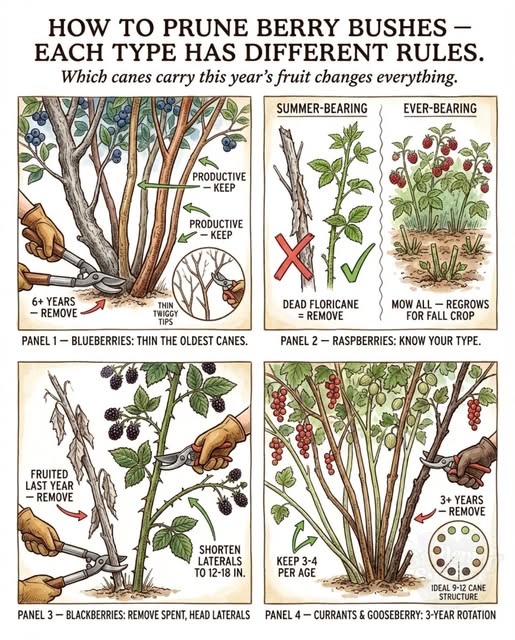
Best fruit comes from canes that are a few years old. After about six years a cane turns thick and gray-barked with sparse small berries. Remove one or two of the oldest trunks at the base each spring and let fresh shoots replace them. A mature bush wants six to eight main canes of mixed ages
Raspberry
The cane type changes the whole approach:
– Summer-bearing types fruit on last year’s canes. Those spent canes are gray and brittle by spring — cut them all at ground level. Then thin the new green canes to the four or five strongest per foot of row
– Ever-bearing types fruit on the current season’s growth. The simplest method is to mow everything to the ground in early spring and let the row regenerate for one heavy fall crop
Blackberry
Same principle as summer raspberry. Canes that fruited last year are done — gray and papery while this year’s canes are green or reddish. Remove the spent ones at the base. On upright varieties, shorten the side branches on new canes to concentrate berry size
Currant and Gooseberry
Both fruit best on two- and three-year-old wood. Remove canes older than three years each spring. Keep three or four canes of each age class so the bush stays permanently productive without losing a full crop year
The canes that fruited are finished. The canes that grew last year are loaded. The canes emerging now are next year’s investment. Three ages, three roles — pruning is just deciding who stays.