
Effectiveness is about getting the right result.
Efficiency is about getting that result with a minimal waste of resources.
The dictionary defines efficiency as acting or producing effectively with a minimum of waste, expense, or unnecessary effort.
And it defines effectiveness as having the intended or expected effect. Getting the result you wanted.
So to be effective or efficient requires you know what the result is you are aiming to produce. Let’s call this result a ‘product’, be that physical item like making a meal or a service deliverable like a moble phone service or medical diagnosis.
Therefore efficiency is getting the desired product expending as few resources as possible.
You can fail to attain your goal, despite being very efficient, by not getting products that forward your progress towards your overall goal.
You can fail by being effective without being efficient over too long a time frame to be successful.
Ideally each product you obtain should forward your progress towards some overall goal.
If it does not, you can be the most efficient person in the world and still fail to reach your goal.
So every task you undertake in an area should be aligned to forward your progress towards your goal for that area.
And even better, arrange your tasks in the priority of doing first those things that will most rapidly advance your forward progress.
To simplify it:
Effectiveness = doing the right things.
Efficiency = doing things right.
Effectiveness without efficiency means you reach the desired result, but waste resources getting there.
Efficiency without effectiveness means you perform the wrong task extremely well.
Efficiency Can Make Ineffectiveness Worse
If only your time is involved it makes no difference whether you inefficiently do one ineffective thing an hour or efficiently do ten ineffective things in the same hour.
But if resources other than your time are used, being more efficient at doing ineffective things is actually more wasteful than doing them inefficiently! The increased efficiency compounds the loss of the non-time resources.
Efficiency Is Not A ‘Set And Forget’ Activity
I am always looking for ways to accomplish a high standard product as efficiently as possible. Sometimes I even shame myself when I come up with a better technique after doing something many, many times.
As a for instance, for nearly two decades I have measured ingredients into multiple mixing bowls for different batches of my health products.
When I started, I would measure the amount required into a smaller bowl on a set of scales them tip that into each large mixing bowl.
After a while I bought multiple sets of scales, set each mixing bowl on its own set of scales then measured the quantity of each ingredient directly into each mixing bowl.
Saved the time of emptying the small quantity into each bowl. Sometimes the amount I emptied from a spoon would be more than the exact required so I would have to, if possible, fetch it out.
Then one day I set several mixing bowls out on the table with one set of scales in front and put the first ingredient packet or tub on the scales, tared the scales them spooned the amount I wanted to put in the first mix measured as a minus from zero on the scales.
This operating basis has the advantages of:
Only having to set up one set of scales – saves time and the capital cost of scales.
Only ever spooning out the exact ingredient amount. If I extract out too much onto the spoon it is easier to just jiggle the spoon to return some to the bag.
No taking a large spoonful, sprinkling into the mixing bowl until the exact amount is reached then returning the unused portion to the bag or tub.
No overage making it into the mixing bowl and no time wasted retrieving it.
Saves time cleaning only one set of scales at the end of the day.
So don’t be mistaken that just because you or somebody else has been doing something for years or decades that a faster way cannot be found that does not diminish the quality of the product and in some cases even improve it.
Doing Work Once
One of the simplest and easiest rules to say and which the vast majority of people violate most heinously in the digital realm is, “Only do a job once.”
The most egregious violation of this is reading emails. How many times have you opened an email, read it, decided to come back to it later and reread it? Instantly your workload just doubled. You just did the same work – read an email – twice. For zero increased productivity.
This is an example of why efficiency is never a set-and-forget activity – the best systems always look for smarter ways to do the same job once, perfectly, every time.
Discipline yourself to set a specific time to go through your emails and rigorously apply the data in the section below called The Four ‘D’s.
I would love it if you could, before you start this practice, run a stop watch on your email time for a week to document the amount of time you spend on emails.
Then, while rigorously applying what you have learned from this article, run the same stop watch on your email time for the next week.
If you do this I’d love you to drop me a line with your productivity gain.
Trade-offs
We don’t live in a perfect world and often a tradeoff must be made between quality and efficiency.
Hand-made goods are an extreme example. Some people are prepared to pay far more for custom-built furniture, original artwork, unique dresses etc. By all means perform that work efficiently but originality and quality are far more important.
Then there is having to get 5 tasks done in the time it would normally take you to do 4.
You may have heard the maxim that applies to software development.
1. You can choose to have the finished product contain all the features you want.
2. You can choose the have the software finished on time.
3. You can choose to have the product come in under budget.
But you can only have any two of them.
If you want the software to contain all the features and be delivered on due date, forget about budget.
If cost and features are chosen, forget about target dates.
If cost and budget are the priorities you need to tightly prioritise your features as you will not get all of them.
Testing and Piloting New Ideas
Sometimes you will want to try a new idea. Could be a new form of advertising, a new way of doing something, a new sales pitch, whatever.
Once of the best ideas I picked up from a very successful marketer was the idea of failure as being a necessary stepping stone to success.
The key was to manage testing and pilot projects, in fact you could apply this to anything new, tightly and rigorously with the intention to ‘fail small and fail fast’ so as to waste as little as possible learning if that idea worked or not.
Much better to learn the idea is a flop in a day with $100 spent than $1,000 in 10 days.
This is an excellent reason to keep score on the existing so it can be compared to the new.
How many hours does it take to produce 100 widgets under the old system versus the new?
How many leads and sales from $100 spent in the old medium compared to the new one?
Opportunity Cost
The cost of undertaking a task is not only the resources it consumes. The cost is also the lost opportunity to use those resources for something more valuable.
If your time is valued at $50 an hour at your job and you spend an hour doing something that does not contribute to the organisational goal, that is a waste of $50.
But if that same hour were expended in something that yielded $500 of gain towards the organisational goal then the opportunity cost is $500, far more than the $50 of wasted time.
The opportunity cost, in this example, $500, of inefficiency is usually higher than the cost, again, in this example, $50, of the wasted resource.
Standards Matter
Some people can misunderstand efficiency as “do everything as quickly as possible”.
Efficiency does not mean doing something as cheaply, quickly or easily as possible regardless of quality.
It means achieving the product to the required standard with no deferment of work to a later time. It is NEVER more efficient to scrimp on effort to get the stated quality. If only due to double handling, having to pick up the article or open the file again.
I have a sign over my desk that say, “There is never enough time to do it right but there is always time to do it again.”
Shortcuts that not only save time but also reduce the quality of the product often result in that work needing to be redone. This does not just result in the time to redo the work to the proper standard but also the opportunity cost of that time and potentially financial or reputational lossses or damage from the sub-standard product.
When Efficiency Becomes the Bottleneck
Efficiency is awesome… …until it isn’t.
There comes a point when pushing to make something more efficient actually hurts the result.
When you’re already doing a task 95% perfectly, any extra efficiency push (extra shortcuts, extra speed) can create rework or quality loss, introduce errors, fatigue or create new bottlenecks elsewhere.
The rule of thumb: If you’re already hitting the required standard with no double-handling, stop. Efficiency only pays off up to the point where the product still meets the standard with minimal wasted effort. Beyond that, effectiveness (getting the right result) takes over again.
Real-world examples from recent sources include:
Building projects (2026 analysis): “Faster building demands better planning” – efficiency gains without corresponding quality checks create long-term failures.
Business operations (McKinsey, HBR): Overly aggressive efficiency pushes can turn into “bottleneck bosses” or operational drag.
Personal productivity: If you’re already batching emails perfectly, adding another layer of rules just increases mental load.
Quality Control Step
In my experience, delivering a product to a specified standard requires an inspection step frequently enough to incorporate routine inspection as a standard practice.
This was brought home to me in software development. If I was conceited enough to think that code should work just ‘cos I wrote it and it looked good, I was severely humbled on testing it.
Same reality adjustment when painting a balustrade over a staircase. I could think I had painted the far side of the balustrade verticals reasonably completely until I stood up and looked over the top to see all the places I had missed.
Effectiveness therefore requires periodically asking:
“Did the product actually produce the result I expected?”
Productive Work Versus Completed Work
The product of a task is not necessarily the goal. It is only useful if obtaining that product contributes to achieving the goal.
The optimum result is obtained by identifying the most important task(s) calculated to most rapidly forward your progress towards your goal and by getting that task done to the required standard with as little wasted motion and as few resources as possible.
To consistently attain this optimum result from your efforts necessitates that you allocate some time to set overall goals then each week and day when you make a list of what products you are going to attain, ensure they are aligned to your goals for each activity.
This is a major departure from the way many of us operate most of the time. I have, from time to time, observed in myself and gotten agreement from others on, an operating basis that when you stop and take a look back at it feels like ‘running on automatic’.
So if you find merit in the above, the first action to take is to decide to ‘come off automatic’ and allocate some time to identify your goals for different areas of your life.
Batching
Batching (grouping similar products or tasks)is one of the highest-ROI productivity tools because it dramatically cuts attention residue (the mental “tax” of switching contexts) and context-switching costs so you only pay the setup cost once. Schedule fixed blocks for emails, meetings or other tasks of similar nature instead of reacting to every ping.
Studies on cognitive load confirm people are far more efficient when they stay in the same mental “state” instead of jumping between topics.
Customer support teams who batch inbound calls/emails into 30–60 minute blocks report 20–30% fewer interruptions and higher resolution rates.
Knowledge workers (designers, writers, analysts): Batch research into morning “deep work” blocks, then content creation in afternoon blocks. The 2026 Daybook guide gives a simple 5-step habit to build it:
(1) pick 2–3 similar tasks,
(2) schedule a dedicated block,
(3) silence notifications,
(4) start with the most complex first,
(5) end with a 5-minute reset.
TASK SELECTION AND MANAGEMENT
One of the first rules I learned in economics was that there are always more things on which to spend money than there is money to spend.
The same is true for time. There are always more things to do than there is time to do them.
It is unrealistic to think at the beginning of the day, “I will be as efficient as possible and do everything that comes my way.”
I find the more aware I become, the more I see that needs to be done, so every year I am less and less abble to do ‘everything that hits my plate in a day’.
So a key element in determining your success in a given area is your selection of which things are important and take priority over all others.
Triage
Triage is a French word meaning to pick or sort, used in medicine to describe how front line or ER staff prioritise patients to be seen. It is usually relied upon when there are more injured individuals than available care providers or when there are more injuries than supplies to treat them.
Most often, patients are grouped into three categories:
A) Those almost certain to die, regardless of how much effort is expended.
B) Those who will most likely only survive given timely treatment.
C) Those most likely to survive, treated or not.
One treatment regime is to do as little as possible that will relieve the pain for group A. For those in group C to stop bleeding, prevent infection etc. and to devote most of the available medical personnel and supplies to maximise the survival potential for those in group B, those for whom it will make the most difference.
OK, that’s picking and sorting in the medical field. How can we apply that to the workaday world, or even at home?
There are various tools you can use to increase your chances of success in this regard. I will detail several so you can choose the one with which you are most comfortable to commence.
Feel free to come back to this article after a month then quarterly to revist the others to see if you can take your effectiveness and efficiency to a new high level.
Set Some Goals
First and foremost is having clearly defined, written goals. It is hard to overestimate the value of this one.
I once heard a lecture on the question, “Is the future cause and the present effect or is the present cause and the future effect?”
Do we think about eating tomorrow (cause) so we work today (effect) to bring that about or do we eat tomorrow (effect) as a result of having worked today (cause)?
Which one is cause?
Well as a hypothesis, let’s take the view that the future is cause. We list every result we want to bring about in the future. Then we work out what action we need to perform in the present to bring about that future result.
So let’s come out of the philosophical and bring it right back to helping you get what you want out of life. What future do you want to create?
Some questions to help in this task are:
“Where do I want to be in five years time?”
“Where do I want to be in ten years time?”
“Where do I want to be at retirement?”
Ask these about different areas of your life relevant to you:
Awareness and attitude
Body fitness
Health level
Family – Relationship with your significant other, children, parents and siblings, wider family
Financial
Career
Colleagues
Professional Associations
Social/sports groups
Community
Pets
Possessions – House, furniture, car
Environment
Spiritual
Doing that as a first step ensures you are in a position to evaluate any action against the criteria of whether or not it moves you forward to your goal.
It enables you to operate on the solid principal of ‘Effective First. Efficient Second.’
A note of caution:
Don’t get too hung up on needing to have everything perfect or thinking if you write it here it holds good for all eternity. Just get something on paper to start with and be prepared to refine, modify or completely replace it later.
While there is some old advice to, “Set your goals in concrete and your plans in sand.” it is also true that the first time you do anything it is very rarely going to be your best attempt.
Task Evaluation
When a task hits your plate, there are really five questions to ask yourself:
Should this be done?
Is this the right thing to do?
What result must it produce?
Is it delegatable or do I need to do it?
How can we obtain the product as efficiently as possible?
I have seen a couple of tools to help with this.
One of them was a grid into which you assign each task:
| Difficult & Dislike | Difficult & Like |
|---|---|
| Delegate first (easy tasks you hate) | Do it yourself – enjoy the challenge! |
| Easy & Dislike | Easy & Like |
| Delegate first | Delegate or do it – whatever you prefer |
The premise being that if a task was easy and you dislike it then that falls into the group you should delegate first. Cleaning the bathroom comes instantly to mind!
You can then delegate the easy tasks that you like.
By then you have hopefully found someone competent enough to do the difficult tasks that your dislike.
This leaves you doing the complex, difficult tasks that you enjoy. And as a result you are a lot happier at your job!
Learn To Say No!
I had a management consultant say to me many years ago that it was very important for a small business owner to learn to say No.
He said opportunity was the enemy of small business owners or entrepreneurs as they could see opportunity everywhere but did not have the resources of a large enterprise to take advantage of them – these ‘opportunities’ became a distraction.
I can recall examples of very large businesses perceiving an opportunity in acquiring a smaller business only to have some very large investments totally evaporate value wise in less than 5 years. So I think the problem is not restricted to small businesses.
So that is saying no on a large scale. It also applies to minor tasks. (More on this later in the section The Four ‘D’s.)
PRIORITIES
The Eisnhower Method
Another tool was a similar grid suggesting you classify tasks according to Urgency and Importance that came from a saying attributed to the American General then President Dwight D Eisenhower: “I have two kinds of problems, the urgent and the important. The urgent are not important, and the important are never urgent.”
| Urgent but Not Important | Urgent & Important |
|---|---|
| Delegate-Put out fires and move on | Do-Tackle these right now |
| Not Urgent & Not Important | Not Urgent but Important |
| Drop-Delete or delegate | Defer-Log it and do later |
The observation can be made that a lot of time can be consumed on doing things that are urgent but not important to the detriment of the important things that are not urgent.
This leaves you ‘putting out fires’ but not making significant progresss towards your goal. Frustrating and discouraging.
In assigning each task to one of these four categories you might decide that many tasks in the Not Urgent and Not Important category can be dropped or delegated, leaving you more time for the higher priority tasks.
The Four ‘D’s
One person told me they classify every task into what they called one of the four ‘D’s.
Do
Drop
Defer
Delegate
This is a brilliant tool for handling emails as most of us read and reread our emails which instantly doubles our workload.
Do: You may have heard of the ‘2 minute rule’. If a tast takes less than two minutes and it does not fall into those that can and should be dropped, it is most efficient to do it now.
It is alawys more efficient to ‘do it now’ as you spend zero time reorienting yourself to it later, no time delegating or diarising it but to have that as your only tool puts you at the effect of every cycle that hits your plate and no point of cause over your priorites or schedule.
Drop: One question to ask is, “What would happen if I just dropped this completely?” If the answer is, “Nothing negative.” you’ve just made your call.
If the answer is a negative but it is less on the minus side of the ledger than your other tasks are on the positive side, you may still be better off dropping it due to the opportunity cost.
Saying no and dropping a task is the fastest way to do more of the right things. Research shows people who say no to 20–30% of requests reclaim 5+ hours a week and focus better on the Pareto 20% that actually moves the goal.
Another study of knowledge workers found that those who said no to 30% of incoming requests had 25% more focused work time and 40% higher satisfaction. That’s a huge payoff for learning to say no and drop more tasks.
Defer: If the tasks is yours, important enough to do but can safely be deferred to another time, log it however you log future tasks and move on. The necessity to do some tasks evaporates in time so it can pay dividends to not do some things instantly.
Of course there is a danger that you build up too many tasks in your deferred pipeline that it creates an overload down the track so be mindful of this and check your deferred tasks at a frequency appropriate to your activity to ensure this does not happen.
Delegate: If the task properly belongs to another person, hand the request back to whomever gave it to you with the name, position title and contact details of to whom it should be forwarded.
If it belongs to one of your subordinates, inform them of it with all necessary data and a deadline appropriate to their workload and priorites.
Pareto Principle
A fairly commonly known concept known as the Pareto Principle asserts that 80 per cent of results come from 20 per cent of the causes – 80% of sales come from 20% of clients.
Working according to this principle, one of your evaluation points is to identify from a given set of targets which are the 20% that will yield 80% of the progress towards your goal.
PICK Chart
While researching for this article I came across a tool apparently used by Lockheed Martin for evaluating process improvement possibilities. It looks like this:
| Low Payoff | High Payoff | |
|---|---|---|
| Easy to Do | Possible – Explore further | Implement – Start now |
| Hard to Do | Kill – Drop the idea | Challenge – Test thoroughly |
According to Wikipedia:
PICK charts are a method to prioritize a number of action items or problem solving ideas. A pick chart allows visual comparison of action items relative to their impact to the problem being addressed vs. the ease/cost of implementation. In very rudimentary terms, PICK charts are a Return on Investment (ROI) method.
When faced with multiple improvement ideas a PICK chart may be used to determine the most useful. There are four categories on a 2*2 matrix; horizontal is scale of payoff (or benefits), vertical is ease of implementation. By deciding where an idea falls on the pick chart four proposed project actions are provided; Possible, Implement, Challenge and Kill (thus the name PICK).
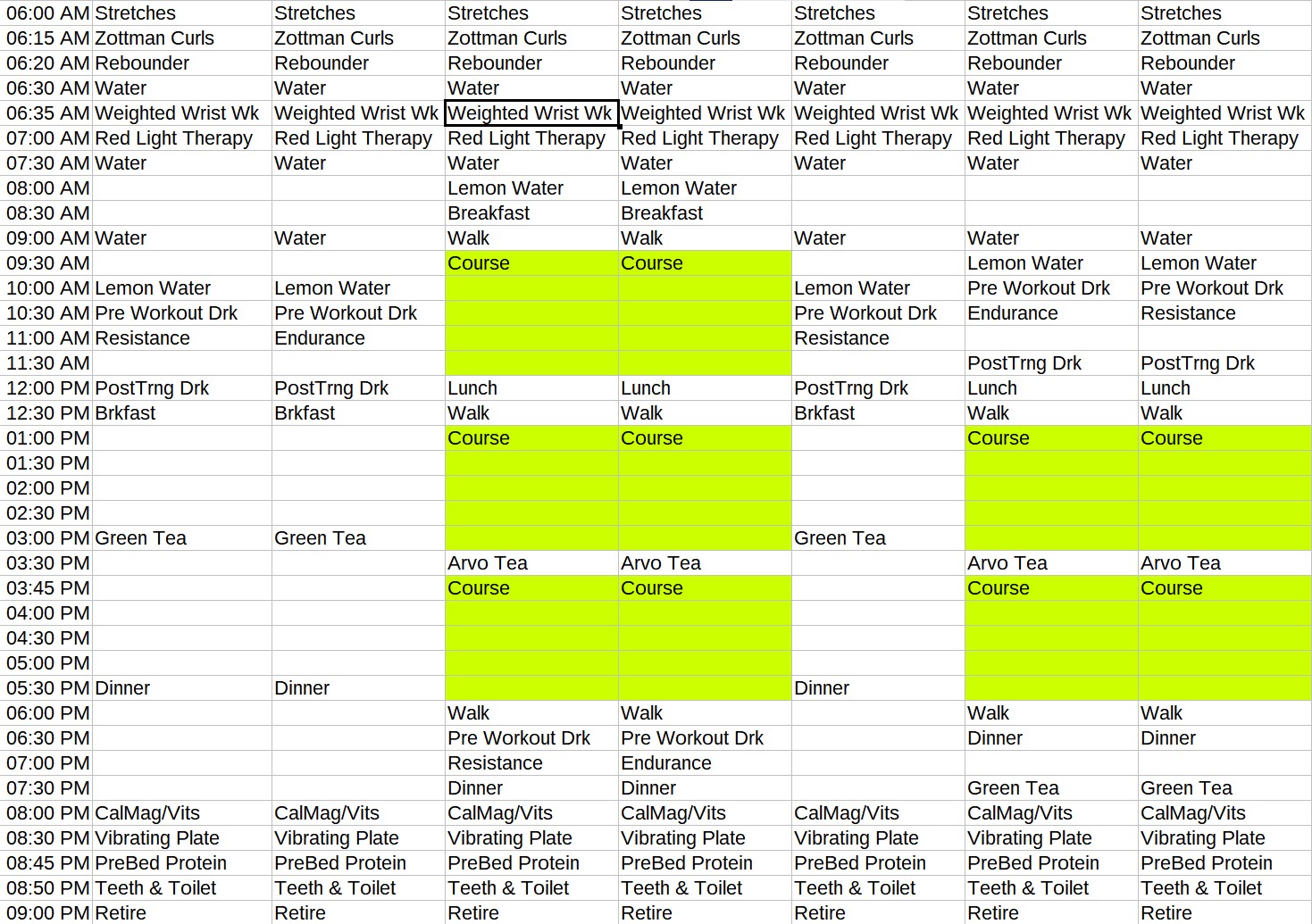
Block Timetable
Way back inthe early 1970s when I was training to be a supermarket manager, Woolworths introduced me to a block timetable for the workplace.
Of course school is the first place most of us are exposed to the concept. But I don’t see a great many people applying it past there. Except for being at work bewtween x and y and travel time too and from. But not for tasks.
It can be a very useful tool to prevent the minor priorities taking up more of your schedule that they should. You may have heard the saying, “The job expands to fill the available time.” Well here is one way to limit the available time taken up by low priority jobs – schedule blocks of time for the high priority ones.
Here is one of mine filled in for my diet and exercise scheduled items arranged around my course study time.
Statistics
Management guru Peter Drucker said many years ago: “What gets measured gets managed.” so your management is improved considerably be keeping daily and weekly statistics on the production of your products.
Statistics should measure the quantity of that being produced but only those that are produced to the required standard. This discourages the number being artificially inflated by low quality products.
The degree to which the product contributes to the viability of the activity also determines whether or not it should be staticised.
Ideally a weekly graphed statistic should be on a long-term up-trend. Tools exist to help in managing an activity based on the trend of the line on a statistic graph. If better management interests you, get in touch with me. I can recommend a course I did many years ago that helped me enourmously.
In Conclusion
Being busy is not evidence of being effective or efficient.
Having an operating basis of being efficient at low priority items sabotages your progress towards your goal.
Working inefficiently on high priority targets yields slower progress towards your goal.
Overall Framework
1. Set Goal – Decide what you want to achieve.
2. Plan – Decide what results/products will move you towards it.
3. Prioritise – Decide which results matter most.
4. Manage – Eliminate tasks that don’t contribute or contribute minorly.
5. Produce – Produce the required products effectively and efficiently to the required standard.
6. Inspect – Inspect the completed products to ensure they meet the required standard.
7. Review – Check the quantity, quality and viability of products produced per statitics and whether the products produced actually moved you towards the goal.
8. Adjust and repeat.
If you want to get deeper into this I can recommend a free course that teaches you about planning production and setting targets in a lot more detail. Drop me a line. I will be happy to share it with you.
Once you have fleshed out your framework a really valuable question to ask yourself is, “What are the top 3 things that, if I got perfect at in the next 12 months, would make everything else easier or more valuable?”
And of course then allocating some time to acquiring those skills.
And before you go down in the mouth contemplating the time it would take, remember that most people over estimate what they can get done in a day and under estimate what they can accomplish in five years.
I did not post 18,000+ blog posts and write two 2,000+ page books in two weeks, I can assure you!
To your ever growing effective efficiency.
Tom Grimshaw
tom@tomgrimshaw.com
Additional Reading:
How To Work Out Your Basic Purpose In Life: https://www.tomgrimshaw.com/tomsblog/?p=37862
Boosting Your Confidence:
On Bringing Order
https://www.bringorder.info/English.html
Addressing Procrastination: https://www.tomgrimshaw.com/tomsblog/?p=67238
How To Boost Self-Discipline: https://www.tomgrimshaw.com/tomsblog/?p=67086