
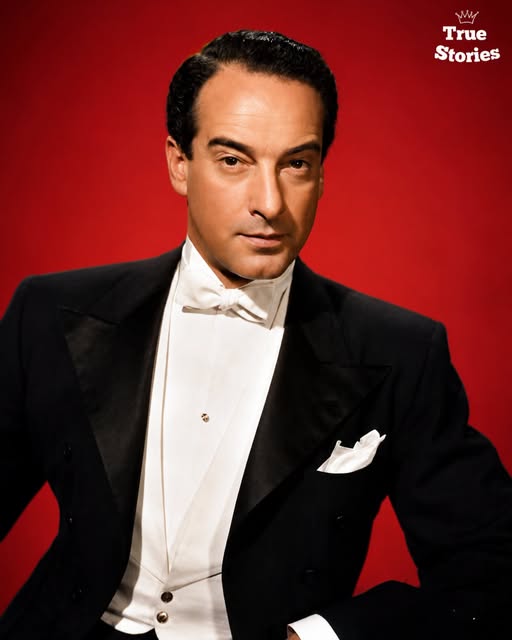
Victor Borge made jokes about Hitler when Hitler could have had him arrested for them. Then the Nazis invaded Denmark, and the Jewish comedian escaped Europe on the last neutral American ship out of northern Scandinavia—with about $20 and almost no English.
Five years later, millions of Americans were laughing at him.
That sounds like the setup to one of Borge’s routines.
It wasn’t.
Before America knew the impeccably dressed man sitting at a grand piano, deliberately destroying classical music with terrible timing, fake mistakes and perfectly controlled interruptions, Borge had already learned that a joke could carry consequences far beyond laughter.
His real name was Børge Rosenbaum.
He was born in Copenhagen in 1909 into a musical Jewish family. His father, Bernhard, was a violinist; his mother, Frederikke, was a pianist.
Børge’s talent appeared almost immediately.
He began learning piano as a small child, received serious classical training and eventually studied at the Royal Danish Academy of Music.
He could have remained a conventional concert pianist.
There was one problem.
He was funny.
Borge discovered that audiences responded when he interrupted the solemnity surrounding classical music.
A mistake could become a joke.
A pause could become a joke.
Even preparing to play could become funnier than actually playing.
By the 1930s, he had begun combining serious musicianship with comedy and became one of Scandinavia’s popular entertainers.
Then Europe became dangerous.
Adolf Hitler was in power.
Nazi Germany was expanding.
And Borge was Jewish.
He could have kept politics out of the act.
Instead, he mocked the Nazis.
One of his most pointed jokes came after Denmark and Germany signed a non-aggression pact in 1939. Borge sarcastically suggested the Germans could now sleep safely without worrying about being attacked by the Danish army.
It was funny because the idea was absurd.
Denmark posed no serious military threat to Hitler’s Germany.
But dictatorships are rarely famous for appreciating satire.
Danish Nazis noticed Borge.
Threats followed.
And then the joke became terrifyingly real.
On April 9, 1940, German forces invaded Denmark.
Borge happened to be outside the country, performing in Sweden.
That accident of geography may have saved him.
He did not return home.
He moved toward Finland instead, trying to get out of Europe with his American-born wife, Elsie.
The escape route was narrowing.
Much of Europe was already at war.
Ports were closing.
Refugees were desperately searching for passage.
Then Borge and Elsie secured places aboard the USS *American Legion* at Petsamo in northern Finland.
The ship sailed on August 16, 1940.
There were hundreds of passengers aboard.
And the *American Legion* carried something besides refugees.
Hidden among its important cargo was a Bofors 40-millimeter antiaircraft gun that American authorities wanted brought to the United States for evaluation.
The ship carrying the Jewish comedian fleeing Hitler was also carrying a weapon whose design would eventually become enormously important to American naval defenses during the war.
Then the route closed.
The *American Legion* became the last neutral ship permitted to leave Petsamo.
Twelve days later, it reached New York.
Borge arrived on August 28, 1940.
He had roughly $20.
And the comedian had another serious problem.
His jokes were almost useless.
He couldn’t speak English.
Comedy is difficult enough in your own language.
Borge had built an entire career around timing, wordplay and communication with an audience.
Now he was in a country where he could barely communicate at all.
The famous Danish entertainer had become an unknown immigrant.
So he began again.
Borge later described learning English partly by watching movies.
He studied how Americans spoke.
He adapted his material.
He changed Børge Rosenbaum into the easier American stage name Victor Borge.
And remarkably quickly, the man who had arrived unable to perform his established act in English was doing exactly that.
Radio opened the door.
Borge appeared with Rudy Vallée and then joined Bing Crosby’s *Kraft Music Hall*.
American listeners began discovering something difficult to categorize.
Was he a concert pianist?
Yes.
Was he a comedian?
Absolutely.
Was the piano part of the joke?
Usually.
Was the joke sometimes an excuse to demonstrate that he could actually play extraordinarily well?
Also yes.
By 1942, Borge was being recognized as an outstanding new radio performer.
The refugee had been in America for roughly two years.
Now America knew his voice.
Then television arrived.
Borge was almost designed for it.
One of his famous routines was “Phonetic Punctuation.”
Instead of merely reading punctuation marks, he gave them ridiculous sounds.
Periods.
Commas.
Question marks.
Exclamation points.
A normal piece of speech could become completely deranged once Borge began “pronouncing” the punctuation.
Another routine involved his repeated inability to simply sit down and perform a piece of classical music normally.
He would announce something.
Become distracted.
Talk to the audience.
Misunderstand the music.
Restart.
Interrupt himself.
The audience waited for the piano.
Borge made the waiting funny.
And beneath all of it was a crucial fact.
He was not pretending to be a pianist.
He was one.
That was why the comedy worked.
Borge knew exactly what the music was supposed to sound like before he dismantled it.
Then he took the idea to Broadway.
In 1953, Borge opened his one-man production *Comedy in Music*.
A comedian alone on Broadway is exposed.
A bad evening cannot be blamed on an ensemble.
Borge carried it.
Again.
And again.
And again.
The production eventually ran 849 performances, establishing a record for a one-man show.
The man who had arrived in America unable to speak English had now built one of Broadway’s extraordinary solo successes around his ability to communicate with an English-speaking audience.
And there was another irony.
Hitler had forced Borge out of Europe.
The exile helped make Victor Borge an international star.
Borge himself later acknowledged that without Hitler, his career might have followed an entirely different path.
But he did not forget why he had escaped.
During the Nazi occupation, Denmark became the scene of one of World War II’s remarkable rescue efforts.
In 1943, when German authorities moved to deport Danish Jews, Danish citizens helped thousands escape across the water to neutral Sweden.
Borge later helped establish Thanks to Scandinavia, an effort honoring Scandinavians who helped save Jews during the Holocaust.
The comedian who had escaped now helped remember those who made escape possible for others.
America became home.
Borge became a U.S. citizen in 1948.
But Denmark never disappeared.
Neither did the piano.
Neither did the jokes.
Borge performed with major orchestras.
He appeared on television.
He toured internationally.
He could sit beside an accomplished classical musician and turn the conventions of a concert hall inside out without cheapening the music.
That was the secret.
He was mocking classical music because he loved it enough to understand every rule he was breaking.
And he kept doing it for an astonishing length of time.
The child prodigy became the young concert pianist.
The pianist became a comedian.
The comedian became a refugee.
The refugee became an American radio star.
The radio star became an international institution.
Decades passed.
Borge entered his eighties.
Then his nineties.
He still performed.
In September 2000, his wife Sarabel, to whom he had been married since 1953, died.
Borge continued.
In December, at 91, he traveled back to Denmark for a concert.
Then he returned to his home in Greenwich, Connecticut.
On December 23, 2000, one day after returning from that trip, Victor Borge died peacefully in his sleep. He had spent roughly 75 years entertaining audiences.
There is an almost impossible symmetry to his life.
In 1940, Borge left Scandinavia because Nazi Germany had made remaining there dangerous for a Jewish comedian who had publicly mocked Hitler.
He crossed the Atlantic on the last neutral ship out of Petsamo.
He reached America nearly broke.
He couldn’t speak the language.
Everything that had made him famous suddenly had to be rebuilt.
So he learned the words.
Kept the accent.
Sat down at the piano.
And made the country laugh.
Sixty years later, Victor Borge made one final trip back to Denmark to perform.
Then he crossed the Atlantic again.
This time he wasn’t an unknown refugee carrying $20.
He was Victor Borge.
One of the world’s most famous musical comedians.
Hitler had forced Børge Rosenbaum out of his homeland.
He could take the country.
He could threaten the comedian.
He could force him onto a ship.
But he couldn’t kill the joke.
Victor Borge carried it all the way to America—and spent the next six decades getting the last laugh.