
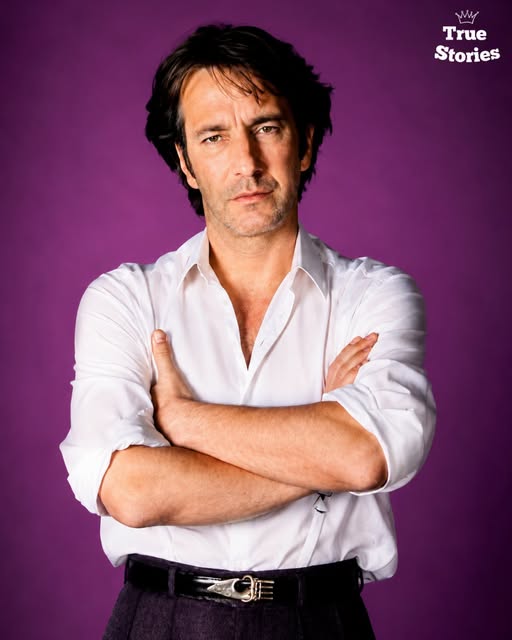
Alan Rickman once refused to say one of the most famous lines in Die Hard — because he thought it was stupid. Then he rewrote it himself, and it became one of the greatest villain moments in film history.
The line was simple: “Shoot the glass.”
The scene: Hans Gruber, cold and calculating, commanding his henchmen to fire at Bruce Willis’s bare feet. Rickman read it, frowned, and told the director, “No one that intelligent would bark orders like a fool.” He rewrote it in his slow, venomous cadence, turning it into a whisper, each syllable dipped in ice. “Schoot… ze glass.” The crew froze. Even Bruce Willis broke character. The moment was pure menace — improvised elegance that transformed the entire tone of the film.
That was Rickman. He didn’t just play villains — he reengineered them.
But the story gets better. Die Hard was his first film — ever. He was 41, a theater actor who’d never stood in front of a camera. On his very first day of shooting, they told him he’d be dropped 40 feet onto an airbag for the finale. He thought it was a joke. It wasn’t. The director promised they’d count to three before releasing him. They dropped him on one. The look of shock on his face in that scene — eyes wide, arms flailing — was real. “That’s not acting,” he later laughed. “That’s betrayal.”
And yet, it made cinematic history.
Behind that poise and voice like honey over steel was a man who distrusted fame and loved rebellion in small, devastating doses. He turned down blockbusters to do indie films and poetry readings. He co-directed theater productions for no pay. When Warner Bros. asked him to make Snape more “sympathetic” in Harry Potter, he refused. “You’ll understand him when the time comes,” he said. No one — not even the directors — knew that J.K. Rowling had secretly told him Snape’s true ending. He guarded that secret for a decade, playing every glare and pause like a man living two lives.
The most intimate, scandalous truth came out after his death. Rickman had kept journals for 25 years — over 25 volumes of his thoughts, frustrations, and tenderness. In them, he wrote about his doubts, his quiet fury at the industry, and his total devotion to his partner, Rima Horton. “She has been my compass,” one entry read. “All love songs, in the end, are about her.”
He also confessed that he almost quit Harry Potter after the second film, furious at studio meddling. “It’s as if they don’t understand what I’m doing,” he wrote. Rowling called him personally, begged him to stay, and reminded him of Snape’s purpose. He stayed — for the children, for the story, for the art.
Rickman had the face of a villain and the heart of a poet. When he died, Emma Thompson — his closest friend — said, “Alan was incapable of small talk. He’d go straight to the soul of things.”
The man who taught us to fear silence was also the one who made it holy.
Alan Rickman didn’t just perform — he conspired with the audience. Every smirk, every pause, every drawling insult was his secret way of saying: You think you know evil, but I’m about to show you something far more interesting — humanity, in disguise.