
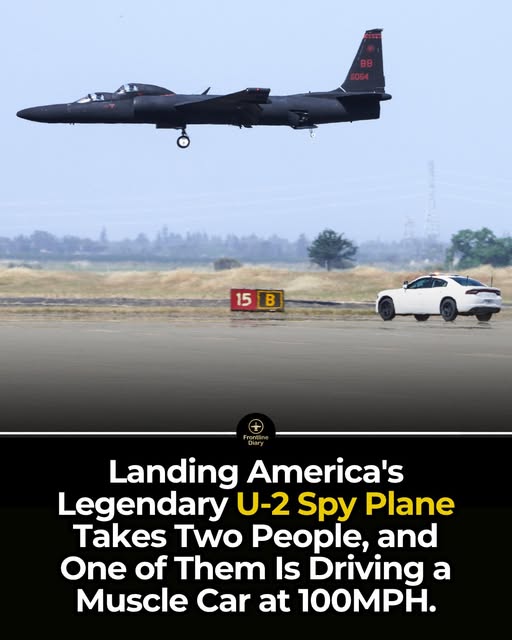
There is an American aircraft so difficult to land that the Air Force can’t do it with the pilot alone. To bring it home safely, a muscle car races down the runway right behind it at over 100 miles an hour, with another pilot at the wheel shouting instructions. It sounds like something out of a movie. It’s completely real, and it’s been happening for decades.
The aircraft is the U-2 “Dragon Lady,” one of the most legendary spy planes ever built. And the reason it needs a chase car is a fascinating story of trade-offs.
BUILT TO FLY IMPOSSIBLY HIGH
The U-2 was designed in the 1950s for one job: fly higher than anything else on earth, so high that Soviet fighters and missiles couldn’t reach it. To do that, Lockheed’s legendary Skunk Works built it with enormous, glider-like wings spanning over 100 feet, wings so efficient they let the aircraft soar above 70,000 feet, at the very edge of space.
But everything that makes the U-2 a superb high-altitude aircraft makes it a nightmare to land.
THE PROBLEMS PILE UP
Start with the wings. Those huge, high-lift wings are so eager to keep flying that even a few feet off the ground, the aircraft desperately wants to stay airborne. It simply won’t settle onto the runway the way a normal plane does.
Then there’s the landing gear. To save every possible pound for altitude, the U-2 doesn’t have normal landing gear. Instead of wheels spread out under the wings, it has just two sets of wheels down the center of the fuselage, one in front, one in back. The aircraft literally balances on them like a bicycle. If a wing dips even slightly at touchdown, the wingtip can scrape the runway.
Add to that a pilot crammed into a bulky, pressurized space suit, essentially an astronaut’s outfit, with severely limited visibility, sitting in a cockpit where he can barely see the runway beneath him.
The result is an aircraft that has to be flown to a stall just two feet above the runway, with the wings held perfectly level, by a pilot who can’t see the ground well and is balancing on a bicycle’s worth of wheels. It’s considered the single hardest landing in all of American military aviation.
ENTER THE CHASE CAR
So how do you land it? You get help from the ground, moving just as fast as the plane.
As the U-2 makes its final approach, a high-performance car floors it down the runway and races into position directly behind the descending aircraft. Behind the wheel is not a random driver, but another fully qualified U-2 pilot, known as the “mobile.” As the plane sinks toward the runway, the driver calls out the aircraft’s exact height over the radio, “ten feet… five feet… two feet…”, and warns the pilot of any wing tilt, all in the final seconds before touchdown.
The car has to accelerate from a dead stop to over 100 miles an hour in seconds to catch the plane, then match its speed exactly, all while the driver holds the wheel with one hand and the radio with the other, staying a few car lengths back and slightly off to the side to avoid the blast of the jet’s exhaust.
One U-2 pilot described the landing philosophy simply: there isn’t really a landing procedure. You get the airplane down to about two feet, pull the power to idle, and just wait for it to run out of energy and settle down.
MUSCLE CARS AND SPY PLANES
The best part might be the cars themselves. Over the decades, the Air Force has always chosen fast, powerful American vehicles for the job. It started in the 1950s with supercharged Ford station wagons. Over the years it moved through Chevy El Caminos, Ford Mustangs, Camaros, Pontiac GTOs, and Corvettes. Today, the chase cars are often Dodge Chargers. When U-2s deploy to Europe, the squadrons sometimes use high-performance Mercedes-AMG or Audi vehicles instead.
Picture it: one of the most sophisticated spy planes ever built, worn from a mission at the edge of space, being talked down to earth by a fellow pilot flooring a muscle car down the runway behind it. It’s one of the most unusual and charming traditions in all of aviation.
STILL FLYING AFTER 70 YEARS
The most remarkable part? This is not history. The U-2 first flew in 1955, and roughly 70 years later, it’s still flying real missions for the United States, still doing things newer aircraft and satellites can’t. And every time one comes home, a chase car is there, engine roaring, racing down the runway to bring the Dragon Lady safely back to earth.
Fewer than 1,000 pilots have ever been qualified to fly it in its entire history. Each one of them also learned to drive the chase car. Because in the strange, demanding world of the U-2, landing the plane is a two-person job, and one of them is behind the wheel of a very fast car.