
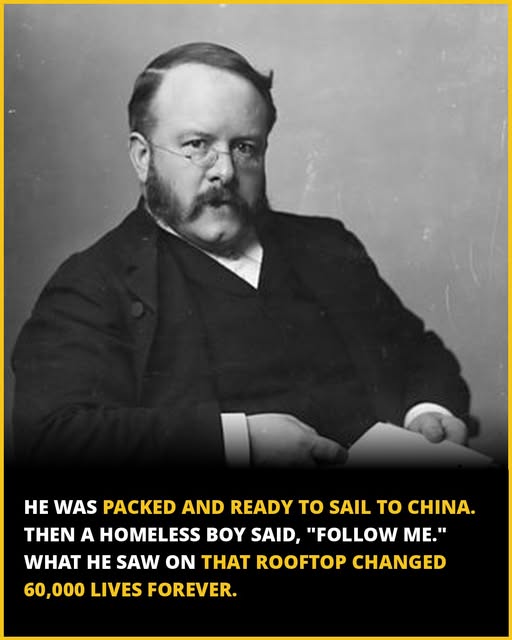
London, 1866. The fog was thick. The streets were dark. And a young man named Thomas Barnardo had a plan.
He was going to China.
He had his mission, his purpose, his bags nearly packed. He would travel across the world to help people who needed him. It felt noble. It felt right.
Then one winter night, after teaching a free class for poor children in the East End, he noticed a small boy sitting alone near the heater. Everyone else had left. The boy hadn’t moved.
Barnardo asked him why.
The boy — his name was Jim Jarvis — shrugged and said something that stopped the young man cold.
“Don’t live nowhere, sir.”
Barnardo asked if there were others like him. Jim looked up and said quietly, “Hundreds, sir. I can show you.”
He followed the boy through the dark streets, down to the waterfront, until Jim pointed up at a flat iron rooftop. Barnardo climbed up.
What he found there he would never forget.
Eleven boys — the youngest just seven years old — were pressed together in a pile of rags, sharing body heat to survive the freezing night. They had no home. No parents. No one looking for them. They were surviving the only way they knew how.
Barnardo stood in the cold and looked at their faces.
Then he thought about China.
And he made a decision.
He unpacked his bags.
In 1870, he opened his first home in Stepney and hung a sign above the door that no charity had ever dared to put up before:
“No Destitute Child Ever Refused Admission.”
People called him reckless. They said he’d go bankrupt inside a year. But when the beds were full, he gave up his own. When money ran out, he went door to door and begged. He didn’t just feed the children — he taught them. He turned boys and girls the world had thrown away into carpenters, nurses, teachers, and tailors. He gave them not just shelter, but a future.
He fought lawsuits. He fought abusive guardians. He fought disease outbreaks. He fought anyone who stood between a child and safety.
For thirty-five years, he fought.
When Thomas Barnardo died on September 19, 1905, he had opened 96 homes and cared for nearly 60,000 children. His funeral procession drew thousands of working-class Londoners into the streets — people who had seen what he had done with their own eyes.
He never made it to China.
But it turns out the world he needed to change was right there — on a rooftop in the cold, wrapped in rags, waiting for someone to climb up and notice.
He noticed.
And 60,000 children lived differently because of it.