
New Haven, Connecticut. 1882.
The knock came early — the kind that only happens when something has already gone terribly wrong.
A woman stood at the door of St. Mary’s Church. Irish. Young. Three children clinging to her skirt, eyes wide with the particular blankness that comes when shock hasn’t yet converted itself into grief. Her husband had been killed in a factory accident. No warning. No savings. Nothing left. In 1882 America, for an Irish Catholic immigrant family, that sentence was the entire story. Here one day. Gone the next. And when the man was gone, everything went with him.
Father Michael McGivney was twenty-nine years old. He stood in the doorway and looked at this woman and her children. Then he looked past them at the neighborhood — the cramped tenement blocks, the men with scarred hands walking to mills that would work them twelve hours and pay them barely enough to keep hunger at a distance.
He had seen this before. He would see it again. Everyone told him it was simply the way things were for people like them.
He went home that night and couldn’t sleep.
Michael McGivney understood poverty from the inside. He had been born the eldest of thirteen children — six of whom died in infancy — to Irish immigrant parents in Waterbury, Connecticut. His father worked in a brass mill, breathing noxious fumes in punishing heat for wages that stretched thin over a crowded house. At thirteen, Michael left school and went to work in the same mill to help the family. At sixteen, he left for seminary, driven by something he couldn’t fully articulate — a calling that felt less like a career choice and more like a command.
He was ordained in 1877 and sent to St. Mary’s Church in New Haven, where he threw himself into the life of a poor immigrant parish with the kind of energy that frightened people who loved him. Morning Mass. Hospital visits. Confession booths past midnight. Street ministry. Funerals — so many funerals.
And after every funeral, the same thing: a widow. Children. Empty hands. No safety net. No help coming.
In New England at the time, several generations of the same family often worked in mills for twelve hours a day, six days a week. There were few social structures to help those who were injured, and little to no support for those who lost a loved one. No insurance company in America would touch Catholic immigrants — they were considered too poor, too foreign, too risky. No government program existed to catch them. The Catholic Church could offer prayers and charity, but charity ran out. And the older priests, the experienced ones who had watched this for decades, offered the young Father McGivney the same weary wisdom: America Magazine
This is just the way it is for people like us.
Michael couldn’t live with that answer.
He began to turn an idea over in his mind — something so simple it was almost embarrassing, the kind of idea that makes you wonder why nobody had tried it before. What if working men pooled small amounts of money together? Not as charity, which carried humiliation. Not as a loan, which carried debt. As a brotherhood. A mutual promise. You fall, we catch your family. I fall, you catch mine.
In early February 1882, largely unnoticed, the young curate assembled eighty Catholic laymen in the basement of St. Mary’s Church. They were factory workers and laborers. Men with calloused hands and worn coats. Men who had buried friends and watched their families dissolve into poverty. Men who knew, bone-deep, what it meant to have nothing. Catholic Courier
Michael stood before them and made a promise that was both modest and enormous.
When one of us falls, the rest of us catch his family.
They needed a name. The society chose Christopher Columbus as its patron — who was Catholic, and at the time considered the discoverer of America — expressing the Knights’ loyalty to both their faith and their country. They were Catholic. They belonged here. They would prove it by caring for each other. Encyclopedia Britannica
They called themselves the Knights of Columbus.
Word traveled through immigrant neighborhoods the way hope always does — faster than fear. Men who had felt invisible in America found something they hadn’t expected to find: each other. Chapters formed in neighboring parishes. Members multiplied. And when men died — as they did, constantly, in factories and on scaffolding and in the dangerous ordinary work of immigrant life — their families received payments. Children stayed in school. Widows kept their homes.
It worked.
In the early days, the Knights’ leaders confronted severe criticism, deep disillusionment, and seriously doubted the value of their efforts. Critics called McGivney reckless. Naïve. They said he was encouraging dependency, that the organization would collapse under its own ambitions. Some questioned whether Irish Catholic immigrants deserved organized protection at all. Catholic Review
McGivney didn’t stop. He traveled to other parishes to establish new chapters. He lobbied the Connecticut state legislature for a formal charter, which was granted in March 1882. He wrote letters, organized meetings, settled disputes between members, and quietly kept the whole fragile structure together through sheer force of belief in what it could become.
And all the while, he was disappearing.
The people closest to him watched it happen — the gradual erosion of a man giving more than he had. He was up before dawn for morning Mass. He was at hospital bedsides in the afternoons. He was in confession booths until midnight. He was writing letters and traveling to chapter meetings on weekends. He ate poorly. He slept when he could. His friends begged him to slow down. His bishop expressed concern. People who loved him saw what he couldn’t seem to see: that he was burning through himself at a rate the body couldn’t sustain.
“There’s no time,” he would say. “Families are suffering right now.”
In 1884, he was assigned as pastor of St. Thomas Church in Thomaston, Connecticut — taking on a second parish simultaneously, driving a horse and carriage between them to serve both communities. His pastoral load would have broken a healthy man. Michael was not a healthy man. He had never been physically robust, and years of relentless work had worn down whatever reserves he had started with.
In January 1890, he contracted pneumonia. He had also been weakened by tuberculosis working through his body. He continued ministering from his bed as long as he could — writing letters, praying for his parishioners, asking about the families he had been helping. Marians of the Immaculate Conception
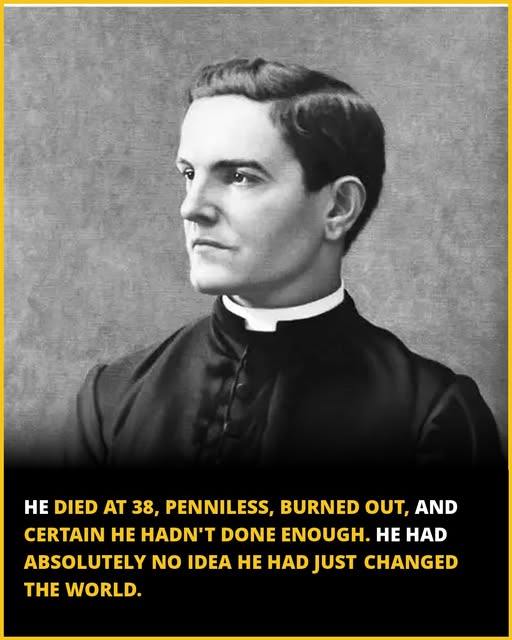
On August 14, 1890 — two days after his thirty-eighth birthday — Father Michael McGivney died in a rented room in Thomaston, Connecticut.
He was completely spent. Burned all the way down.
He died not knowing whether the thing he had built would last. Not knowing how many people it would reach. Not knowing whether the exhausted years and the missed meals and the sleepless nights had added up to something that would survive him, or whether it would quietly fold without the man who had willed it into existence.
He had given everything he had to something he would never see completed.
And then history took over.
No one, least of all Father McGivney, suspected that over a century later the Knights of Columbus would grow to be an international body of around 2 million Catholic men and a powerful force for good. Today the organization spans the United States, Canada, Mexico, the Philippines, the Caribbean, Central America, Poland, Ukraine, and Lithuania. They have given billions of dollars to charitable causes. They have built hospitals. They have funded disaster relief operations across multiple continents. They have supported refugees, fed the hungry, stood beside the sick and the dying in dozens of languages in dozens of countries. Every year, at the local and international level, the Knights give away millions of dollars to people who need it — quietly, without announcement, the way the man who started it all once helped families in the basements of Connecticut churches. Catholic Courier
In 2020, Pope Francis declared him Blessed Michael McGivney — one step from official sainthood — calling his “zeal for the proclamation of the Gospel and generous concern for the needs of his brothers and sisters” a witness of Christian solidarity that had made him an outstanding example of fraternal assistance. Fathermcgivney
He never heard that. He never saw any of it.
He died in a rented room, thirty-eight years old, believing he had made a small dent in one corner of a suffering world — and not entirely sure even that would last.
He had no idea.
There is something in this story that reaches beyond religion, beyond history, beyond the specifics of Irish immigrants in nineteenth-century Connecticut. It touches something true about how the most important things in the world actually get built.
Not by people who could see the finished cathedral. By people who placed one stone, trusted it mattered, and went back the next day to place another.
Most of us will never know the full size of what we’re building. We raise children whose children will do things we cannot imagine. We plant kindness in people who carry it somewhere we’ll never see. We build things that outlive us by generations, and we die without ever reading the final chapter.
Michael McGivney died on a Tuesday in August, certain he hadn’t done enough.
Two million people around the world continue the work he started.
If you are showing up, day after day, for something that feels too small, too slow, too thankless — if you are planting in ground you may never harvest, building something you may never see finished —
You are in very good company.
And somewhere, decades from now, someone will be alive because of what you did today.
Even if you never know their name.