
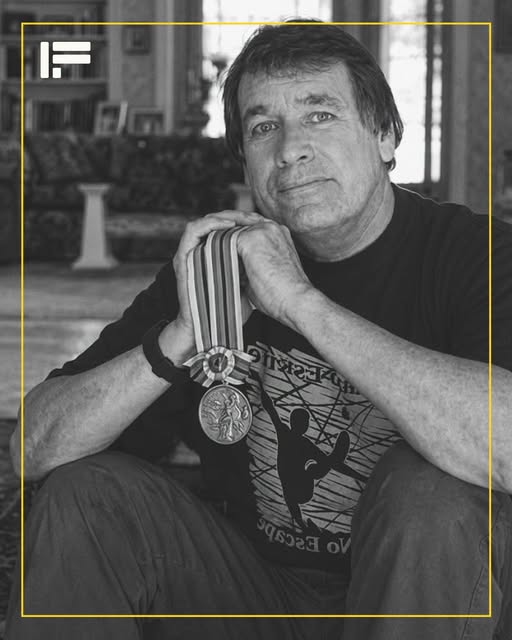
He was a young man alone in a hotel room, at the lowest moment of his life, certain the world had no place for him.
He had been an orphan since he was twelve. He had been told, over and over, in a hundred ways, that he did not belong. And on that night, the weight of it all had nearly finished him.
Then he heard a voice — and what he did next would carry him all the way to one of the greatest moments in the history of the Olympic Games…
His name is Billy Mills.
Mills was born in 1938, an Oglala Lakota, and raised on the Pine Ridge Reservation in South Dakota — one of the poorest places in America. His mother died when he was eight. His father died when he was twelve. And in the space of those four years, a boy became an orphan.
But his father had left him something worth more than money. Sydney Mills had told his grieving son to look past his broken heart toward a dream: “You have broken wings now, son. But someday you could have the wings of an eagle.”
Billy found his wings in running — good enough to earn a scholarship to the University of Kansas and a place among the nation’s best college athletes. But even there, the cruelty followed him: a photographer setting up a team picture once ordered him out of the shot, because of the color of his skin.
It was one rejection too many, piled on a lifetime of them. And in a hotel room near Louisville, the darkness nearly swallowed him whole. He came to the very edge of giving up.
And then he heard something — not with his ears, but from somewhere deeper: a voice that sounded like his late father’s, saying one word. Don’t.
He didn’t give up. Instead, through his tears, he reached for a piece of paper and a pen, and he wrote down a single sentence — a goal so wildly beyond him that he had no earthly reason to believe it. “Gold medal,” he wrote. “Olympic 10,000-meter run.” He had no evidence he could do it. He wrote it anyway, and he began, from that night, to chase it.
Around that time, he met a young woman named Patricia. They married in 1962, while still in college, and she became the steady anchor that would hold his life together for the next sixty years and more.
After Kansas, Mills became an officer in the U.S. Marine Corps and kept training — even as his own body fought him. He had hypoglycemia and diabetes, which made his energy crash late in long races. And of every event he could have chosen, he’d fallen in love with the one his body was least built for: the 10,000 meters, the longest race on the Olympic track.
By 1964, against the odds, he’d made the U.S. Olympic team — though almost no one noticed. His best time trailed the world record, held by Australia’s great Ron Clarke, by nearly a full minute. When the team reached Tokyo, they didn’t even give Mills proper racing shoes at first; those were saved for the men expected to win.
Billy Mills was not one of those men.
On October 14th, 1964, nearly forty runners lined up on a rain-soaked cinder track in Tokyo’s National Stadium. Ron Clarke set a brutal pace from the gun, trying to break the field apart. By the halfway point, only a handful of runners could still hang on.
Somehow, impossibly, Billy Mills was one of them.
As the stadium lights came on against the darkening sky, the real race began. With two laps to go, three men pulled clear: Clarke, Tunisia’s Mohamed Gammoudi, and Mills. On the final lap, weaving through runners being lapped, there was contact — Mills was bumped and knocked off stride, and Gammoudi burst into the lead. Mills dropped to third, his blood sugar crashing, his vision starting to blur.
Every camera in the stadium was locked on the two favorites. Mills was fading into the background of his own race.
And then, with about a hundred meters to go, Mills glanced at a runner beside him and thought he saw, on the man’s singlet, the image of an eagle. His father’s words came roaring back. Wings of an eagle. “I can win,” he thought. “I can win.”
He swung wide into an open lane, onto firmer ground, and he unleashed everything he had left on that final straightaway — a burst of speed no one in that stadium believed was still in him.
On the broadcast, the announcers were still calling the duel between Clarke and Gammoudi when analyst Dick Bank grabbed the microphone and screamed the words that became legend: “Look at Mills! Look at Mills!”
He blew past Gammoudi. He blew past Clarke. And Billy Mills — the orphan from Pine Ridge nobody had come to watch — broke the tape in 28 minutes, 24.4 seconds: a new Olympic record, nearly fifty seconds faster than he had ever run in his life.
No American had ever won Olympic gold in the 10,000 meters. And in the more than sixty years since, no American ever has again.
Afterward, Mills went looking for the runner whose eagle had lifted him — and found there had been no eagle on the man’s jersey at all. He had imagined it. The wings his father promised him had been inside him the whole time.
Mills was never forgotten. His story became the 1983 film Running Brave; he was inducted into hall of fame after hall of fame; in 2012, President Obama awarded him the Presidential Citizens Medal; and in 2024, at eighty-six, he returned to the Olympics in Paris to donate his 1964 Team USA tracksuit to the sport’s museum.
Yet if you ask Billy Mills what that race in Tokyo really meant, he doesn’t talk about the medal. He talks about healing. Tokyo, he has said, was where a broken soul finally found some peace — where the vision that had once kept him alive was proven real.
And then he did the most Lakota thing of all. In his tradition, one who receives a great gift holds a “giveaway,” returning the blessing to the community. In 1986, Mills co-founded Running Strong for American Indian Youth, which today brings clean water, food, shelter, and hope to Native communities across more than thirty states.
Now in his late eighties, Billy Mills still lives with Patricia, his wife of more than sixty years, and still travels to speak to Native young people about the power of a dream.
He didn’t just outrun Ron Clarke and Mohamed Gammoudi that night in Tokyo. He outran the voice that had told him, his whole life, that he didn’t belong — and spent the rest of that life making sure the children of Pine Ridge would never face that voice alone.