
October 25, 2009.
Barbara Picower’s husband was found dead in their pool. A heart attack. Jeffry Picower was 67 years old, and just like that — in a single ordinary morning — he was gone.
She was still grieving when the second shock arrived.
Jeffry had been Bernie Madoff’s largest investor. Over decades, he had withdrawn $7.2 billion from Madoff’s firm — more than any other person in history. And when Madoff’s Ponzi scheme collapsed in 2008, destroying the savings of thousands of ordinary people — retirees who lost everything, charities that had to shut their doors, families erased financially overnight — investigators began looking very closely at everyone who had profited.
Nobody had profited more than Jeffry Picower.
Every dollar he’d withdrawn had come from a fraud. Madoff hadn’t been investing — he’d been stealing, paying old investors with new investors’ money, for decades. The real wealth destroyed totaled approximately $17 billion. And now federal prosecutors wanted $7.2 billion back, for the victims.
Jeffry was dead. Barbara was left holding the weight of it.
She was 67 years old, in the first raw weeks of widowhood, and suddenly at the center of the largest financial fraud in American history. Her legal team could have fought. She could have spent years in court arguing the money was legitimately earned, that she bore no responsibility, that the burden of proof lay elsewhere. She could have dragged it out for a decade while fraud victims waited in financial ruin.
She chose not to fight.
But to understand why, you have to go back further — to before the wealth, before Madoff, before any of this.
Before all of it, Barbara had been a teacher in New York City in the 1960s. Then a social worker. She spent her days sitting across from families making choices no one should ever have to make — mothers deciding between rent and food, children arriving at school hollow-eyed because there had been nothing to eat at home. She knew what suffering looked like. Not as an abstraction. As a face sitting across a desk from hers.
That woman never left her.
So when the moment came — when she faced the most consequential decision of her life — she didn’t calculate what she could keep. She remembered who she had always been.
She gave it all back.
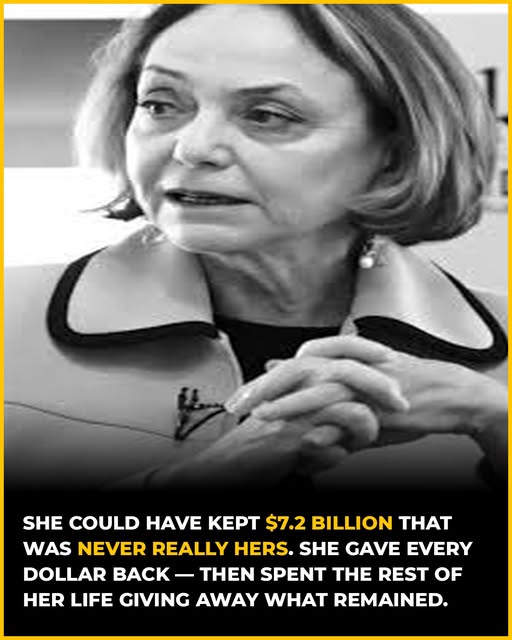
In December 2010, Barbara signed papers forfeiting $7.2 billion to compensate Madoff’s victims. Federal prosecutors made one thing unambiguously clear: Barbara Picower had done nothing wrong. She was not charged with any crime. This was a widow, voluntarily, making right what her husband had been part of — returning money to people who needed it, without being forced to, without a trial, without years of legal theater.
It was one of the largest single forfeitures in the entire Madoff case.
And then — when she could have quietly disappeared, when anyone would have understood if she had retreated from public life entirely — Barbara went back to work.
In 2011, she founded the JPB Foundation with what remained of her estate. And this wasn’t charity as performance. This was the social worker from the 1960s, back at the table, now with resources and a lifetime of knowing exactly what actually helps people and what doesn’t.
She didn’t fund buildings with her name carved above the entrance. She didn’t host galas or seek profiles in magazines. She went after root causes.
Poverty — not just its symptoms, but the systems that produce it. Affordable housing. Living wages. Policy reform that changes lives at scale, not just one family at a time. Healthcare access. Environmental justice. And when voting rights came under pressure, she became one of the largest private funders of voter access and protection in the country.
The JPB Foundation gives away over $250 million every year. Hundreds of millions in total since she started.
Almost no one knows her name.
People who have worked with her say she asks the same question about every single grant: Will this actually help people? Not: Will this look good? Not: Will this be recognized? Just: Will it help?
In 2020, she made one more decision that said everything about her. Rather than preserving the foundation forever — letting it grow and accumulate and exist as a monument to itself — she chose to spend it down completely. The people who need help need it now. Not in fifty years. Now.
Think about the full arc of this.
A woman who spent her young life sitting with struggling families. Who watched her husband’s wealth collapse into scandal. Who, in the worst moment of her life — grieving, pressured, facing the full force of federal investigators — chose integrity over every legal avenue available to her. Who returned $7.2 billion. And then kept giving.
Quietly. Persistently. Without credit.
Her husband’s story ended in tragedy. Hers became something entirely different — proof that even inside the darkest circumstances, the choice of who to be still belongs to you.
She made that choice in December 2010, with a signature on a forfeiture agreement.
And she has been making it every single day since.
Because she never forgot what she saw in those 1960s New York offices. The faces across the desk. The people the world walks past without looking.
She saw them then.
She’s been fighting for them ever since.