
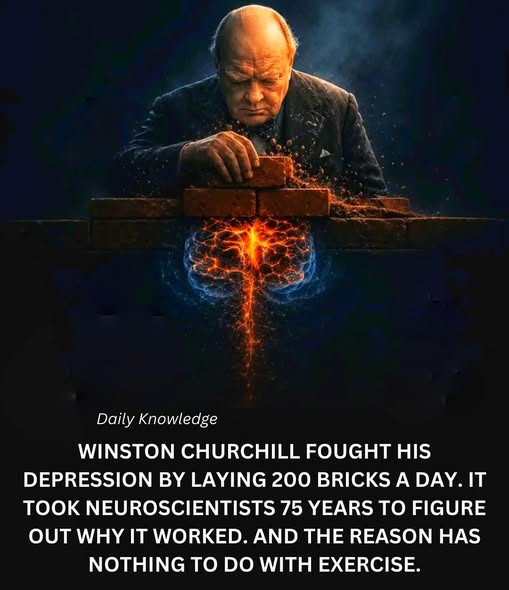
Winston Churchill fought his depression by laying 200 bricks a day. It took neuroscientists 75 years to figure out why it worked. And the reason has nothing to do with exercise.
Churchill called his depression the black dog. It lived inside his nervous system for 40 years. His solution was a trowel and 200 bricks a day. He wrote about why it worked decades before neuroscience could explain it.
A tired brain cannot be fixed by resting it. The mind has to use a different part of itself. The part that moves the eyes and the hands.
Depression sets a trap. You feel bad so you stop doing things. Less action means less dopamine. Less dopamine means worse feeling. The loop tightens until you cannot breathe inside it.
241 adults with severe depression. Three groups. Antidepressants. Talk therapy. Scheduled activity before they felt ready. The activity group kept up with the drugs and beat the therapy.
A 2014 review of 26 trials confirmed it. Moving first before you feel like it breaks the loop faster than talking about the loop. Action changes the feeling. The feeling does not change first.
Pick one thing that uses your hands. Clean something. Build something. Cook something. Do it before you feel ready. Depression hates a brain that has somewhere else to be.
REFERENCES
Dimidjian, S., et al. (2006). Randomized trial of behavioral activation, cognitive therapy, and antidepressant medication. Journal of Consulting and Clinical Psychology, 74(4), 658 670.
Cuijpers, P., et al. (2007). Behavioral activation treatments of depression. Clinical Psychology Review, 27(3), 318 326.
Mazzucchelli, T., et al. (2009). Behavioral activation treatments for depression in adults. Clinical Psychology Science and Practice, 16(4), 383 411.
DISCLAIMER
For educational purposes only. Not medical advice. If you are experiencing depression please consult a qualified healthcare professional.