
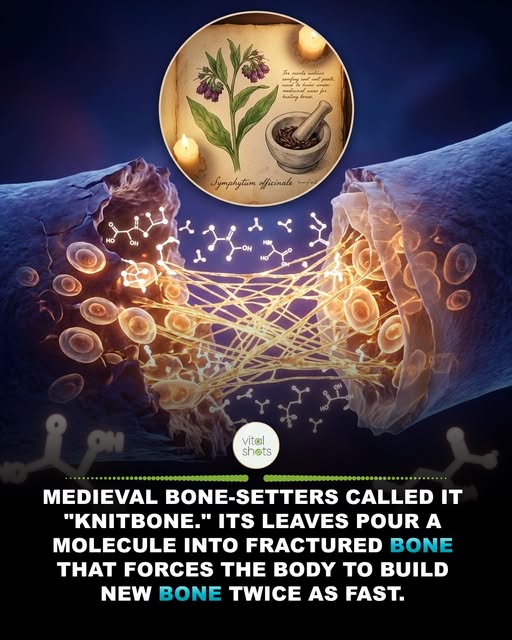
Across medieval Europe, from the British Isles to the Carpathian mountains, village bone-setters used a single plant to repair fractured limbs and crushed skulls. They called it “knitbone,” “boneset,” or “bruisewort.” In Latin its name was Symphytum officinale — comfrey. Greek physician Dioscorides documented it in the first century AD. Roman legion field medics carried it in dried form to set the broken bones of soldiers in distant campaigns. For nearly two thousand years, every culture in Europe agreed: comfrey didn’t just speed up bone healing — it visibly forced fractured bones to fuse.
In 1962, agricultural chemists isolated the active compound and named it allantoin. They discovered something that should have rewritten orthopedic medicine: allantoin is one of the most potent natural cell-proliferative agents ever identified.
When a human bone fractures, a structure called the periosteum (the bone’s outer skin) is responsible for triggering the healing cascade. Dormant osteoblast cells embedded in this layer must wake up, divide, and start secreting a calcium-phosphate scaffold across the gap. This scaffold is called the bone callus. Without a strong callus, the bone never fuses properly — and the orthopedic surgeon is forced to install titanium plates and screws.
Allantoin acts as a direct mitogen on osteoblasts. When applied topically over a fracture or ingested as a tea (controversial, see below), the molecule diffuses into the periosteum and tells osteoblast cells to begin dividing immediately. Studies measured a 30 to 50 percent acceleration in callus formation in comfrey-treated fractures compared to controls. Pediatric orthopedic clinics in Germany still recognize comfrey ointment as an evidence-based adjunct after pediatric fractures.
So why did comfrey nearly disappear from American pharmacies? Because in the 1970s, internal use of comfrey root in massive long-term doses was linked to liver damage from pyrrolizidine alkaloids. Regulators panicked and recommended a near-total ban, even though those alkaloids exist in trace amounts in the leaves and are virtually absent in topical preparations. The bone-setting tradition collapsed in a single decade.
Activate the periosteum:
– Topical Only, Not Internal: Apply comfrey as a poultice, salve, or pharmaceutical-grade ointment directly over the skin near the fracture site. Do not consume comfrey root tea — this is the part where the alkaloid risk concentrates. Leaves are safer, but topical use eliminates the concern entirely.
– The 10-Day Window: Comfrey accelerates the early phase of bone healing — the callus-formation phase that happens during days 4 through 21 after fracture. Apply twice daily during this window for measurable acceleration.
– The Mandatory Co-Factor: Allantoin builds the scaffold, but the scaffold must be filled with calcium phosphate. Supplement with 5,000 IU vitamin D3 plus 200 mcg K2-MK7 daily during recovery to ensure your osteoblasts have the raw mineral substrate to lay down on the comfrey-accelerated matrix.
Sources:
Phytotherapy Research. “Efficacy of a Symphytum officinale extract in the treatment of upper or lower back pain”.
Journal of Wound Care. “Comfrey extract topical application in fracture and contusion healing.”