
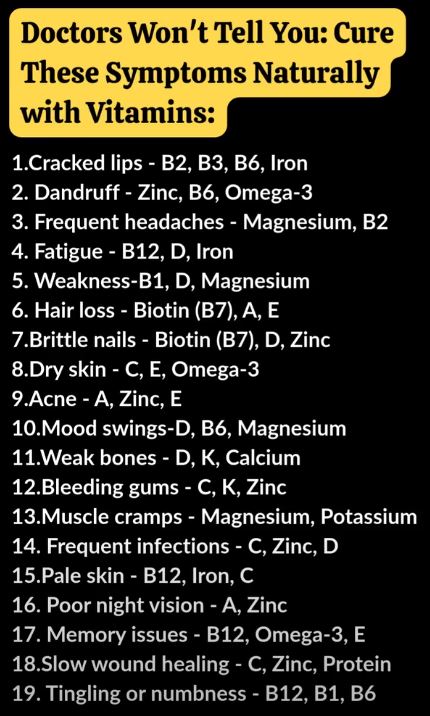
Grok evaluates thus: The list shared is a popular type of social media post that links common symptoms to specific nutrient deficiencies and suggests “natural cures” with vitamins/minerals. Many of these associations have some basis in medical and nutritional science, but the claims are often oversimplified, overstated, or incomplete.
These symptoms can have multiple causes (e.g., dehydration, stress, infections, hormones, medications, or other medical conditions), not just deficiencies. Deficiencies are real but relatively uncommon in people with balanced diets in developed countries — they’re more likely in cases of restricted eating, malabsorption issues (e.g., celiac, IBD), certain medications, or specific groups (vegans for B12, limited sun exposure for vitamin D).
Here’s a breakdown of the claims, based on reliable sources like NIH, Mayo Clinic, Cleveland Clinic, Harvard Health, and peer-reviewed literature:
Cracked lips (often angular cheilitis/cracks at corners) — Mostly accurate. Strongly linked to deficiencies in riboflavin (B2), sometimes niacin (B3), B6, iron, and occasionally zinc or other B vitamins. This is one of the more classic and well-supported associations.
Dandruff — Partially accurate but overstated. Linked to zinc deficiency (supports scalp health/oil regulation), B6 (riboflavin/B2 and B6 can contribute to seborrheic dermatitis-like flaking), and omega-3 (anti-inflammatory, may help dry/scaly scalp). Not the only or primary cause — dandruff is often fungal (Malassezia), hygiene-related, or seborrheic dermatitis.
Frequent headaches — Some support. Magnesium deficiency is associated with migraines/headaches (supplementation like 400-600 mg riboflavin/B2 or magnesium often recommended for migraine prevention). Riboflavin (B2) has good evidence for reducing migraine frequency. Iron deficiency (anemia) can contribute via reduced oxygen delivery. Not all headaches stem from this.
Fatigue — Very common and accurate. Classic for B12, vitamin D, and iron deficiencies (anemia from iron or B12/folate leads to tiredness/weakness).
Weakness — Accurate. Overlaps with fatigue; linked to B1, D, magnesium, A, and E (e.g., vitamin D for muscle function, magnesium for energy/contraction).
Hair loss — Partially accurate. Biotin (B7) is heavily promoted but evidence is weak except in rare true deficiencies. Better links to iron, zinc, vitamin D, A, E, and protein/essential fatty acids. Telogen effluvium (shedding) often ties to iron or other shortfalls.
Brittle nails — Some support. Linked to biotin (B7) (popular but mixed evidence), vitamin D, and zinc/iron.
Acne skin — Overstated. Vitamin A (retinoids) helps regulate skin/oil; zinc has anti-inflammatory effects and evidence for acne reduction; omega-3 may help inflammation. Vitamin E has limited direct link. Acne is multifactorial (hormones, bacteria, etc.).
Dry skin — Some support. Zinc and essential fatty acids (including omega-3) support skin barrier; deficiencies can worsen dryness.
Mood swings — Some support. Vitamin D, B6, and magnesium influence neurotransmitter function/serotonin; low levels associate with mood issues/depression.
Weak bones — Strongly accurate. Vitamin D, K, and calcium are essential for bone density/mineralization (rickets/osteomalacia in severe deficiency).
Bleeding gums — Accurate. Classic for vitamin C (scurvy causes bleeding gums/swollen tissues); K for clotting; zinc for healing.
Muscle cramps — Good support. Magnesium and potassium deficiencies commonly cause cramps (electrolyte imbalance).
Frequent infections — Accurate. Vitamin C, zinc, and D support immune function (e.g., zinc shortens colds; D deficiency links to higher respiratory infections).
Pale skin — Accurate. From anemia due to B12, iron, or sometimes vitamin C (aids iron absorption).
Poor night vision — Classic and accurate. Vitamin A deficiency causes night blindness/xerophthalmia; zinc aids vitamin A metabolism.
Memory issues — Some support. B12 deficiency causes neurological symptoms (memory problems, neuropathy); omega-3 for brain health; vitamin E as antioxidant.
Slow wound healing — Accurate. Vitamin C (collagen synthesis), zinc (cell repair), and adequate protein are key.
Tingling or numbness — Strongly accurate. Classic neurological sign of B12 deficiency (peripheral neuropathy); also B1 (beriberi) and B6 (in excess or deficiency).
Overall:
About 60-70% of the pairings have legitimate scientific backing (especially B vitamins, iron, zinc, D, C, magnesium for the symptoms listed).
The list presents them as direct “cures” and implies doctors hide this info — that’s misleading. Doctors do check for deficiencies (via blood tests) when symptoms suggest it, and supplementation helps if a deficiency exists. Self-diagnosing and mega-dosing vitamins can cause issues (e.g., excess A, iron, or B6 toxicity).
If you’re experiencing several of these symptoms, see a doctor for proper testing (blood work for vitamins/minerals) rather than just supplementing blindly. A balanced diet usually prevents most deficiencies, but targeted fixes work when needed.