
Five thousand years before Tylenol. Three thousand years before aspirin. Four thousand years before penicillin. The ancient Egyptians already had a medicine that killed bacteria, blocked pain, healed wounds, and reduced inflammation. They used it so much and valued it so highly that they stockpiled it in their royal tombs. Archaeologists have found myrrh resin in Egyptian burial chambers dated to 3,000 BC, still fragrant after five millennia.
The Ebers Papyrus, written around 1,550 BC and considered one of the oldest medical texts in existence, lists myrrh in over 50 separate prescriptions. For infected wounds. For tooth pain. For mouth ulcers. For joint aches. For stomach problems.
The Babylonians traded it across the entire ancient world. The ancient Chinese documented it in their medical texts over 2,000 years ago. King Solomon wrote about it in the Song of Solomon. Jesus was offered myrrh mixed with wine as a painkiller before the crucifixion, an act so well-known to people of that era that it needed no explanation in the text. Every major ancient civilization on Earth, without any contact with each other, arrived independently at the same conclusion: myrrh is one of the most powerful healing substances in nature.
Here is what they knew by observation and what science now explains in detail.
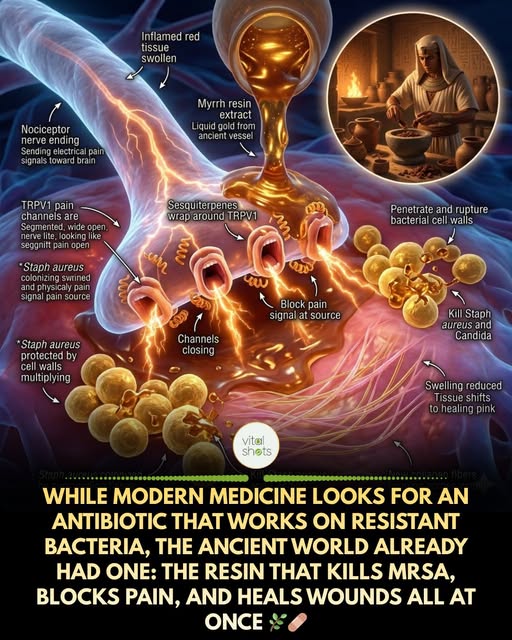
Myrrh comes from the Commiphora tree, a thorny desert shrub that grows across East Africa, the Arabian Peninsula, and India. When you wound the bark, the tree bleeds a thick amber resin that hardens into small, irregular lumps that smell like warm, earthy spice. That resin is packed with sesquiterpene compounds, specifically curzerene, furanodiene, and elemol, that have three distinct mechanisms modern medicine has now confirmed.
First, pain blocking. The sesquiterpenes from myrrh are potent inhibitors of the TRPV1 receptor, the exact channel that carries pain signals from damaged tissue up the nerve toward the brain. A 2024 study (PMC10768035) confirmed that Commiphora myrrha extract reduced established nerve pain and prevented its development by blocking TRPV1 channels peripherally and restoring normal TRPV1 protein expression in the spinal cord. The ancient Egyptians rubbing myrrh on sore joints were, without knowing it, performing targeted TRPV1 blockade.
Second, bacteria killing. A 2025 study in Nature Scientific Reports (PMID from ) confirmed that myrrh resin extract showed strong antimicrobial activity against Staphylococcus aureus, Pseudomonas aeruginosa, Klebsiella pneumoniae, and Candida albicans, all major modern pathogens including antibiotic-resistant strains. The mechanism is direct disruption of bacterial cell membranes from outside, the same mechanism that makes it impossible for bacteria to develop resistance to it the way they do to antibiotics.
Third, wound healing. The same 2025 study documented that myrrh extract accelerated fibroblast migration and collagen production in wound tissue, the two processes that physically close a wound and rebuild skin. The ancient practice of packing wounds with myrrh resin was, in precise biological terms, applying a simultaneous antimicrobial and wound-healing accelerant.
Five thousand years of use across every major civilization on Earth. Not coincidence. Evidence.
THE ANCIENT PHARMACY
For Mouth Pain, Gum Infections & Ulcers (the most documented traditional use): Myrrh tincture (liquid resin extract in alcohol), available in most health food stores. Apply 2 to 3 drops directly on the affected gum, tooth, or ulcer with a cotton swab. Leave for 2 minutes. The numbing and antimicrobial effects start within minutes. This is the original dental antiseptic before dentistry existed.
For Internal Use (joint pain and inflammation): Myrrh resin capsules, 400 to 500 mg daily with food. Look for standardized Commiphora myrrha or Commiphora molmol on the label.
For Wound Care (the Egyptian method modernized): Mix 2 drops of myrrh essential oil in a teaspoon of raw honey. Apply to clean minor wounds, cuts or skin infections. The myrrh kills bacteria on contact. The honey creates a moist healing environment and adds its own antimicrobial properties. Together they replicate what the Egyptians used for 3,000 years.
For Aromatherapy: Combine myrrh oil with frankincense in a diffuser (3 drops frankincense, 2 drops myrrh). This is the exact combination burned in the Temple of Jerusalem for over a thousand years, and in Christian churches for 2,000 years after that.
Sources: Myrrh extract blocks TRPV1 pain channels, reduces neuropathic pain (PMC10768035, 2024). Myrrh kills MRSA, Staph aureus, Candida and accelerates wound healing, 2025 (Nature Scientific Reports). Comprehensive pharmacological review of Commiphora myrrha: antimicrobial, analgesic, anti-inflammatory (PMC9672555, 2022).