
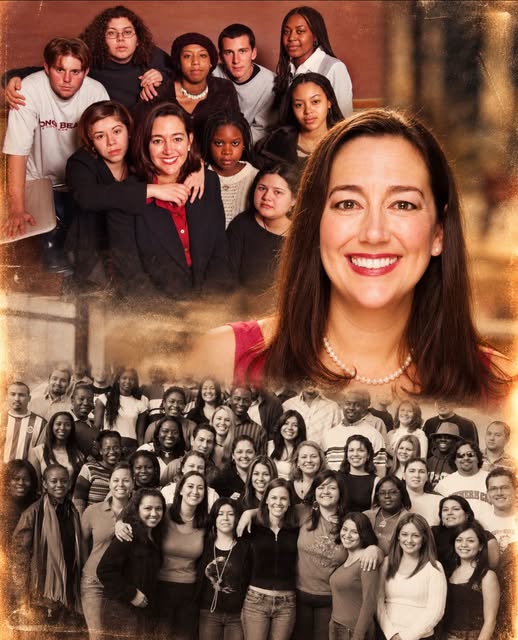
In September 1994, a 23-year-old teacher named Erin Gruwell walked into Room 203 at Woodrow Wilson High School in Long Beach, California, ready to begin her first day of teaching English. What she found was a classroom divided by race, fear, and years of anger. Latino students sat together, Black students kept to their own corner, Cambodian students stayed separate, and the few white students remained isolated. They were not simply avoiding one another. Many genuinely hated each other.
Long Beach was still living with the aftermath of the 1992 Los Angeles riots. Gang violence was widespread, and many of Erin’s students had already experienced things no teenager should have to face. Some had watched friends die. Others were homeless, living with relatives, or dealing with parents who were in prison or had been deported. The school had placed them in its lowest-track classes and labeled them “at-risk,” as though their futures had already been decided. Although they were freshmen, many could barely read at an elementary school level. Erin was even warned by the administration not to waste resources on students who probably would not graduate.
Her first day quickly turned into a struggle. Some students ignored her, others walked out, and a few even threw books. Most new teachers might have followed the standard curriculum, tried to get through the year, or decided the job was not worth the trouble. Erin chose a different approach. Instead of focusing only on what the students were doing wrong, she started paying attention to what they were going through. She noticed how they separated themselves by race, how easily arguments turned into fights, and how something as small as a look could spark violence. She began to understand that this was not simply a difficult English class. For many of these teenagers, the classroom reflected the same tensions and dangers they faced outside school.
One incident made that reality impossible to ignore. A student passed around a racist drawing that mocked another student’s appearance, and the class laughed. Erin could have sent the student to the principal or assigned detention, but she stopped the lesson instead. Holding up the drawing, she explained how similar caricatures had been used to dehumanize Jewish people before millions were murdered in the Holocaust. Then she asked the students how many had ever been shot at. Every hand went up. She asked how many had lost friends to violence, and every hand remained raised.
For once, the room fell silent for a different reason. The students knew what it meant to live in fear, to be judged, and to be treated as though their lives mattered less than other people’s. They had never thought about how their own experiences connected to the history they were being asked to study. Erin helped them make that connection, and it changed the way she approached her teaching.
She abandoned the standard curriculum and brought *The Diary of Anne Frank* into the classroom. At first, the students questioned why they should care about a white girl who had died decades earlier. But as they read about Anne hiding from people who wanted to kill her, trying to make sense of fear while holding on to hope, they began to see something familiar. Anne was not just a name in a history book. She was a teenager who had experienced hatred and had found a way to record her thoughts and feelings.
Erin deepened that connection by inviting Holocaust survivors to speak to her students. When Renee Firestone, a survivor of Auschwitz, visited Room 203 and shared her story, many of the teenagers cried. They had never met someone who had survived a genocide, but they understood the pain of loss and the struggle to survive. History no longer felt distant or irrelevant. It had become something real, something they could connect to their own lives.
Then Erin introduced an idea that would change the classroom even more. She gave each student a journal. These notebooks were not meant to be graded assignments, and she did not expect perfect grammar or polished essays. She simply wanted them to write honestly about their lives. They could keep their entries private or choose to share them with the class. There would be no red marks correcting every mistake and no judgment about what they chose to say.
At first, many students left their pages blank. Trust was difficult for teenagers who had repeatedly been let down by adults. But gradually, they began to write. One described watching his brother get shot. Another wrote about sleeping in a car because his family had nowhere to live. A student admitted that she hid her intelligence because being smart could make her a target. These were not ordinary school assignments. They were personal accounts of fear, grief, and survival.
As the students became more comfortable sharing their stories, the divisions between them began to weaken. A Latino student discovered that a Black classmate had also lost a brother to gang violence. A Cambodian refugee and a student from South Central Los Angeles realized that their families had escaped similar hardships. They started to understand that beneath the racial hatred and hostility were experiences of pain that were not so different from one another. Their backgrounds were different, but grief, fear, and the desire to survive were feelings they could all recognize.
Erin’s methods did not win much support from the school administration. When she asked to take her students on field trips, she was told that they were too expensive or risky. Requests for better books were rejected because of budget limitations. She wanted her students to have the same opportunities and attention as everyone else, but the system seemed to have already decided what they were worth. Rather than accept those restrictions, Erin took on three jobs, working at Nordstrom, a Marriott hotel, and selling real estate. She used the money to buy books and pay for field trips herself. She refused to let the school’s low expectations determine how far her students could go.
Meanwhile, Room 203 was changing. Students who had rarely finished a book began reading eagerly. Those who had once refused to speak in class started sharing their writing. Teenagers from rival gangs sat beside one another without the hostility that had once seemed unavoidable. The violence that had defined the classroom began to fade, not simply because Erin enforced rules, but because the students were learning to understand one another. Once they knew the stories behind each other’s anger, it became harder to see one another as enemies.
By their senior year, all 150 students were on track to graduate. These were the same teenagers the administration had warned Erin would probably never finish high school. Yet every one of them made it to that point. Their journals, which had begun as a simple way for students to express themselves, eventually became a book. Published in 1999, *The Freedom Writers Diary* brought together the voices of all 150 students, sharing their experiences with poverty, racism, violence, and the struggle to build a future.
The book reached readers around the world because it was honest. It did not present the students as statistics or reduce their lives to academic problems. It allowed them to tell their own stories in their own words. Teachers began using it in classrooms, and in 2007, the story reached an even larger audience through the film *Freedom Writers*, starring Hilary Swank as Erin. The movie showed how education could be about far more than standardized tests and grades. It could begin with recognizing students as people whose experiences deserved to be heard.
But the greatest measure of Erin’s work was not the success of the book or the film. It was what happened to the students themselves. Many went on to college, becoming the first members of their families to do so. Some eventually became teachers, carrying Erin’s approach into their own classrooms. Others became social workers, counselors, and advocates, dedicating themselves to helping young people facing the same kinds of challenges they had once known.
Erin also founded the Freedom Writers Foundation to help teachers around the world use writing, literature, and storytelling to build stronger connections with their students. Through its work, the foundation has reached hundreds of thousands of students.
Years later, former Freedom Writers reflected on what had happened in Room 203. One student remembered believing that he might not live to see his eighteenth birthday, only to go on to earn a master’s degree. Another said Erin had done more than teach English. She had taught them that they mattered.
That was the real lesson of Room 203. Writing gave the students a way to speak about their lives, and a dedicated teacher helped them discover what they could achieve. But at the heart of it all was something even simpler: Erin saw young people whom the school had largely given up on, and she refused to believe that their circumstances defined their future.
When she walked into that classroom in September 1994, she was a 23-year-old teacher facing students who had every reason to distrust another adult. Some threw books at her, and many had been told, directly or indirectly, that they were unlikely to succeed. Erin gave them journals instead, asking them to write their truths. She introduced them to Anne Frank, brought Holocaust survivors into their classroom, and worked three jobs to provide the books and experiences the school would not fund.
By graduation, all 150 students had made it. Many went on to college, their writing became a bestselling book, and their story inspired a film. It all began because one teacher refused to accept that being labeled “at-risk” meant being incapable of success. She gave her students the chance to be heard, and they showed what could happen when someone finally believed in them.