
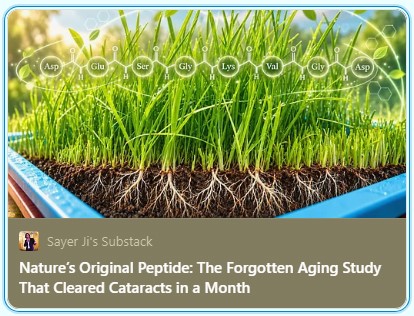
In 2005, in the peer-reviewed journal Biogerontology, they tested a wheat sprout extract to see whether it “could mimic the thymus action on recovering age-related alterations,” and whether it could treat “an age-associated pathology, the cataract in dogs” (Basso et al., Biogerontology, 2005).
Here is what they reported:
• Aging liver cells moved back toward youth. In old mice, the wheat sprout extract restored the declining DNA synthesis of liver cells, much as calf thymus extract did. It also brought abnormally high DNA and protein content back down “to levels observed in young mice.”
• Sprouting multiplied the biological activity. The sprouts showed 10 to 40 times more phosphorylation activity than the seeds they grew from.
• Cataracts receded. Old dogs given the extract by mouth for one month showed a 25–40% reduction in lens opacity.
Life has been encoding regulatory information into food since long before there were laboratories. A sprouting seed is a burst of growth signals: peptides, phosphates, antioxidants, and chlorophyll, all working together to tell a living system to grow and renew. When aging researchers asked whether that signal could stand in for the thymus, the answer they published was yes, at least for the markers they measured.
This is what I mean when I say food is information. The most important longevity peptide may not come from a vial. It may come from the soil.
https://sayerji.substack.com/p/natures-original-peptide-the-forgotten