
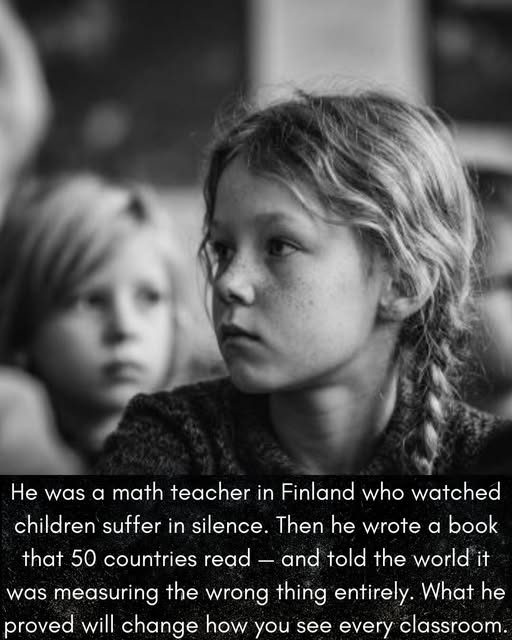
Did you know Finland doesn't rank its schools or test young children against each other — and still produces some of the best-educated people on earth?He was a 26-year-old math and science teacher in a small Finnish classroom.
The education ministers of 50 countries had never heard his name.
The United States had just spent billions on standardized tests — and their children were still falling behind.
Then in 2001, Finland's results hit the world like a thunderclap. Number 1 in reading. Number 2 in science. Top tier in mathematics.
No one could explain it.
So they came to him.
October 26, 1959. Oulu, Finland.
A city in the north, close to the Arctic, where winters are dark and long and children grow up knowing that survival requires more than facts memorized from a page.
Pasi Sahlberg grew up here. He was not a happy student.
He wanted to leave school as fast as he could.
Then a teacher named Timo walked into his life — a math and science teacher who loved the arts — and something shifted. Not because Timo drilled him harder. Because Timo saw him.
That moment stayed with Pasi for the rest of his life.
He became a teacher.
By the 1980s, Finland was quietly doing something the rest of the world called impossible.
No standardized tests for children. No school rankings. No competition between classrooms.
Teachers were required to earn master's degrees — the same level as doctors and lawyers. They were trusted to make their own decisions. If a child seemed anxious, a teacher could stop the lesson and talk.
The philosophy was simple, and it had no room for debate:
The most important thing in a classroom is the relationship between the teacher and the child.
Then came December 4, 2001.
The OECD released the first PISA results — the biggest international study of student performance ever conducted, covering 32 countries.
Finland ranked number 1 in reading. Number 2 in science.
The United States — which had spent decades and billions building a system of tests and targets — ranked 15th in reading. 19th in science.
Education ministers from Paris to Washington picked up the phone.
What are you doing differently?
Pasi Sahlberg had the answer.
But no one wanted to hear it.
He traveled to conferences. He sat across from policy makers. He explained, again and again, that Finland had not built a better testing system. Finland had built a system that refused to test children against each other at all.
No child labeled as a failure. No school ranked below another. Every teacher trusted. Every child seen as a whole person — not a score.
The officials listened politely.
Then they went home and built more tests.
In 2011, Pasi Sahlberg published Finnish Lessons.
It became one of the most widely read education books in the world.
In 2013, it won the Grawemeyer Award — one of the most prestigious prizes in education globally.
Educators in 50 countries read it. Governments in Australia, Canada, and Germany cited it in policy debates.
He went on to teach at Harvard University's Graduate School of Education.
He had gone from a classroom in Oulu to one of the most influential voices on how the world teaches its children.
But here is the part of this story that most people still miss.
Pasi Sahlberg never argued that Finland was perfect.
He argued for one simple thing:
You cannot weigh a pig and call it feeding.
Testing a child does not teach a child. Measuring a feeling does not create one. Ranking a school does not improve one.
What changes a child — what actually changes a human being — is being seen. Being trusted. Being taught that their inner world matters as much as their test score.
Pasi Sahlberg refused to pretend that a spreadsheet could measure a human being.
Today, 93 countries participate in PISA testing. The race for rankings has never been more intense. Children in South Korea, Singapore, and the United States report some of the highest levels of school-related anxiety in the world.
Finland still does not rank its schools. Still does not test children against each other in primary school. Still requires every teacher to hold a master's degree.
And Finnish children still rank among the happiest students on earth.
The lesson was always there.
Most of the world just kept choosing the test instead.
Pasi Sahlberg spent 4 decades arguing for one truth: that the purpose of school is not to sort children — it is to grow them.
He taught in a small Finnish classroom. He wrote a book that changed policy on 5 continents. He stood in front of governments that had billions invested in the wrong answer and told them plainly what they did not want to hear.
Today, as a global mental health crisis among children grows louder — as anxiety, loneliness, and burnout reach record levels in schools worldwide — the question he has been asking since 1986 is more urgent than ever:
What if we taught children that who they are matters more than what they score?
PASI SAHLBERG: The teacher from Finland who told the world it was measuring the wrong thing — and proved it.