
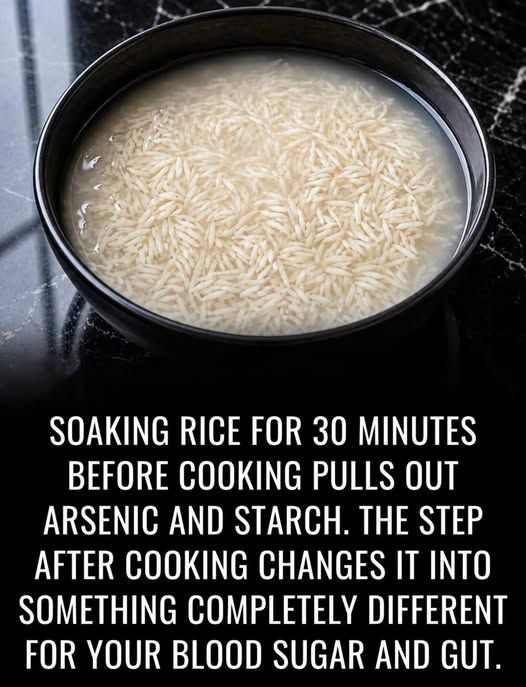
I saw this meme and thought to query the data. This is what ChatGPT returned:
Soaking rice for 30 minutes before cooking can remove some surface starch and a small amount of arsenic, but the two effects are quite different.
1. Arsenic removal
Rice absorbs arsenic from the soil and water in which it grows. Much of this arsenic is inorganic arsenic, the form of greatest concern for human health.
– A 30-minute soak may remove some arsenic, particularly arsenic on or near the surface of the grain.
– However, it is not particularly effective at removing arsenic contained within the grain.
– Rinsing the rice several times before cooking can help, but the reduction is generally modest.
2. Starch removal
Here the answer is more positive.
– Soaking allows some loose surface starch to enter the water.
– Discarding that water and rinsing the rice removes the suspended starch.
– This can reduce the cloudy water and, to some extent, the stickiness of the cooked rice.
– However, most of the starch remains inside the grain.
Research suggests that washing alone does not necessarily make a significant difference to the texture of cooked rice.
3. What is the most effective way to reduce arsenic?
The best-established household method is to cook rice in excess water, much as you would pasta, and drain it afterwards.
| Method | Arsenic reduction |
|---|---|
| Ordinary rinsing | Generally small |
| 30-minute cold soak | Some reduction, variable |
| Cook in 6–10 parts water to 1 part rice, then drain | Approximately 40–60% |
The figures for excess-water cooking come from FDA research.
There is also an interesting alternative: USDA research found that soaking white rice for 10 minutes in water at 80°C, using ten parts water to one part rice, removed an average of approximately 38% of inorganic arsenic.
My recommendation
If your objective is to reduce both arsenic and surface starch, I would:
1. Rinse the rice thoroughly.
2. Soak for 30 minutes in plenty of fresh water.
3. Discard the soaking water.
4. Cook in excess fresh water.
5. Drain when cooked.
One qualification: cooking in excess water also removes some water-soluble nutrients, particularly B vitamins and iron from enriched white rice.
Finally, I wouldn’t become overly concerned about rice consumption. Varying your grains rather than relying heavily on rice is a sensible way to reduce long-term exposure to arsenic.