
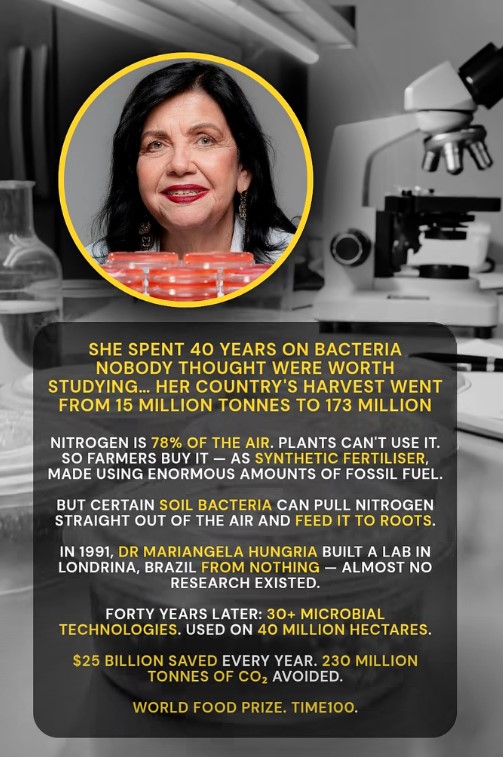
Nitrogen makes up 78% of the air you’re breathing right now. Plants can’t touch it. That single inconvenience is why the world spends fortunes on fertiliser.
Synthetic nitrogen fertiliser is one of the reasons eight billion people can eat. It’s also enormously energy-intensive to produce, expensive for farmers, and a significant source of greenhouse gas emissions and water pollution when it runs off fields.
But there’s a workaround, and it’s been sitting in the soil the whole time.
Certain bacteria — rhizobia — form nodules on the roots of legumes and convert atmospheric nitrogen into a form plants can actually absorb, in exchange for energy from the plant. It’s called biological nitrogen fixation.
The question was whether you could make it work reliably, at industrial scale, in tropical soils.
When Mariangela Hungria started, almost nobody thought you could.
She’s a microbiologist from São Paulo who studied under Dr Johanna Döbereiner, an early champion of using microorganisms in tropical agriculture. In 1991 Hungria moved to Londrina, in Paraná state, to start a soil microbiology laboratory at Embrapa’s National Soybean Center.
There was essentially no existing research on biological nitrogen fixation for soybeans in the tropics. She built the programme from scratch.
The work was painstaking. Selecting elite strains of rhizobia. Testing what happened when you introduced them to plants. Establishing how environmental stress affected performance. Identifying plant genotypes that partnered well with the bacteria. Then convincing farmers to re-inoculate their seed every single year — which she demonstrated could increase yields by up to eight percent compared with relying on synthetic fertiliser alone.
She also became the first to isolate strains of Azospirillum brasilense suitable for use with non-legume crops, which opened the same approach up to maize, wheat, rice and pasture grasses.
Over a forty-year career she and her group developed more than thirty microbial technologies.
The results are on a scale that’s difficult to hold in your head.
Her products have been used across more than 40 million hectares in Brazil. The World Food Prize Foundation estimates they save Brazilian farmers around $25 billion a year in input costs and prevent the release of 230 million metric tons of CO2-equivalent emissions annually.
And over the same four decades, Brazilian soybean production rose from 15 million tonnes in 1979 to an anticipated 173 million tonnes. Brazil became the world’s leading soybean producer and the global leader in the commercial use of biological inoculants.
In May 2025 she was named the World Food Prize Laureate, receiving the $500,000 award. Gebisa Ejeta, who chairs the selection committee, cited extraordinary scientific achievements in biological nitrogen fixation that transformed the sustainability of agriculture in South America.
Her own reaction was less formal: “I can’t quite believe I am now receiving the World Food Prize.”
This year she was named to the TIME100.
She has also supervised more than a hundred masters and doctoral students — which, given where she started, may end up mattering as much as the bacteria did. Döbereiner taught Hungria. Hungria taught a hundred more.
There’s a version of the future where feeding people means more chemistry, more energy, more inputs. Her entire career is an argument for a different one: that a great deal of what we’re paying for is already happening, for free, underneath us — and the job is to understand it well enough to get out of its way.
Forty years on one invisible thing.