
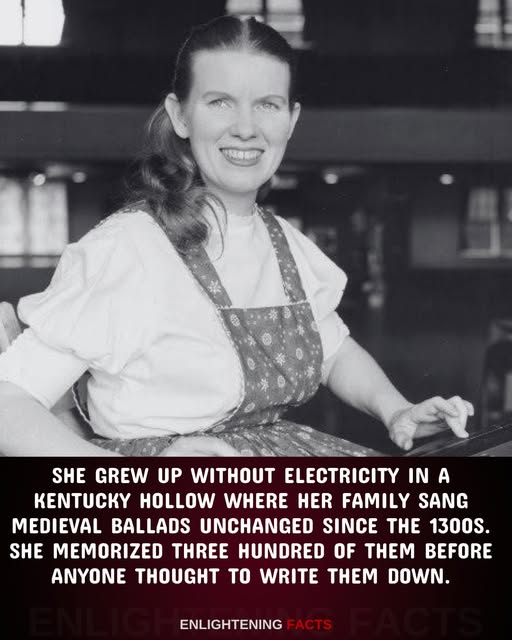
She was five years old when she began teaching herself her father’s dulcimer in secret.
The instrument was nearly forbidden to her. Balis Ritchie was protective of the three-stringed Appalachian dulcimer he played, and his children were not to touch it without permission. So Jean Ritchie waited for the hours when her father was away from the house and traced the strings with fingers too small for the frets, learning by doing what she could not yet be taught. When he discovered what she had been doing, he did not scold her. He called her a natural-born musician.
She had been born on December 8, 1922, in Viper, Kentucky, in the Cumberland Mountains — the youngest of fourteen children in a house without electricity and without running water. What the house had was music. Her family sang ballads that their Scots-Irish ancestors had carried across the Atlantic from Scotland and preserved, in the isolation of the Appalachian mountains, in forms closer to their medieval originals than anything still being sung in Britain. The poverty and the geography that had cut the mountains off from mainstream American life had also cut those songs off from the changes and the compromises that had altered them everywhere else. The isolation had been, inadvertently, a form of conservation.
Jean absorbed the repertoire with a memory that went well beyond ordinary musicality. She learned songs like Lord Barnard and Barbara Allen, songs that had crossed an ocean with her family’s ancestors and arrived intact in the Kentucky mountains, where they had stayed intact for generations. She learned them not as historical objects but as living things — songs that were simply what her family sang, the way some families say grace and some tell stories.
And she watched what happened when the people who held them died.
Songs that existed in no book and on no recording, that lived only in a particular voice at a particular address in the mountains, ceased to exist when that person was gone. A whole verse, a whole melody, a whole version of something that had survived three centuries of Atlantic crossings and mountain winters simply vanished into silence. She understood what this meant in a way that was not abstract. She made a decision that she later described as defining everything that came after: these songs were too precious to let die with the people who held them. Someone had to hold them on purpose.
In 1946, she graduated Phi Beta Kappa from the University of Kentucky — a remarkable achievement for the youngest daughter of a mountain family in a house that had never had electric light. She moved to New York City and began teaching at the Henry Street Settlement in Manhattan, and she sang the mountain ballads for audiences of folklorists and musicians who were, by multiple accounts, stunned by what they were hearing.
This was not someone performing versions of folk songs. This was the thing itself — preserved exactly, in a voice that seemed to carry the altitude of the mountains and the weight of the centuries it had traveled through.
The folk music establishment had complicated feelings about this.
A prominent folk scholar declared that Jean Ritchie could not legitimately be called a folksinger because she had been to college — that authentic tradition and formal education were mutually exclusive categories, that the degree had somehow contaminated the tradition. Jean’s response was to continue being both things simultaneously, without apparent contradiction and without apology. She had learned Lord Barnard on a porch in Viper, Kentucky, before anyone outside the mountains had thought to write it down. She had also graduated Phi Beta Kappa. Neither fact had damaged the other.
In 1952, a Fulbright scholarship sent her to Britain for eighteen months to record traditional singers in England, Scotland, and Ireland. What she found confirmed what she had suspected: the isolated mountain communities of Appalachia had preserved medieval songs more faithfully than the societies that had originally produced them. The mountains had kept what Britain had let change.
She recorded more than thirty albums across her career. She wrote seven books. She wrote songs about the strip mining that was tearing apart the Kentucky mountains she came from, and she sang them alongside the centuries-old ballads without feeling any contradiction between the two. She almost single-handedly revived the Appalachian dulcimer from the edge of extinction — playing it on every record, writing instruction books, selling instruments, teaching anyone who wanted to learn — until what had been a nearly vanished instrument from isolated mountain communities became recognized as a classic of American folk tradition.
Bob Dylan, Joan Baez, Judy Collins, Emmylou Harris, and Dolly Parton all cited her as foundational to their own musical development. When Dylan was accused of drawing the melody of Masters of War from a traditional tune in Jean’s family repertoire — a song called Nottamun Town — she wrote him a polite letter asking about it. His lawyer never responded. She let the matter go. She said, in effect, that the music mattered more than the credit. The song was out in the world and being heard, which was the point.
In 2002, she received the National Heritage Fellowship, the highest honor the United States government confers on traditional artists.
She died on June 1, 2015, at ninety-two years old, back home in Kentucky. Her recordings are archived at the Library of Congress. The dulcimer she helped bring back from the edge of disappearance is now a recognized part of the American musical canon. The songs she had memorized on a porch in the Cumberland Mountains, before anyone thought to write them down, are still being sung.
The folk scholar who said she could not be a folksinger because she had been to college was making an argument about purity — that some kinds of knowledge cancel other kinds, that the authentic and the educated cannot coexist without corruption. Jean Ritchie’s entire life was a refutation of that argument. The degree had not erased the porch. The porch had not been damaged by the degree. She had held both things at once for ninety-two years, and the songs she had memorized as a girl in a house without electricity are still alive because she decided, at some point in her childhood, that someone should hold them on purpose.
She was the person who noticed in time.
For anyone who has ever been the last person in a room who still remembered something important — what did you do to make sure it didn’t die with you?