
The simple things, the cheap things, the things your grandma used, don’t get tested. And then the doctor says, “There’s no evidence that the onion works.” But the only reason there’s no evidence is that nobody paid to look. The onion still works. It’s just that nobody’s selling it.
That’s what this essay is about. Twelve simple, cheap things that work, and the medicines that took their place, and why.
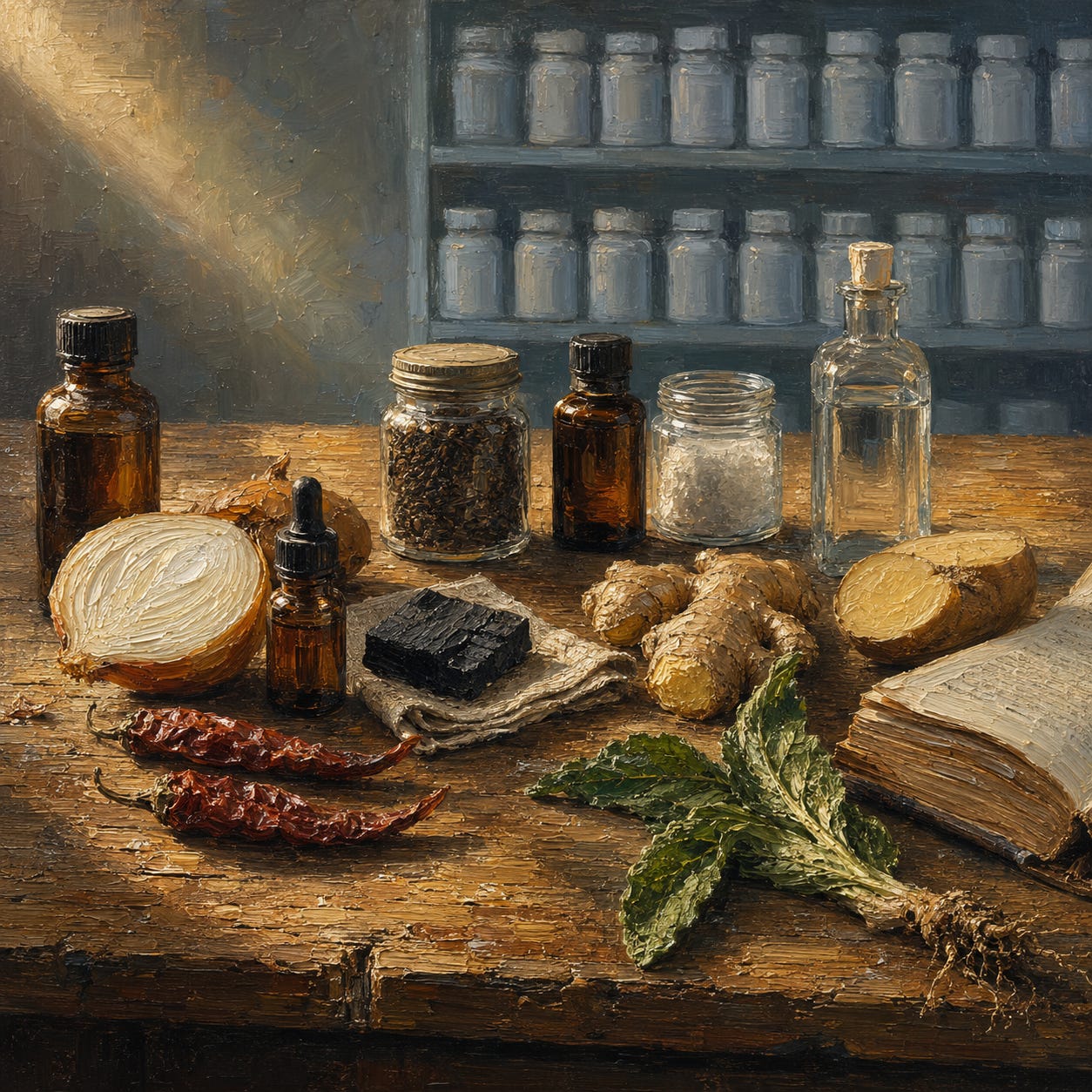
The Draws
Castor Oil
Potato
Onion
Comfrey
The Eliminators
Charcoal
Milk Thistle
Iodine
MSM
The Movers
Cayenne Pepper
Ginger
Hydrogen Peroxide
The Carrier
DMSO
Fortifying the Argument
The closest objection is the one that says: these are anecdotes, not trials. It is the correct objection for some of the twelve and the wrong one for others. There are no large randomised controlled trials of castor oil packs in lymphatic congestion, of onion poultices in otitis media, of comfrey in fracture healing, of cayenne in haemorrhage — those trials do not exist because nobody would pay to run them, and the absence is the evidence, not the disproof. But the claim of blanket absence is itself false. Ginger has been tested head-to-head against ondansetron and held its ground. Silymarin has hundreds of trials behind it and is used intravenously in European hospitals for the deadliest poisoning a liver can face. Charcoal is first-line toxicology in every emergency room. For these, the evidence exists, it is positive, and the neglect persists anyway. That is the more damning finding: where the trials were run, they did not change clinical adoption, because adoption does not track evidence. It tracks ownership.
The second objection, raised against every entry on the warning or banned end, is that the substance is dangerous. Comfrey contains pyrrolizidine alkaloids. Hydrogen peroxide at high concentration is corrosive. DMSO carries co-administered substances into tissue, which means it carries contaminants into tissue too. These are real considerations and the risk profile of each substance should be understood. What is missing from the establishment’s framing is the comparison. The risk of comfrey in its medicinal form has been measured and is minimal at therapeutic dose. The risk of the substances that replaced comfrey (NSAID-induced gastric haemorrhage kills tens of thousands of Americans annually, and long-term corticosteroid use produces a documented catalogue of consequences) is rarely weighed beside the comfrey warning. Risk labels are applied to natural substances and absent from products that have killed far more people.
A third objection, raised against the structure of the case, is cherry-picking. Twelve substances are named here; an honest critic could probably name twelve traditional remedies that do not work, or whose claimed effects do not stand up. The answer is that the twelve here were not picked because they support the argument. They were picked because each has a substantial documented record, each is genuinely cheap, each is genuinely unpatentable, and each has a clearly identifiable patented replacement. The pattern across all twelve is the argument. One coincidence is anecdote. Twelve, across substances unrelated in chemistry and origin, is a structure.
The final objection is that this analysis requires medical or pharmacological expertise. It does not. The patent law is public. The Supreme Court rulings are public. The drug-development cost estimates are published in JAMA and elsewhere. The traditional use of each substance is in books anyone can read. The FDA warnings, restrictions, and approvals are publicly searchable. The argument here rests on documents, not on credentials.
Closing
Twelve substances, unrelated in chemistry, origin, mechanism, or culture of use, sharing one fate.
Castor oil, used since the Egyptian dynasties, sits unmentioned in every pharmacy in the country. The potato slice that drew heat and swelling from inflamed skin, replaced by hydrocortisone. Onion, used by every grandmother in Europe for a child’s earache, replaced by ofloxacin. Comfrey, knitbone, restricted. Iodine, demonised, replaced by a synthetic thyroid hormone marketed for life. MSM, the sulphur the soil lost, replaced by Humira. Ginger, gentler than Zofran, replaced by Zofran. Cayenne, which could stop the bleeding, replaced by an intravenous medication delivered by a trained paramedic in an ambulance. Charcoal, kept in every emergency room, refused everywhere else. Milk thistle, taken seriously in Italian hospitals, ignored in American ones. Hydrogen peroxide, warned against. DMSO, approved for one rare bladder condition out of the hundreds of indications its clinical record covers.
These are not twelve coincidences. The ones that were merely neglected can be explained by oversight, by inertia, by the slow forgetting that follows when nobody talks about a thing. The ones that were warned against, restricted, and prosecuted cannot. Neglect is what happens to what cannot be sold. Prohibition is what happens to what competes with what is being sold.
The FDA has approved DMSO for a single indication. The clinical record of DMSO covers thousands of indications. The difference between the two numbers is not a scientific finding. It is a measure of how dangerous a substance can be to the patented alternatives, before the regulatory machinery moves from indifference to active suppression.
The pattern is the case.
Explain It To A 6 Year Old
When you go to the doctor and they give you medicine, the medicine usually has a name on the box and it usually costs a lot of money. The reason it costs a lot of money is that the company that made it has a special permission from the government saying nobody else is allowed to sell that exact medicine for a long time. So if you want it, you have to buy it from them.
There is a rule about this special permission. You can only get it for things you invented yourself. You can’t get it for things that grew in the ground all by themselves, like an onion, a piece of ginger, a potato, a leaf from a plant, or a mineral that comes out of the sea. So nobody has the special permission for onions, for ginger, for castor oil, for comfrey, for charcoal, for milk thistle, for cayenne, for iodine, for sulphur powder, for hydrogen peroxide, or for the other simple things that used to live in everybody’s kitchen and medicine cabinet.
Before a doctor will say something is a real medicine, somebody has to do a very big and very expensive test on it. The tests cost hundreds of millions of dollars. The only people who can afford the tests are the companies that can sell the medicine afterwards and make all that money back. So the companies test the medicines they own. They don’t test onions. They can’t own onions. They can’t make their money back on onions.
https://unbekoming.substack.com/p/the-12-remedies-they-cant-patent