You know that bay leaf you fish out of your pasta sauce before serving? The one that seems to do nothing except sit there looking noble? That leaf is speaking a language your garden desperately needs you to learn.
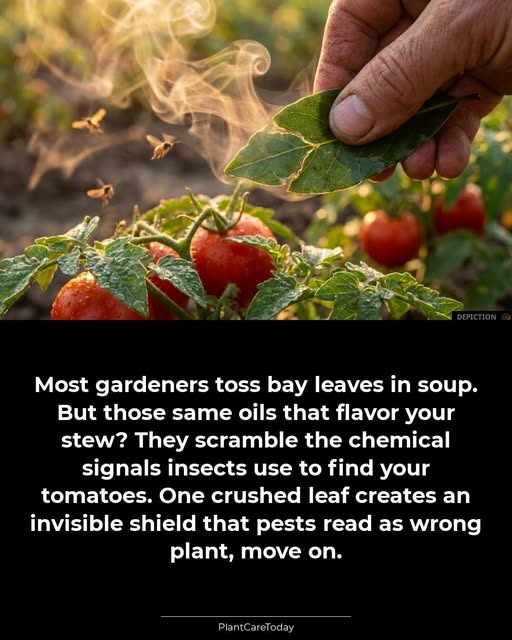
When you crush a bay laurel leaf between your fingers, you release compounds called terpenes and eucalyptol. These aren’t just pleasant aromas for humans. They’re chemical sentences in an ancient conversation between plants and insects, and what they’re saying is surprisingly aggressive.
Here’s what most people miss. Insects don’t see plants the way we do. They navigate by scent molecules that drift through the air like invisible road signs. An aphid finds your tomato plant because that tomato is broadcasting a specific chemical signature, a scent fingerprint that says “juicy stem cells, come feed here.” The aphid’s antennae are tuned to receive exactly that signal.
Bay leaves jam the frequency.
When you scatter crushed bay leaves around the base of vulnerable plants, you’re not creating a barrier. You’re creating confusion. The oils from those leaves mingle with the air currents, overlaying the tomato’s invitation with a completely different message. To an aphid or whitefly, it’s like trying to find your house when someone keeps moving the street signs. The chemical signature they’re searching for gets buried under eucalyptol and cineole, compounds that most pest insects associate with plants they don’t want to eat.
This isn’t about toxicity. Bay leaves won’t kill anything. They simply make your vegetable garden illegible to the insects trying to read it. A thrip lands on a leaf, tastes something that doesn’t match the scent promise, and moves on. A moth circling at dusk can’t lock onto the pepper plant she’s looking for because the air is thick with wrong information.
I keep a bay laurel in a pot near my kitchen door, and when I’m harvesting basil or checking on young seedlings, I’ll grab a handful of older bay leaves and crush them right there in the garden. You’ll see me tucking them into the mulch around eggplants, laying them across the soil near young cucumber starts. They dry out over a few weeks, but while they’re fresh, they’re broadcasting static into the insect communication network.
The Indigenous peoples of the Mediterranean figured this out centuries before we had words like “volatile organic compounds.” They planted bay laurel near food storage areas, wove branches into grain baskets, tucked leaves into flour sacks. They weren’t just repelling weevils. They were speaking the language of chemical ecology without needing to name it.
Your bay leaf isn’t flavoring the soup through some mystical essence. It’s releasing the same defense compounds the tree uses to protect itself in the wild, and you can borrow that protection for the plants that need it most. The tree paid the cost to manufacture those oils. You’re just putting them to work in a new location.
That quiet leaf sitting in your spice drawer is a translator, a scrambler, a shield. It’s been protecting plants from the wrong kind of attention since before humans learned to cook. Maybe it’s time we let it do that work again, not just in our food, but in the soil where our food is trying to grow.