
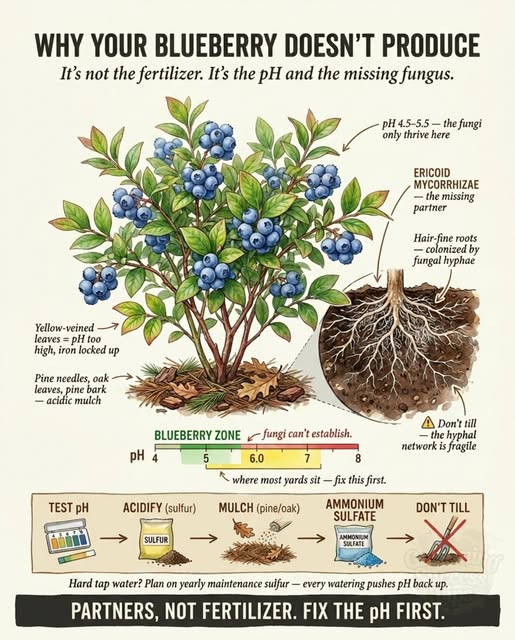
Your blueberry bush isn’t producing because it can’t reach the nitrogen in your soil — even when you fertilize.
The missing piece isn’t nutrients. It’s a partner.
Blueberries evolved alongside a specific group of fungi that colonize their hair-fine roots and unlock nitrogen from the soil around them. Those fungi only work in acidic ground — and most garden soil isn’t acidic enough.
When the pH runs too high, the fungi can’t establish. The bush sits there absorbing almost nothing on its own, and adding more fertilizer doesn’t solve it because the delivery system is missing.
That’s also why struggling bushes get pale leaves with yellow veins — iron locks up in the same pH range.
?? The fix takes one season to start and about three to mature:
– Test your soil pH first — if it’s above the acidic range, mulching alone won’t correct it
– Work elemental sulfur into the top several inches of soil — it converts slowly into acid over months, which is why you apply it well ahead of planting
– Mulch with pine needles, oak leaves, or pine bark and replenish every spring — this feeds the acidic layer the fungi need
– Switch to an acidifying fertilizer instead of generic balanced feed — the form of nitrogen matters as much as the amount
– Stop tilling the root zone — you’re shredding the fungal network you’re trying to build
If your tap water is hard, expect to reapply sulfur yearly. The water nudges pH back up every time you irrigate.
The ecosystem rebuilds over a few seasons. The berries tell you when it’s working.