
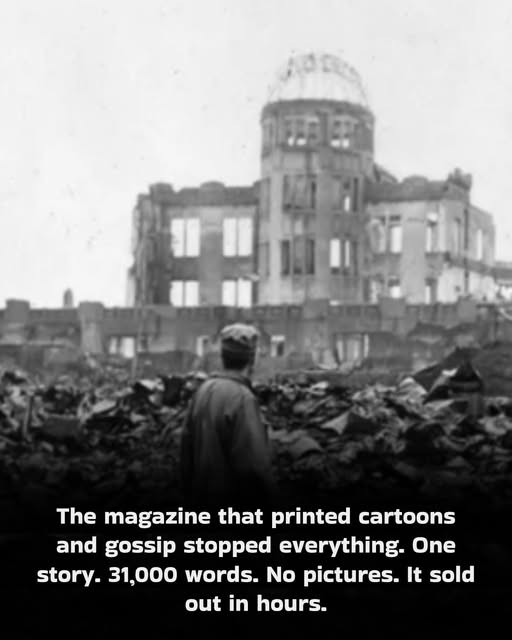
The magazine that printed cartoons and gossip stopped everything. One story. 31,000 words. No pictures. It sold out in hours.
August 31, 1946. The New Yorker.
Subscribers opened their latest issue expecting the usual: witty essays, reviews, cartoons, advertisements.
Instead, they found one word on the first page:
“Hiroshima”
And then 31,000 words about six people who survived the atomic bomb.
No cartoons. No other articles. No variety.
Just one story. For the entire issue.
Nothing like this had ever been done before.
And it changed American journalism forever.
THE STORY NOBODY WANTED TO HEAR
August 6, 1945. 8:15 AM. Hiroshima, Japan.
The United States dropped the first atomic bomb ever used in warfare.
140,000 people died by the end of 1945.
The bomb ended World War II. Japan surrendered nine days later.
President Truman called it a necessary act that saved American lives.
Most Americans agreed. The war was over. We’d won. Move on.
But one year later, most Americans still had no idea what actually happened in Hiroshima.
They knew a bomb had been dropped.
They didn’t know what it felt like when the city turned into hell in one second.
They didn’t know about the radiation sickness that killed people weeks after the blast.
They didn’t know about the shadows burned into walls where people had been vaporized.
They didn’t know about the mother searching through burning rubble for her children.
They didn’t know because nobody had told them.
Until John Hersey did.
THE JOURNALIST WHO WENT TO SEE
Spring 1946. John Hersey—already a respected war correspondent—traveled to occupied Japan.
He went to Hiroshima.
And he did something unusual: he didn’t interview military officials or politicians.
He found six ordinary people who’d survived the bombing.
A doctor. A widow with three children. A priest. A young woman. A pastor. Another doctor.
And he asked them: What happened to you on August 6, 1945?
What were you doing at 8:15 AM?
What did you see?
What did you feel?
How did you survive?
What happened after?
He spent weeks interviewing them. Taking notes. Documenting every detail.
Then he went home and wrote their stories.
THE ARTICLE THAT BROKE THE RULES
Hersey wrote 31,000 words.
No dramatic language. No political commentary. No judgment.
Just: this is what happened to these six people.
Mrs. Nakamura was making breakfast for her three children.
Dr. Sasaki was walking through the hospital corridor.
Father Kleinsorge was reading in his room.
Miss Sasaki had just sat down at her desk at work.
At 8:15 AM, the world ended.
Hersey described it calmly. Almost clinically.
“A tremendous flash of light cut across the sky… Mrs. Nakamura’s house was violently shaken and everything fell…”
No screaming headlines. No sensationalism.
Just: the flash. The blast. The fire. The screaming. The silence.
And then the aftermath.
The radiation sickness that killed people weeks later. The burns that never healed. The children who never came home. The city that kept dying long after the bomb fell.
Hersey let the facts speak.
And the facts were devastating.
THE EDITOR’S GAMBLE
William Shawn, editor of The New Yorker, read Hersey’s manuscript.
He realized immediately: this was extraordinary.
But it was also 31,000 words. Way too long for a magazine article.
Shawn made a decision that had never been made before:
Publish it as the entire issue.
No other articles. No cartoons. No reviews. No ads mixed in.
Just Hersey’s story, from cover to cover.
It was a massive gamble.
The New Yorker was a general-interest magazine. Readers expected variety. Entertainment. Wit.
Not 31,000 words about the atomic bomb.
Shawn didn’t care.
He published it on August 31, 1946.
THE DAY AMERICA WENT SILENT
The issue sold out within hours.
Newsstands ran out. The New Yorker had to reprint immediately.
It became the most-requested reprint in the magazine’s history.
Albert Einstein ordered 1,000 copies.
ABC Radio cleared its schedule and broadcast the entire article over four nights—uninterrupted, no commercials.
Within weeks, it was published as a book. It became an international bestseller.
But more importantly: people read it.
And when they did, they went silent.
WHAT PEOPLE LEARNED
Before “Hiroshima,” Americans thought:
Atomic bomb = big explosion
Ended war quickly
Saved American lives
Japan deserved it
After “Hiroshima,” Americans understood:
Radiation sickness (invisible death that came weeks later)
Vaporization (people literally erased, only shadows left)
Firestorms (city burned for days)
Survivors’ agony (burns, starvation, searching for family in rubble)
Ongoing suffering (cancer, keloid scars, orphans, trauma)
It wasn’t “Japan suffered.”
It was:
Mrs. Nakamura searching for her children in burning streets.
Dr. Sasaki treating patients with no supplies while bleeding himself.
Father Kleinsorge carrying dying people through radioactive ruins.
Miss Sasaki trapped under a bookcase with her leg crushed, waiting hours for help.
Real people. Real suffering. Names and faces.
That changes everything.
THE IMPACT
“Hiroshima” did something no government report, no military briefing, no news headline had done:
It made Americans see what the atomic bomb actually did.
Not to “the enemy.”
To people.
A widow trying to protect her children.
A doctor trying to save patients.
A priest trying to understand how God let this happen.
Ordinary people in extraordinary horror.
And suddenly, the atomic bomb wasn’t just a military achievement.
It was a moral question.
Should we have done this?
Was it worth it?
What have we created?
Those questions started because John Hersey told six stories honestly.
THE LEGACY
“Hiroshima” is still taught in journalism schools worldwide as the gold standard for narrative non-fiction.
It created the template for human-centered war reporting.
It proved that restraint can be more powerful than sensationalism.
It showed that one story, deeply told matters more than a hundred stories told shallowly.
And it changed how the world thinks about nuclear weapons.
Before Hersey: atomic bombs were symbols of power.
After Hersey: atomic bombs were instruments of human suffering.
That shift influenced:
Nuclear arms control movements
Anti-nuclear activism
How governments talk about nuclear weapons
International laws on warfare
All because one magazine published one story about six people.
FORTY YEARS LATER
In 1985, John Hersey returned to Hiroshima.
He found four of the six survivors still alive.
Dr. Sasaki. Mrs. Nakamura. Father Kleinsorge. Reverend Tanimoto.
(Dr. Fujii had died in 1973. Miss Sasaki had become a nun and lived until 1986.)
Hersey interviewed them again. Documented their lives over 40 years.
Published “Hiroshima: The Aftermath” in The New Yorker.
The survivors had lived long lives despite radiation. Had families. Careers.
But they never forgot August 6, 1945.
And they’d spent decades telling their stories—hoping the world would never do it again.
WHY THIS STILL MATTERS
In August 1946, The New Yorker did something unprecedented:
They trusted their readers.
They gave them 31,000 words about suffering.
No cartoons to lighten the mood.
No short articles to break it up.
Just the truth, carefully told.
And readers responded by reading every word.
Because sometimes, people don’t need entertainment.
They need understanding.
They need to know what really happened.
They need to see the humanity behind the headlines.
That’s what John Hersey gave them.
Six people. One city. One bomb.
Told with such honesty and restraint that it was impossible to ignore.
THE LESSON
The New Yorker could have published Hersey’s story as a series. Spread it over multiple issues. Kept their cartoons and variety.
But William Shawn understood something important:
This story deserved to stand alone.
Not competing with gossip columns or restaurant reviews.
Not interrupted by ads for perfume or cigarettes.
Just the story. Respected. Honored. Given the space it needed.
That decision—giving one story an entire issue—was radical.
And it worked because the story mattered.
Today, “Hiroshima” remains one of the greatest pieces of journalism ever written.
Not because it was dramatic.
But because it was true.
Not because it told people what to think.
But because it showed them what happened.
August 31, 1946.
One magazine. One story. Six survivors.
And America finally understood what the atomic bomb had done.
Sometimes one story is enough to change how the world sees everything.
This was that story.