
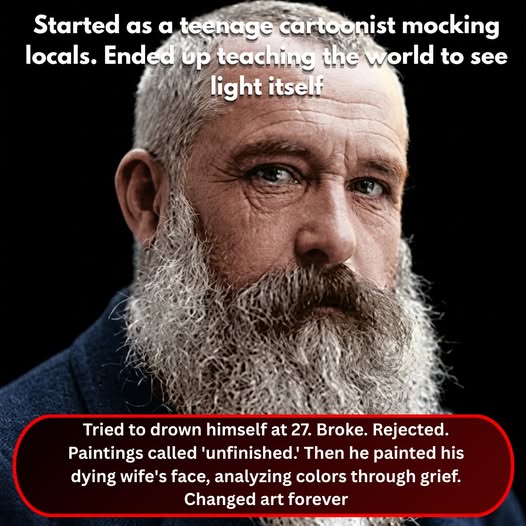
A 15-year-old boy in Le Havre, France, was getting rich.
Not from painting. From mockery.
Oscar-Claude Monet sat in cafés sketching brutal caricatures of local bigwigs—exaggerated noses, bloated bellies, pompous expressions. He charged 10 to 20 francs per portrait (about $200 in today’s money) and couldn’t keep up with demand.
“If I’d continued,” he said later, “I’d be a millionaire today.”
He displayed his work in the window of Gravier’s frame shop, where crowds gathered to laugh at the drawings. “Why, that’s so-and-so!” they’d shout, pointing.
Young Monet was bursting with pride. He was somebody. A local celebrity at fifteen.
Then a landscape painter named Eugène Boudin saw the caricatures in that same shop window.
Boudin asked to meet the talented teenager.
Monet blew him off. Repeatedly. The kid had zero interest in landscapes. Caricatures were profitable. Why waste time painting trees?
But Boudin persisted. Finally wore him down.
One summer day in 1858, Boudin dragged the reluctant teenager to Rouelles, a village outside Le Havre, and set up his easel.
Monet watched Boudin paint the sky. Actually paint it—not as a flat blue backdrop, but as a living, breathing, constantly shifting thing.
“Everything painted on the spot,” Boudin told him, “has a strength, a power, a vividness you’ll never find in the studio.”
Monet bought his first paint box that day.
“The next day,” he recalled, “I brought a canvas. I was a painter.”
By 1868, Monet had a problem.
He’d moved to Paris to become a serious artist. He’d fallen in love with Camille Doncieux, a model seven years younger. They’d had a son, Jean.
And Monet was drowning in debt.
The French Academy—the gatekeepers who decided which art mattered—kept rejecting his work. Called it “unfinished.” “Blurry.” Amateurish.
His father refused to support him financially unless he abandoned Camille and their baby.
Monet chose his family. And starved for it.
Creditors seized his paintings. His landlord evicted them. Camille and baby Jean moved to the countryside to stay with friends because Monet couldn’t afford to house them.
June 1868. Monet stood on a bridge over the Seine.
Overwhelmed. Humiliated. Unable to feed his family or sell his work.
He jumped.
The water was cold. His body sank. Then his swimming skills—automatic, involuntary—kicked in.
He surfaced. Survived.
The next day, he wrote to his friend Frédéric Bazille: “I was so upset yesterday that I was stupid enough to hurl myself into the water.“
Stupid. That’s how he described his own suicide attempt. Not tragic. Stupid.
Because nothing had changed. He was still broke. Still rejected. Still failing.
But he kept painting.
Camille became his muse. His ghost in green silk. His lady with a parasol. She appeared in dozens of paintings—elegant, ethereal, impossibly patient with a man who could barely afford canvas.
They married in 1870. Had a second son, Michel, in 1878.
Then Camille got sick.
She was 32 years old. Dying of what doctors suspected was tuberculosis or pelvic cancer. Wasting away in their home in Vétheuil.
Monet sat by her deathbed, watching her fade.
And something horrifying happened.
He started analyzing the colors.
Not consciously. Not deliberately. His artist’s eye—trained through two decades of obsessive observation—wouldn’t turn off.
Blue shadows on her temples. Yellow undertones in her skin. Gray settling into her lips. Purple where blood pooled beneath translucent flesh.
He painted her. Right there. As she died.
Forty years later, he told his friend Georges Clemenceau—former Prime Minister of France—what that moment had been like:
“I found myself staring at her tragic countenance, automatically trying to identify the sequence, the proportion of light and shade in the colors that death had imposed on the immobile face. Shades of blue, yellow, gray… Even before the thought occurred to memorize the face that meant so much to me, my first involuntary reflex was to tremble at the shock of the colors. In spite of myself, my reflexes drew me into the unconscious operation that is the daily order of my life.”
He was horrified by his own reflexes. His wife was dying, and he was studying her. Cataloging hues. Recording the way death changed light on skin.
He kept the painting for the rest of his life. Hung it in his bedroom. Never sold it. Never exhibited it.
It was too personal. Too raw. Too honest about what it meant to be an artist who couldn’t turn off the part of his brain that saw everything as color and light.
Seven years earlier—1872—Monet had painted something that would accidentally name an entire movement.
He was in Le Havre, the port town where he’d grown up mocking locals with caricatures. He looked at the harbor at sunrise.
Orange sun bleeding into hazy blue water. Ships barely visible through morning fog.
He painted it fast. Loose brushstrokes. Atmospheric. Unfinished-looking by Academy standards.
When he exhibited it in 1874, he needed a title. He called it Impression, Sunrise.
Art critic Louis Leroy saw it and laughed. Wrote a scathing review mocking the “unfinished” quality. Called Monet and his friends—Renoir, Pissarro, Degas—“Impressionists” as an insult.
The painters loved it. Wore the insult like armor.
They were Impressionists. They weren’t interested in photographic precision. They wanted to capture the “envelope”—the atmosphere, the light between the eye and the object.
A cathedral wasn’t made of stone. It was made of light hitting stone. And the light at 10 AM was fundamentally different from the light at 4 PM.
By the 1880s, Monet’s financial situation stabilized. He moved to Giverny, a village where he could finally afford space.
He became as much gardener as painter. Diverted a river branch to create a water garden. His neighbors complained—thought his “exotic” plants would poison the water supply.
Monet didn’t care. Built a Japanese bridge. Planted water lilies. White and pink blooms floating on reflective water.
For thirty years, he painted those lilies. Obsessively.
He’d set up multiple easels in a row. Paint one canvas for ten minutes. Move to the next as the sun shifted. Back to the first. The light had changed. Everything had changed.
He wasn’t painting flowers. He was painting time.
Then his biology betrayed him.
Late 60s. Monet developed cataracts in both eyes.
The vibrant world he’d spent his entire life capturing started to muddy. Whites turned yellow. Blues became murky green. Reds dulled to brown.
For a man whose entire existence was predicated on seeing color precisely, this was worse than death.
He destroyed canvases in rage. Couldn’t trust what he saw. Couldn’t paint what he couldn’t accurately perceive.
Eventually—terrified—he agreed to surgery. Early 1920s. Primitive by modern standards.
They removed the lens from his right eye entirely. Left him with aphakia—no lens to filter light.
Strange side effect: without that biological filter, Monet started seeing ultraviolet light. Colors humans aren’t supposed to see.
His late water lily paintings shifted into deep violets and spectral blues. He was literally painting a world most people couldn’t perceive.
During World War I, German guns thundering in the distance, Monet began his final masterpiece: the Grandes Décorations.
Massive wraparound canvases of his lily pond. A gift to France to celebrate the war’s end.
He wanted to create “an illusion of an endless whole, of water without horizon or shore.”
Despite failing health—despite losing his second wife Alice and his eldest son Jean—he worked on these enormous paintings until his death in 1926.
Refused to release them until they were perfect. Kept retouching. Layering paint. Never satisfied.
December 5, 1926. Claude Monet died at 86.
His old friend Georges Clemenceau arrived for the funeral. Saw a black shroud draped over the coffin.
Ripped it away. Replaced it with colorful floral cloth.
“No black for Monet!“ he shouted. “Black is not a color!“
Because Monet had spent his entire life proving that even the darkest shadows were actually deep purples, emerald greens, burnt sienna. Nothing was truly black. Everything was light.
Today, the Orangerie in Paris houses his final water lily cycles in oval rooms designed to his specifications.
Walking into those rooms feels like stepping inside someone’s mind. Like experiencing how Monet saw time itself—not as moments, but as flowing, shifting light that never stops changing.
His legacy isn’t just beautiful paintings.
It’s the liberation of the artist’s hand from photographic accuracy.
He proved that how a painter feels about light is just as real as the object itself. Maybe more real.
He paved the way for abstraction. For modernism. For the idea that art doesn’t have to represent reality—it can represent experience.
The boy who started by mocking pompous locals with cruel caricatures ended by teaching the world that the most important thing isn’t what we look at.
It’s the light that allows us to see it.
And that light is always changing. Every second. Every breath.
Monet didn’t just paint water lilies for thirty years because he liked flowers.
He painted them because they gave him an excuse to paint time. Reflection. The way morning light is completely different from afternoon light, which is nothing like evening light.
The same pond. The same lilies. The same bridge.
But never—ever—the same painting.
Because light never stops moving.
And Monet spent 86 years chasing it.
In the late 1980s, a man walked into the British Museum carrying a small piece of brown clay his father had brought home from the Middle East after the war. He didn’t know what it said. One of the world’s leading experts in ancient writing read the first few lines — and felt the room go quiet. It would be twenty years before he got it back long enough to finish reading it. What he found changed everything we thought we knew about the oldest story ever told.