
In a town of 700 people, the mayor knows your name.
He probably knows your phone number too – and in Milestone, Saskatchewan, that turns out to matter enormously.
On August 18, Mayor Jeff Brown received word that one of his constituents – a farmer named Brian Williams – had died after a brief illness. Brian had left behind a wife, three sons, and approximately 640 acres of unharvested durum wheat sitting in the fields.
Jeff Brown is also a farmer. He understood immediately what that meant.
“Mid-August is go time for crops,” he said. “And if a family is in need, the community pulls together.”
He pulled out his phone and sent a text to about ten locals – asking if anyone could help. He didn’t organize a committee. He didn’t wait for a meeting. He sent a message to people he knew, in the direct, practical way of someone who understands that grief doesn’t pause for logistics and wheat doesn’t wait for grief.
Word spread from those ten to everyone who needed to know.
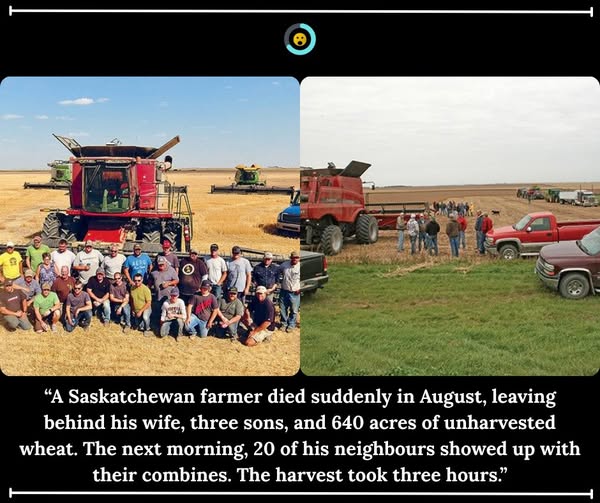
The next morning – the day after Brian Williams died – 20 farmers arrived at the Williams’ farm with their combines.
They didn’t need to be briefed or organized or assigned rows. They knew what needed doing and they did it.
In approximately three hours, they completed a harvest that would have taken the Williams family’s three sons several days to finish on their own. Rows that had been waiting – heavy with the season’s work, representing a year of planting and tending and hoping – were brought in. The grain was secured. The fields were cleared.
And then the farmers went home.
No ceremony. No press release. No expectation of recognition. Just twenty combines on a Saskatchewan morning, doing the work that needed doing for a family that was too broken by grief to do it themselves.
Mayor Brown, reflecting on it afterward, reached for the most honest explanation he had.
“Years ago, when the farming machines weren’t so big, families would get together more to help out like this,” he said. “It’s in our DNA.”
That phrase – it’s in our DNA – is worth sitting with.
Because what he was describing is not a trend or a movement or a viral moment. It is something older and quieter than any of those things. It is the accumulated habit of communities that have always understood, on a practical and physical level, that survival is collective. That a neighbour’s crisis is everyone’s problem. That when the season turns and the work is urgent and a family is too devastated to function, you don’t wait to be asked.
You show up with your equipment and you get the crop in.
Milestone, Saskatchewan has fewer than 700 people. There is no anonymity there. No passing by on the other side of the street and telling yourself someone else will handle it. Everyone is someone’s neighbour. Everyone’s grief is visible. Everyone’s fields are known.
And when a mayor texts ten people and twenty show up – that is not a surprise. That is a community working exactly as it was always designed to work.
The Williams family lost their husband and father in August.
They did not lose their harvest.
Because twenty people in Milestone, Saskatchewan remembered that love, in farming communities, has always been a practical thing – something you do with your hands, something that shows up before breakfast, something measured not in words but in acres completed and hours given and grain safely in.
“It’s in our DNA.”
It always has been. It always should be.
And somewhere in rural Saskatchewan, on a farm that could have been left to struggle through the worst kind of season, three sons and a mother came home to fields that had been tended – by neighbours who never asked for thanks and didn’t wait to be thanked.
That is the whole story.
It is also, somehow, everything a community is supposed to be.
Share this story – because twenty combines on a Saskatchewan morning remind us what it means to actually show up for each other. Not with thoughts. Not with prayers. With combines.