
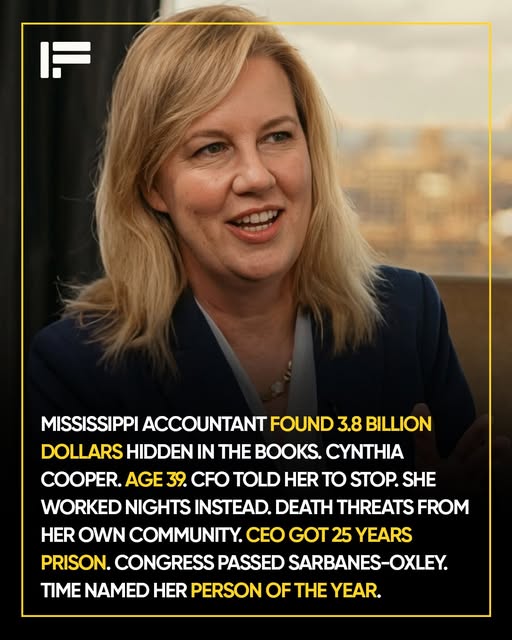
In late May 2002, in an office park in Clinton, Mississippi, an internal auditor named Cynthia Cooper opened a routine audit that would end with the largest corporate fraud in American history, the largest bankruptcy in American history, and the most significant overhaul of U.S. financial regulation since the Great Depression.
She was 39 years old. She had grown up in Clinton. Her parents had invested their retirement in the company she was about to investigate. Half her high school classmates worked there.
The company was WorldCom.
Cooper had been born in Clinton on January 1, 1963, the first person in her family to attend college. She had earned an accounting degree from Mississippi State University and a master’s in accountancy from the University of Alabama. By 2002 she held four major professional certifications: Certified Public Accountant, Certified Internal Auditor, Certified Information Systems Auditor, and Certified Fraud Examiner. She had worked at the Atlanta offices of PricewaterhouseCoopers and Deloitte & Touche before joining WorldCom’s predecessor company, *LDDS* (Long Distance Discount Services’, in 1994. The company rebranded as WorldCom the following year.
By the early 2000s, WorldCom had become the second-largest long-distance carrier in the United States. Its CEO, Bernard Ebbers, had built the company through aggressive acquisitions, capping it off with the $37 billion purchase of MCI in 1998 — at the time, the largest corporate acquisition in American history. WorldCom was the fifth most widely held stock in the country. It was also, by 2002, the only Fortune 500 company headquartered in the state of Mississippi. The entire state was proud of it. The Cinderella story of one of the poorest states in the nation.
That same year, the dot-com bubble had burst. The telecommunications industry was collapsing. WorldCom was carrying roughly $30 billion in debt. The SEC was already investigating. Bernard Ebbers had resigned on April 30, 2002.
Cynthia Cooper was the company’s Vice President of Internal Audit.
In late May 2002, her audit manager, Glyn Smith, suggested they move up the team’s planned capital expenditure audit. He had been reading about questionable spending and wanted to look closer. Cooper agreed.
What her small team found, when they pulled the records, did not make sense.
A corporate finance director mentioned a category called “prepaid capacity.” Cooper, with two decades of accounting work behind her, had never heard the term. One of her auditors, Gene Morse, dug deeper into the accounting system and found enormous transfers of money — transfers from the income statement to the balance sheet. Operating expenses, which are required by accounting rules to be expensed immediately, were being reclassified as long-term capital assets.
This is the textbook way to lie about a company’s profitability. You take normal operating costs that would reduce your earnings and you hide them on the balance sheet as if you had built a factory. The earnings look better. The stock holds. The bonuses keep coming.
The numbers Cooper’s team kept finding were not small. They were not in the millions. They were in the billions.
The pressure began almost immediately.
WorldCom’s controller, David Myers, sent Cooper an email telling her that her team was wasting its time, that she should be auditing other parts of the company. The audit committee chair told her to wait for the chief financial officer, *Scott Sullivan*, to call her. Sullivan was, at the time, one of the most celebrated CFOs in America — CFO Magazine had named him CFO of the Year. He had been the highest-paid finance executive in the country. When Sullivan eventually contacted Cooper, his demeanor swung between hostile aggression and elaborate technical justification.
Cooper kept going.
Her team began working at night. They came in after the executives had left for the day. They pulled financial records while the building was empty. They knew that what they were looking at was extraordinary, and they knew that the people who had built it would do whatever was necessary to stop them.
By June 10, 2002, they had documented dozens of fraudulent “prepaid capacity” entries. The pattern stretched from 2001 through the first quarter of 2002. They called WorldCom’s external auditor, KPMG, which had recently replaced the disgraced Arthur Andersen firm. KPMG took one look and confirmed what Cooper already knew.
There was no Generally Accepted Accounting Principle that justified what WorldCom had done. There was no documentation. There was no defense.
It was, by the only definition that mattered, fraud.
The total: $3.8 billion in improperly capitalized operating expenses.
On June 20, 2002, Cooper and Glyn Smith flew to Washington, D.C. and presented their findings to WorldCom’s audit committee. Scott Sullivan sat in the room. He attempted to defend the entries with a technical argument about something called the matching principle. He proposed a restructuring charge. KPMG, sitting across the table, dismissed the defense in flat terms.
The board gave Sullivan the weekend to write a white paper defending himself. After reading it, they asked him to resign.
On June 25, WorldCom briefed the SEC. On June 26, the company admitted publicly that it had overstated its income by $3.8 billion.
It was, at that moment, the largest accounting fraud in American history.
On July 21, 2002, WorldCom filed for Chapter 11 bankruptcy. It was, at that moment, the largest bankruptcy in American history. Eventually, roughly 30,000 employees lost their jobs. Pension funds across the country, loaded with WorldCom stock at $64 per share, watched the price collapse to less than a dollar.
Cooper had not wanted to be public. She gave no interviews. But on July 17, 2002, she testified before the House Energy and Commerce Subcommittee on Oversight and Investigations. A congressman released her internal audit memos to the press. Her name was out.
The threats began. Anonymous death threats against Cooper and members of her team. Security was increased around her family. The community in Clinton — her hometown, her neighbors, her friends, her parents’ friends — split. Some saw her as a hero. Others blamed her for killing the company. They blamed her for the lost jobs, the wiped-out retirement accounts, the collapse of the pride of Mississippi.
She had not killed the company. She had reported the fraud that had already killed it.
In December 2002, TIME magazine named Cynthia Cooper one of three Persons of the Year. She shared the honor with Sherron Watkins, who had blown the whistle on Enron, and Coleen Rowley, the FBI agent who had exposed the Bureau’s pre-9/11 intelligence failures. TIME called the cover story “The Whistleblowers.“ Cooper had refused to participate at first. She agreed only when she was told she would meet Watkins and Rowley.
Eventually, the full scope of the WorldCom fraud was uncovered. The company had not overstated its income by $3.8 billion. The eventual figure was over $11 billion in misstated financials over a period of years, directed by senior management.
In March 2005, Bernard Ebbers was convicted of fraud, conspiracy, and filing false documents. He was sentenced to 25 years in federal prison. He was 63 at sentencing. Scott Sullivan, who cooperated with prosecutors, received five years.
In July 2002 — even before the bankruptcy filing was complete — Congress passed the *Sarbanes-Oxley Act*. President George W. Bush signed it into law on July 30. It was the most sweeping investor-protection legislation since the Great Depression. CEOs and CFOs were now personally required to certify their company’s financial statements under threat of criminal liability. Internal controls had to be assessed and reported on annually. Penalties for corporate fraud were dramatically increased. A new oversight board for auditing firms was created.
The most consequential provision in the entire bill, *Section 404*, requiring assessment of internal controls, was added by the Senate specifically in response to the WorldCom revelations — the bill that had passed the House before WorldCom did not contain it.
Sarbanes-Oxley exists, in the form it exists, because of what Cynthia Cooper found while working nights in Mississippi.
Cooper stayed at the company through its bankruptcy and through its emergence as MCI in 2004. Most whistleblowers leave within a year. She stayed until most of her staff had found new positions. Then she left.
In 2008, she published her memoir Extraordinary Circumstances: The Journey of a Corporate Whistleblower. She donated all her profits to high schools and universities for ethics education. In 2020, TIME named her one of the 100 most influential women of the last hundred years.
In Cooper’s own retelling of the story, the moment that mattered most was a conversation with her mother before she went forward to the audit committee. Her mother had told her one thing.
“Don’t ever allow yourself to be intimidated.“
She didn’t.