
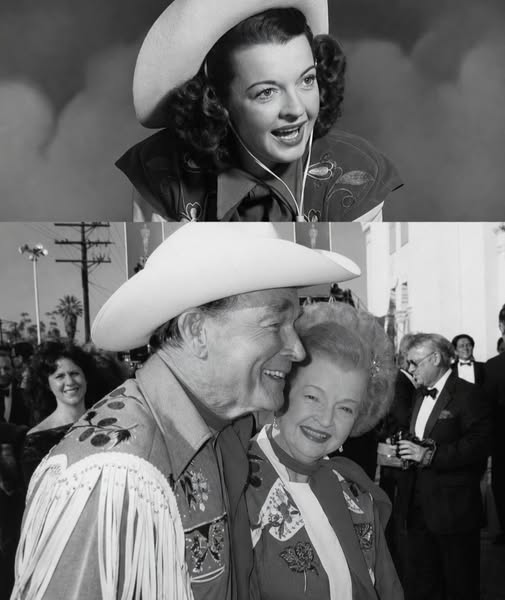
In 1927, fifteen-year-old Dale Evans—then still Frances Smith—sat alone in a Memphis hospital, holding her newborn son. She had eloped at fourteen with a boy just two years older, and by fifteen she was already facing the consequences alone. He had left her before. This time, he wasn’t coming back.
She had no money, no real support, and no clear path forward. Most girls in her position quietly disappeared into lives defined by struggle and silence. But Frances had something that refused to let her fade away: a voice that made people stop and listen.
So she started singing—anywhere she could. Small gigs, local radio, anything that paid. It wasn’t glamorous, but it was a beginning.
Frances Octavia Smith had been born in 1912 in Uvalde, Texas, into a warm Baptist household. She’d been singing in church since she was three years old. Bright and determined, she skipped grades and often seemed older than she was. That same determination led her, at fourteen, to convince a clerk she was old enough to marry. A year later, she was a mother. By seventeen, she was divorced and working as a secretary in Memphis, trying to survive.
One day, her employer heard her singing quietly at her desk. That moment changed everything. He helped her get on local radio, where she began performing under names like “Frances Fox” and “Marian Lee.” She sang whatever audiences wanted—jazz, swing, big band—adapting, learning, growing.
In the early 1930s, she moved to Louisville, Kentucky, chasing bigger opportunities. There, a radio station manager suggested a new name: Dale Evans. Frances hesitated—“Dale” sounded like a man’s name—but he insisted it was memorable and modern. Reluctantly, she agreed.
And Dale Evans began to rise.
By the early 1940s, she had reached Chicago and then Hollywood. She signed with 20th Century Fox, appeared in small film roles, and performed on major radio shows. But success came with a harsh condition. Her son, Tommy, was now a teenager—and Hollywood had strict expectations for its leading ladies. They had to appear unattached, desirable, and free of complications.
A single mother didn’t fit that image.
Her agent told her to remove her wedding ring and, if asked, claim her son was her younger brother. It was a cruel demand, but losing her career meant losing the only way to support him. So she agreed.
For years, Dale Evans lived a double life. Publicly, she was a rising star. Privately, she was a mother who couldn’t be called “Mom” in public. It was the price she paid to keep going.
In 1944, her life shifted again when she was cast opposite Roy Rogers in The Cowboy and the Señorita. There was just one problem—she had never ridden a horse.
During her first scene, she struggled to stay in the saddle, bouncing awkwardly as she followed Roy downhill. When it was over, he joked that he’d never seen so much space between a rider and a horse. Dale took lessons, improved quickly, and the film became a success.
Audiences loved them together. Over the next few years, they made 29 films, becoming one of Hollywood’s most beloved on-screen duos—the cowboy and his sharp, spirited cowgirl.
Off-screen, life was far less simple. Dale’s third marriage ended in divorce in 1945. Roy lost his wife in 1946. A year later, while sitting on horseback before a rodeo performance in Chicago, Roy proposed.
She said yes.
They married on New Year’s Eve in 1947. At last, Dale no longer had to hide. Her son could call her “Mom” again. She became stepmother to Roy’s children, and in 1950, they welcomed a daughter together, Robin.
Robin was born with Down syndrome and serious heart complications. At the time, doctors often advised parents to institutionalize children with disabilities—hide them away, out of sight. Roy and Dale refused. They brought Robin home, loved her openly, and shared her life with the world.
For two years, she filled their home with joy. Then, just days before her second birthday, she passed away.
The loss was devastating. But instead of retreating into silence, Dale turned her grief into something meaningful. She wrote Angel Unaware, a book told from Robin’s perspective in heaven. It challenged how people viewed children with disabilities, presenting them as blessings rather than burdens. The book became a bestseller and helped shift public attitudes.
Tragedy, however, did not stop there.
In 1964, their adopted daughter Debbie died in a bus accident at twelve years old. A year later, their adopted son Sandy died at eighteen while serving in the military.
Three children, gone.
And still, Dale endured.
She kept singing. Kept writing. Kept showing up—just as she had since she was a teenager with nothing but a voice and determination.
In 1950, moments before a radio broadcast, she quickly scribbled lyrics onto an envelope and taught a melody to Roy and the group performing with them. That song became “Happy Trails.”
It would go on to define their legacy—closing every episode of The Roy Rogers Show and becoming one of the most recognizable Western songs in American culture.
“Happy trails to you, until we meet again…”
Those words carried weight, because Dale understood them deeply. Life had not been easy. It had been marked by hardship, loss, and sacrifice. But she kept moving forward anyway.
Dale Evans passed away in 2001 at the age of 88. By then, she had written more than 20 books, recorded hundreds of songs, and been honored in the National Cowboy Hall of Fame.
She had faced poverty, abandonment, and the pressures of Hollywood. She had lost three children. And through it all, she never stopped singing.
Because for Dale Evans, singing was never about an easy life.
It was about surviving a hard one—and choosing to keep going anyway.