
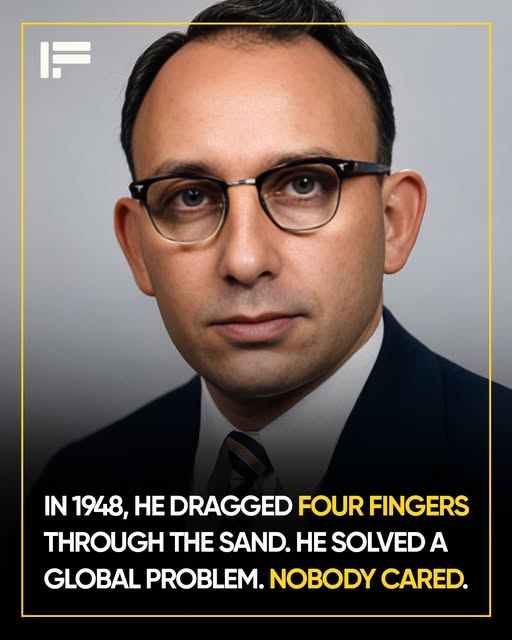
In 1948, a 27-year-old engineer sat on a Miami Beach shoreline and dragged four fingers through the wet sand.
The ocean water immediately filled the narrow trenches. He watched the lines settle into the grit.
He had just solved the largest bottleneck in American retail.
His name was Norman Joseph Woodland.
A few months earlier, the president of a regional supermarket chain had walked onto the Drexel Institute campus in Philadelphia looking for an engineering solution to a financial hemorrhage.
Post-war supermarkets were expanding rapidly, carrying thousands of items. Checkout lines stretched down the aisles. Cashiers had to memorize or manually type the price of every tin, box, and bottle. Errors were costing the industry millions every quarter.
The executive asked the dean to build an automated machine to read product prices. The dean declined. The university did not accept commercial retail projects.
Bernard Silver, a graduate student, overheard the conversation and relayed the problem to Woodland.
Woodland dropped out of graduate school the following week. He emptied his savings and moved to his grandfather’s apartment in Miami Beach to work on the problem full-time.
Their first attempt was chemical. They formulated a specialized ultraviolet ink and painted it onto sample grocery labels. The system technically functioned, but the ink was unstable. Standard warehouse heat degraded the formula. Printing specialized ultraviolet ink onto millions of disposable paper labels was economically impossible.
They needed a structural solution that could be printed with cheap, standard black ink.
Woodland spent his mornings walking the Florida coastline, thinking about Morse code from his Boy Scout days. He knew two variables — dots and dashes — could represent the entire alphabet.
Sitting in the sand, he realized he could stretch a dot downward into a narrow vertical line and a dash into a thick vertical line.
He pressed four fingers into the sand and pulled them toward his body. The parallel tracks remained. He drew a circle around them. His first design was a bullseye. A circular pattern could be scanned from any angle.
In October 1949, Woodland and Silver submitted an application for a “Classifying Apparatus and Method.”
They returned to Philadelphia to build a physical prototype in Woodland’s living room.
They needed massive illumination to read the light reflection off the black and white paper. Lasers did not exist. They purchased a 500-watt incandescent light bulb — the exact model used in cinema projectors. They rigged it to an RCA-931 photomultiplier tube originally designed to read audio tracks on motion picture film.
They slid a piece of paper with the printed lines past the blazing light. An oscilloscope recorded the bounce. It worked. The machine read the lines and translated them into an electronic signal.
The prototype was the size of a standard desk. The 500-watt bulb generated dangerous heat. During testing, the bulb routinely set the paper labels on fire.
The patent office formally granted US Patent 2,612,994 in October 1952.
Woodland took the patent documentation to IBM. He asked the corporation to buy the rights and manufacture the system.
IBM’s engineering division evaluated the prototype. They agreed the underlying logic was sound. They also told him it was commercially useless.
To function in a neighborhood grocery store, the system needed a bright, highly focused light source that didn’t generate destructive heat. It also needed a localized computer small enough to process the signals at the register.
Neither of those technologies existed in 1952. IBM declined the offer.
Woodland had exhausted his personal savings. He needed a stable income.
He sold the patent in 1952 to the Philco Corporation for $15,000. Silver took his half. Woodland took the remaining $7,500. It was enough to help buy a modest house. He never saw another dollar from the intellectual property. Philco eventually sold the patent to RCA.
Woodland accepted a salaried engineering job at IBM. He filed his employment paperwork and went to work on unrelated projects.
The 1950s passed. Cashiers continued to type prices by hand.
In 1960, the first working optical laser was successfully demonstrated in a laboratory. It provided the exact cold, focused light his invention required.
By the late 1960s, early microprocessors were entering commercial manufacturing. The processing power required to decode the printed lines could finally fit on a checkout counter.
The patent expired in 1969. The intellectual property entered the public domain. The $15,000 payment was the only financial transaction attached to his name.
In 1970, the grocery industry formed an ad hoc committee to standardize an automated checkout system. IBM submitted a corporate proposal. They placed Woodland on the development team. He was fifty years old.
Another IBM engineer, George Laurer, evaluated Woodland’s original bullseye design. Laurer flattened the circles into the vertical rectangular bars we recognize today. The rectangles were less prone to ink smearing during the high-speed cardboard printing process.
On June 26, 1974, a cashier named Sharon Buchanan stood at a register in the Marsh Supermarket in Troy, Ohio.
A customer placed a ten-pack of Wrigley’s Juicy Fruit chewing gum on the counter.
Buchanan slid the yellow package over a flat glass scanner embedded in the counter. A red helium-neon laser beam hit the printed lines. The register chimed. The receipt printed the price: sixty-seven cents.
It was the first commercial scan in history. The pack of gum is now held in the archives of the Smithsonian Institution.
He invented the future twenty-five years before the world built the tools to read it.
Today, the system he mapped out in the sand is scanned ten billion times every twenty-four hours.
It tracks global shipping containers crossing oceans. It processes patient medical wristbands in hospital wards. It logs the milk in your refrigerator.
Woodland retired from IBM in 1987. He died in 2012 at the age of ninety-one.
He lived out his life in a quiet residential neighborhood in New Jersey. His obituary in the local newspaper noted his long career in mechanical engineering.
The grocery stores in his town used the scanners. He waited in the same lines as everyone else.