ChatGPT said when I asked about the post and requested more specifics that would make it more useful:
That Facebook post is…dramatic. There’s a real tradition behind it, but it’s been dressed up with a lot of survivalist exaggeration.
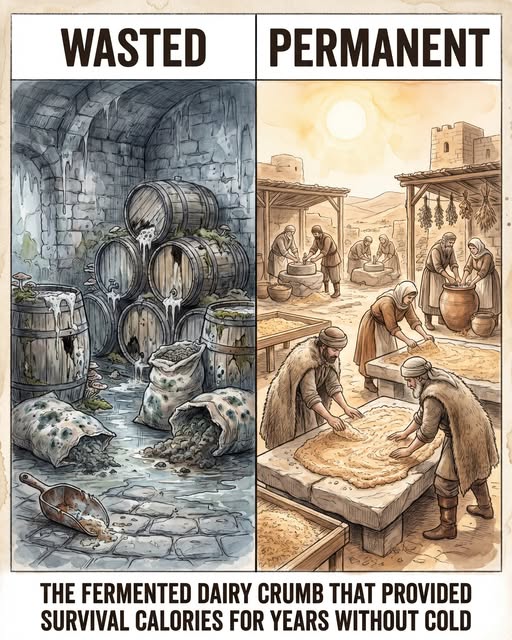
The food they’re referring to is Tarhana, a long-established staple in parts of Türkiye and surrounding regions. It is a clever preservation method combining fermentation and drying—but it’s not magic, and it doesn’t make dairy “infinitely shelf-stable” without care.
Here’s a grounded, practical, and much more fool-proof way to make it safely.
What’s actually happening (in plain terms)
You mix yogurt (lactic acid bacteria) with grains and vegetables.
Natural fermentation acidifies the mixture (lowering pH).
That acidity + drying inhibits spoilage organisms.
The final product is a dry, sour, shelf-stable powder, not raw dairy anymore.
Ingredients (reliable baseline)
Use consistent, clean ingredients to reduce risk:
1 kg plain yogurt (unsweetened, ideally full-fat)
500–700 g cracked wheat (bulgur) or wholemeal flour
1–2 onions (finely chopped or grated)
2–3 cloves garlic (optional)
1–2 capsicum or mild chilli (optional)
Salt (about 1–2% of total mix by weight)
Optional herbs: mint, thyme
Step-by-step process (safe and repeatable)
1. Prepare the base
If using bulgur, soak it in warm water for 30–60 minutes until softened.
If using flour, no soaking needed.
Mix everything together into a thick paste—like a very dense batter.
2. Fermentation (critical stage)
Place mixture in a clean, non-metal container (ceramic, glass, or food-grade plastic).
Cover loosely (cloth or lid not fully sealed).
Leave at 18–25°C (room temp) for 3–7 days.
During fermentation:
Stir once or twice daily.
You should notice:
Sour smell (like yogurt or mild sourdough)
Slight bubbling early on
Thickening consistency
What you do NOT want:
Putrid, rotten, or “meaty” smells
Visible mould (green/black/pink fuzz) ? discard immediately
3. Acidification check (important for safety)
Traditionally done by taste/smell, but for reliability:
It should taste distinctly sour
If you want to be precise: target pH below 4.5
This acidity is what suppresses harmful microbes.
4. Drying (preservation step)
Spread the fermented paste in thin layer (1–2 cm thick max):
Options:
Sun-dry (traditional): several days, covered with mesh to keep insects off
Dehydrator: ~40–50°C until fully dry
Oven: lowest setting with door slightly open
Break it up occasionally as it dries.
End point:
Completely dry
Hard, crumbly, no soft or moist pockets
Moisture is the real enemy here—if it’s not fully dry, it can spoil.
5. Final processing
Crush or grind into coarse powder or small chunks.
Store in:
Airtight containers
Cool, dry, dark place
Shelf life (realistic, not mythical)
Properly dried tarhan lasts: 6–12 months easily, longer if:
Very dry
Stored airtight
Kept cool
It’s not infinite but it is very robust.
How to use it
Mix a handful with water or stock
Simmer 10–15 minutes
Becomes a tangy, nutritious soup
Important safety notes
Fermentation does not kill all pathogens instantly—it reduces risk through acidity and competition.
Cleanliness matters:
Wash hands, utensils, containers
Salt helps control unwanted microbes—don’t skip it.
If in doubt at any stage, discard. It’s not worth the risk.
Bottom line: The traditional method is genuinely clever: Fermentation + drying = long-lasting, portable nutrition but the Facebook version overstates it. Think of tarhana as a well-preserved, fermented food, not a “microbial vault that lasts forever.”