
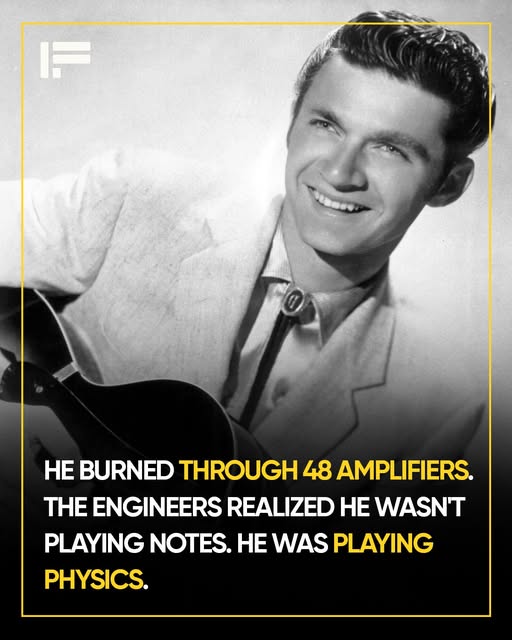
In 1960, a 23-year-old guitarist handed a technician a smoking box of shredded paper and melted wire. It used to be a speaker.
His name was Dick Dale.
He lived in Southern California, riding heavy Pacific swells by day and playing guitar in crowded dance halls by night. But the amplifiers of the early 1960s were polite machines built for quiet jazz rooms and country picking. They could not survive the physical violence of the ocean that lived in his music.
Dale played left-handed on a right-handed guitar strung with heavy piano-wire strings up to .060 gauge. He turned the volume to maximum. He hit a single chord. The paper cone inside the speaker violently detached. The voice coil caught fire.
He packed the ruined box into his car and drove it to Leo Fender.
Fender gave him a stronger speaker. Dale took it to the Rendezvous Ballroom. The room held three thousand people. He blew the speaker out in two days.
Fender went back to his workbench. He built a 100-watt output transformer — power unheard of for a single musician. He paired it with a heavy-duty 15-inch speaker.
Dale pushed the volume until the glass tubes glowed blue. The speaker cone tore straight down the middle. The coils fused together.
This became their routine. Over the next year, Dale destroyed forty-eight amplifiers. He brought the smoking carcasses back to Fender’s shop in Fullerton, leaving them on the floor like casualties.
Fender stopped trying to fix old designs. He called in acoustic engineers from James B. Lansing. They examined the shredded cones and realized they were not dealing with a traditional musician. They were dealing with a force of physics.
They designed the JBL D130F with a massive internal magnet and reinforced metal frame. Fender built an entirely new cabinet with a specific acoustic baffle to contain the internal air pressure. They named the rig the Dual Showman.
They gave it to Dale. He carried it onto the stage. He turned it all the way up. He struck the thickest string.
The walls shook. The floorboards vibrated. The speaker held.
The mechanical standard he established became the baseline for live music. But it took a physical toll. He played so hard his plastic picks melted against the strings. His fingers bled during performances. He permanently damaged his hearing, trading his own eardrums for the volume he wanted.
He didn’t just want to be heard. He wanted to be felt.
The hardware they built him became the blueprint for the next fifty years of sound. Every stadium act that followed was standing on the wreckage of those forty-eight burned-out speakers.
Dick Dale died in 2019. The amplifiers he forced into existence are still sitting in studios around the world. Most of them carry a small warning label near the volume dial.